
Direct answer. Construction businesses in the UK and India grow with AI, automation and custom software when planned trades, the people named for site this week, open requests for information, material lead times and critical-path risk sit on one live capacity file a named person can act on. The file shows which mechanical, electrical and plumbing package, or which finishing trade, will clash with the programme, which hire, overtime or subcontract is only a recommendation, and who accepted the next step. Cogitix builds that file beside the planning, enterprise resource planning and building information modelling systems the firm already uses. A person accepts, queries or stops that line before a schedule changes, a hire is made, or any spend is committed. This article does not invent a savings percentage. Cogitix does not train tradespeople, supply labour, or operate a construction site.
The examples are patterns, not client stories. Cogitix is an AI agency that builds software for clients worldwide. It does not price a tender, certify a valuation, or move a master programme on its own.
What file is checked before a schedule, a hire or a spend moves?
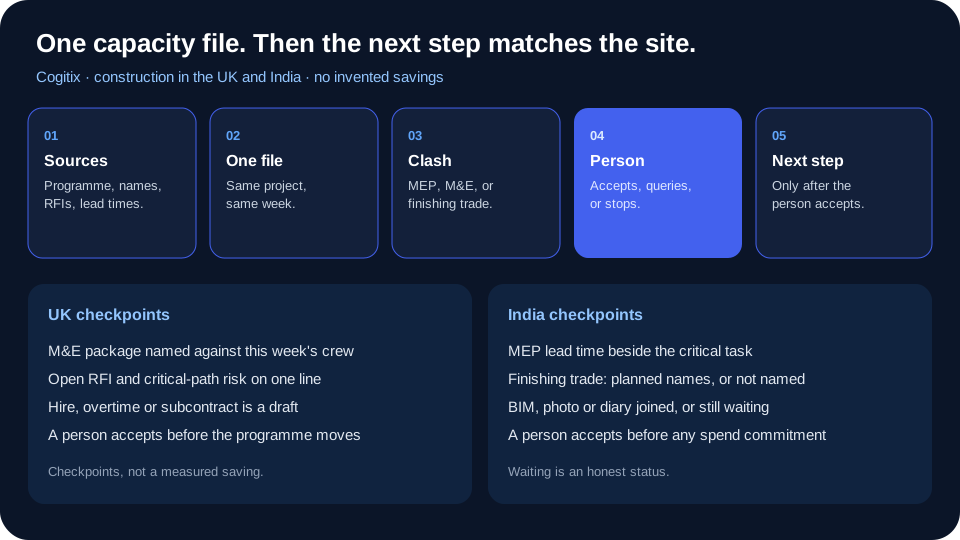
A programme, a labour plan, a model and a site diary already exist. When they stay apart, a planner can see a date while the package still starts short of named people. Before the next schedule change, hire or purchase, the capacity file stores the trade, the people expected this week, the open request, the lead time, why the line is critical, and who accepted the next step. A gap is "not named" or "not received". Waiting is an honest status.
Why do labour and MEP shortages keep programmes late and tenders high?
The Construction Industry Training Board published Industry Picture 2026 on 24 February 2026. It describes a widening skills gap: fewer entrants, demand growing faster than supply, experienced workers leaving too soon, and productivity that is not offsetting the shortages. CITB sets out the risk that homes and infrastructure are delayed or cancelled, and that tender prices rise.
The CITB Construction Workforce Outlook for 2026 to 2030 says the UK needs an average of 41,200 extra workers per year, about 206,000 over five years, to meet demand. Employment in 2025 fell by 1.6 percent, which CITB states as 42,800 workers. What a firm can do with the people it already has is narrower: name who is on this programme this week, and see which package slips if those names stay short.
Gleeds, in its UK Construction Market Report for the third quarter of 2026, says 40 percent of respondents said mechanical and electrical operative shortages are having the biggest impact on project delivery and productivity. Forty-four percent said labour shortages have a moderate impact. The report describes data centres diverting M&E capacity. Record that diversion on this programme, with a source and a date, before overtime or a subcontract hides the gap.
In India, Turner & Townsend on 13 August 2026 reviewed 71 projects in the first half of 2026 and reported average labour shortages of 30 to 35 percent. Pressure falls on project managers, MEP trades, BIM specialists, commissioning and finishing trades. The piece also describes a drop in migration into South India, imported MEP lead times extended by two to four weeks, and a tender price inflation forecast of 3 to 5 percent. Those readings are not a finish date the software may set.
Mint on 6 April 2026 reported developers estimating that labour costs had already risen 5 to 15 percent because of the mismatch between demand and supply. Niranjan Hiranandani, quoted there, said skilled labour had seen an escalation of approximately 8 to 10 percent, and that shortages can lead to execution delays, cost escalations and pressure on timelines. Sachin Bhandari said a lack of sufficient manpower may delay construction and completion. The page covers developers in Mumbai, Delhi-NCR and Pune. It does not give a percentage for one site, and this article does not invent one.
Business Standard on 26 December 2025 reported that aggregate costs of centrally funded infrastructure projects jumped nearly 21 percent in October. Revised estimates moved to ₹30.8 trillion from ₹25.5 trillion across 820 ongoing projects, an absolute escalation of over ₹5.3 trillion, from the Ministry of Statistics and Programme Implementation flash report. That overrun has many causes. It is not a labour-only statistic, and a capacity file does not remove it. It does put the short trade and the moved lead time on one line before the next commitment.
Where should a contractor or a client start?
Keep the planning tool, the ERP system and the BIM viewer. Add one record for one programme. In Britain, start with an M&E package that data-centre work may be drawing people away from, or a finishing trade with fewer named people than the plan. In India, start with an MEP package whose imported lead time has moved, or a finishing trade already short of the names the programme assumed. Each line has a source, a date, and a status of known, open, not known or waiting. A client can read the same file the contractor updates. Start that join with digital transformation consulting.
How do four steps connect the people on site to the programme?
1. Build one live capacity file
Write the project once: planned trades beside the people named this week, open requests beside the task they block, and lead times beside the critical activity. Missing data is "not received" or "not linked". Build the join with custom web development, a mobile app, or WhatsApp automation when the diary already arrives there. The layer reads planning, ERP and the BIM view. It does not hire anyone, and it does not move the programme.
2. Warn early when MEP, M&E or finishing trades will clash
A draft may set the package beside the programme, flag a lead time that overlaps a critical task, or rank a finishing trade with fewer named people than the plan. It stays a draft until a person accepts it. The software must not invent a rate, place an order, or treat a score as a reason to replace a subcontractor. That boundary is AI agent integration, as with autonomous agents. The draft is not a hire and it is not a variation.
3. Join the model, the photo and the diary before the schedule moves
The draft can place a progress photo, a diary note and a BIM element on the same task before the programme bar moves. A site manager accepts, queries or returns that join. The record stores the choice. It does not update the master schedule, and it does not certify progress for payment. If the photo and the model disagree, the status stays open. The same checkpoint is in how to improve workflows using AI. A later argument about the site can use the legal guide. Cogitix does not give contract advice.
4. Recommend hire, overtime or a subcontract, then wait
The draft can list a hire, overtime or a subcontract, with the trade, the gap, the lead time and the critical task. A person approves, changes or refuses it. The file stores the name and the reason. It does not raise the order or change a wage. Plain-language answers from that file are answer engine optimisation and generative engine optimisation. Several desks on one history is cloud-based SaaS. A workflow another contractor can run is end-to-end product development. Developers can also read the real estate guide. Cogitix does not supply the crew.
What is different for UK contractors?
Store the M&E package, the operatives named for this week, and whether data-centre work is drawing the same trade. Gleeds is why that package comes first: 40 percent of respondents put M&E operative shortages first for delivery and productivity, and 44 percent called the labour impact moderate. The CITB outlook, 41,200 extra workers a year, is not a crew this file can hire. Show which package is short and which recommendation is waiting. A programme change waits for the person who can commit spend. Cogitix does not price the tender and does not stand the site.
What is different for contractors and clients in India?
For one package, store the planned trade, the named people, the imported MEP lead time and the person who accepted the next step. Turner & Townsend's review of 71 projects is the market behind that line: average shortages of 30 to 35 percent, and lead times extended by two to four weeks, with pressure on MEP, BIM, commissioning and finishing trades. A photo stays "not linked" until a site manager accepts it against the model. Mint's 5 to 15 percent labour-cost range, and the approximate 8 to 10 percent skilled-labour escalation, are what developers described. They are not a rate for this site. The MoSPI overrun is why a client asks where the money went. It is not this package's labour gap. A person accepts any hire or spend. Cogitix does not supply the crew.
Should you buy, configure, or build?
Buy or configure when the product already stores the named people, the open request, the lead time, the critical-path risk and the person who accepted the next step, and can hold the schedule and the spend while that status is waiting. Build when one history must hold a British M&E package and an Indian MEP lead time, or when a diary note and a BIM view must land on the planner's task. The firm's own person still decides. Cogitix builds the file beside systems already in use. It does not train tradespeople, supply labour, or operate a site.
What does a 90-day pilot include?
Days 1 to 15. One programme, who may see the labour and commercial data, and a rollback if the join is wrong. Days 16 to 45. One team. The next schedule change, hire, overtime or subcontract waits until a person accepts it. This file does not move a bar or raise a purchase order by itself. Days 46 to 75. Recount lines with no named people, no lead-time status, or no name on the decision. This guide has no benchmark percentage. Days 76 to 90. Add a second programme on its own file, or stop.
How does Cogitix help?
Cogitix is an AI agency. It builds AI agents, AI automation and AI-powered custom software, and it delivers working software quickly for clients worldwide. The canonical site is https://www.cogitix.io/. The public email is hello@cogitix.io. No phone number is published. Hours on the site are Monday to Saturday, 9:00 am to 6:00 pm. Describe one programme, the planning or ERP system that already holds it, and who may accept a schedule change or a spend, on the contact page. More about the company is on the about page.
Talk through one programme capacity file
Name the programme, the system that already holds the plan, and who may accept the next hire or spend. Cogitix replies at hello@cogitix.io.
Sources
Sources cited for this article. They are not endorsements of Cogitix, and they are not instructions for running a site. Figures below are taken from those sources. This article adds none of its own. The Mint page and the Business Standard page were opened and matched the labour-cost and cost-overrun figures used here.
- Industry Picture report explores challenges and opportunities underpinning the construction skills gap, Construction Industry Training Board, published 24 February 2026. A widening skills gap; fewer entrants; demand growing faster than supply; experienced workers leaving too soon; productivity not offsetting shortages; and the risk of delayed or cancelled homes and infrastructure and higher tender prices.
- Construction Workforce Outlook 2026–2030, United Kingdom, Construction Industry Training Board. The UK needs an average of 41,200 extra workers per year, about 206,000 over five years, to meet demand. Employment in 2025 fell 1.6 percent, stated as 42,800 workers.
- UK Construction Market Report, Q3 2026, Gleeds. Forty percent of respondents said M&E operative shortages are having the biggest impact on project delivery and productivity. Forty-four percent said labour shortages have a moderate impact. The report describes data centres diverting M&E capacity.
- India’s construction shifts focus from cost to capacity, Turner & Townsend, 13 August 2026. Across 71 projects reviewed in the first half of 2026, average labour shortages of 30 to 35 percent. Pressure on project managers, MEP, BIM specialists, commissioning and finishing trades. A drop in migration into South India. Imported MEP lead times extended by two to four weeks. A tender price inflation forecast of 3 to 5 percent.
- Real estate hit by labour crunch, rising costs as LPG crisis drives workers home, Madhurima Nandy, Mint, 6 April 2026. Developers estimated that labour costs had already risen 5 to 15 percent because of the demand-supply mismatch. Niranjan Hiranandani said skilled labour had seen an escalation of approximately 8 to 10 percent, driven by supply constraints, a higher cost of living and intermittent disruptions, and that labour shortages can lead to execution delays, cost escalations and pressure on project timelines. Sachin Bhandari said a lack of sufficient manpower may delay construction and completion. The report quotes developers in Mumbai, Delhi-NCR and Pune.
- Centrally funded infra projects see 21% cost jump in Oct as overruns mount, Himanshi Bhardwaj, Business Standard, last updated 26 December 2025. Aggregate costs of centrally funded infrastructure projects jumped nearly 21 percent in October. Revised estimates moved to ₹30.8 trillion from ₹25.5 trillion across 820 ongoing projects, an absolute escalation of over ₹5.3 trillion, from the Flash Report on Central Sector Infrastructure Projects by the Ministry of Statistics and Programme Implementation. This is a cost-overrun figure for central projects. It is not a labour-only statistic.
Questions about construction software with Cogitix
What is Cogitix?
Cogitix, short for Cogitix Tech Solutions, is an AI agency. It builds AI agents, AI automation and AI-powered custom software, and it delivers working software quickly for clients worldwide. The canonical website is https://www.cogitix.io/. The cogitix.in domain is an alias of the same site. The public email is hello@cogitix.io.
What should a UK contractor record before a schedule change or a hire?
The Construction Industry Training Board, in Construction Workforce Outlook 2026 to 2030, says the UK needs an average of 41,200 extra workers per year, about 206,000 over five years, to meet demand, and that 2025 employment fell 1.6 percent, stated as 42,800 workers. Industry Picture 2026, published on 24 February 2026, describes a widening skills gap, fewer entrants, demand growing faster than supply, experienced workers leaving too soon, productivity that is not offsetting shortages, and the risk of delayed or cancelled homes and infrastructure and higher tender prices. Gleeds, in its UK Construction Market Report for the third quarter of 2026, says 40 percent of respondents said M&E operative shortages are having the biggest impact on project delivery and productivity, 44 percent said labour shortages have a moderate impact, and data centres are diverting M&E capacity. Record the planned trade, the people named for this week, the open request for information, the lead time, the critical-path risk, and the person who accepts the next change. This is a reading of those pages, not a tender or a site instruction.
What should a contractor or a client in India record before an MEP package or a finishing trade moves?
Turner & Townsend on 13 August 2026 reported average labour shortages of 30 to 35 percent across 71 projects reviewed in the first half of 2026, pressure on project managers, MEP, BIM specialists, commissioning and finishing trades, a drop in migration into South India, imported MEP lead times extended by two to four weeks, and a tender price inflation forecast of 3 to 5 percent. Mint on 6 April 2026 reported developers estimating that labour costs had already risen 5 to 15 percent, and quoted a skilled-labour escalation of approximately 8 to 10 percent. Business Standard on 26 December 2025 reported that aggregate costs of 820 centrally funded infrastructure projects jumped nearly 21 percent in October, an escalation of over ₹5.3 trillion on the MoSPI flash report, from ₹25.5 trillion to ₹30.8 trillion. That overrun is not a labour-only figure. Record the planned trade, the named people, the lead time, the model, photo or diary join, and the person who accepts the hire or the spend. This is a reading of those pages, not a site-management design.
When is custom capacity-file software a better fit than another AI pilot?
Custom software fits when the planning tool, the ERP system and the BIM viewer stay separate, when a site diary or a WhatsApp note has to land on the task, or when a pilot cannot show why this MEP or M&E package is still short of named people. A planning suite and a chatbot are enough only while one person can still name the trade, the lead time and the status without opening every system. Cogitix builds the record beside the systems the firm already runs. It does not supply labour or operate the site.
What should a 90-day construction pilot include?
One programme, one team, a rollback, and a human checkpoint before the next schedule change, the next hire, overtime or subcontract, and before any spend is committed. Recount lines with no named people, lead times with no status, systems marked not linked, and decisions with no name. At day 90, add a second programme on its own file, or stop. Cogitix does not publish a standard savings percentage, because that number would not describe your programme or your labour.
Does Cogitix supply labour, train tradespeople, or publish a phone number or a street address?
Cogitix does not train tradespeople, supply labour, operate a construction site, price a tender, or give construction-contract advice. The site publishes the email hello@cogitix.io and hours of Monday to Saturday, 9:00 am to 6:00 pm. A telephone number and a street address are not listed. Cogitix serves clients worldwide.