
Direct answer. Food and beverage businesses in the UK and India grow with AI, automation and custom software when the recipe version, the label artwork, the allergen or claim that was actually read, and the person who may release the next pack sit on one batch file. The file shows the best-before or batch, whether an outer pack and an inner pack were both checked, whether a licence identity is present, and whether a front-of-pack status is still not known. Cogitix builds that file beside the specification and artwork systems already in use. A person accepts or stops the line before a pack is released, a label status changes, or a customer notice goes out. Cogitix does not rewrite the label, reformulate the product, or issue a recall.
The examples are patterns, not client stories. Cogitix does not print a label or answer a regulator in the business’s name.
What file is checked before the next pack is released?
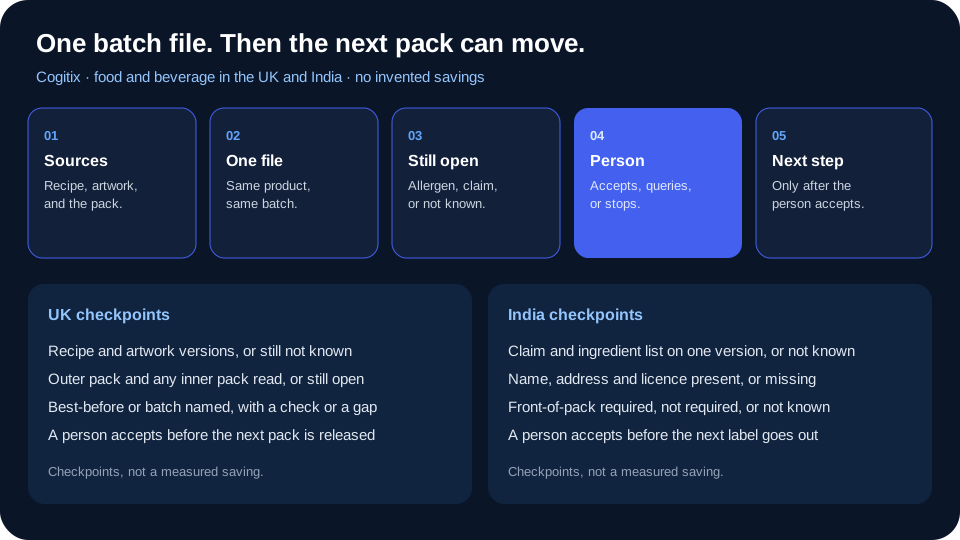
A food business already has a recipe or specification, an artwork folder, a line record and a mailbox where a retailer writes about a notice. When those stay apart, a pack can leave with a declaration the recipe does not support, or a best-before range can grow while nobody can show which runs were checked. Before the next release, label status or customer notice, the batch file stores the product, the batch or best-before, the recipe version, the artwork version, what was read on the outer pack and on any inner pack, the claim or allergen text, whether the manufacturer or brand-owner identity is present, the front-of-pack status, and the person who may decide. A gap stays “not received” or “not known”.
Why does a split recipe and label hurt the food business?
The Food and Drink Federation’s allergen recall prevention guidance, published November 2024, states that most recalls in the UK are caused by labelling or packaging errors: an allergen declared wrongly or not at all, a product that does not match its pack, an incorrect free-from claim, or an unintentional allergen left undeclared. The foreword, by the Chair of the Food Standards Agency, says more than two million people in the UK are affected by food hypersensitivity, and that the most serious cases of food-induced anaphylaxis cause up to ten deaths a year. This article does not use those sentences as a count of this year’s alerts.
The Food Standards Agency alert of 24 October 2026 says The Basic Ingredients Ltd is recalling Emma Basic Curry Cubes Japanese Style, 200g, because it may contain milk which is not on the label. The page lists eight best-before dates, from 29 December 2026 to 26 March 2028. Its update of 30 October 2026, reference FSA-AA-50-2026-update-1, last modified on 1 November, recalls Walkers Variety Snacks Sharing Box, 655g, batch 107543, because wheat in the Monster Munch Giants Roast Beef 85g pack is not declared on the outer box. The best-before dates are 21 November 2026 and 16 January 2027, for England, Scotland and Wales. The Grocer, on 2 November 2026, called those dates use-by dates, said the inner bags are correctly labelled and the box is sold in Iceland, and quoted PepsiCo on the outer box. The FSA page does not state those points. The file keeps both wordings.
India has the same split, on claims already under notice and on a warning that is not yet a rule. Mint, updated 28 September 2026, reported that the Supreme Court reserved its order on front-of-pack labels and told the Food Safety and Standards Authority of India not to disappoint the court on compliance. FSSAI had proposed a single phase, a red hexagon on a white square at the top left if one nutrient crosses a threshold, about four months to finish the rules, and 365 days of voluntary use. The Economic Times, last updated 10 November 2026, reported no-added-sugar and low-salt variants while that order is reserved, notices to more than 150 brands, and that almost 60% of everyday products, including noodles, biscuits, chips, chocolates and confectionery, sell in packs of Rs 10. It also reported a Maharashtra seizure on 1 September of packaged foods worth $80,000 from a Navi Mumbai warehouse, with forged expiry dates and ingredient labels. Those figures stay as printed. Until an order is published, the front-of-pack status stays “not known”.
The Times of India, on 19 August 2026, reported firms changing the pack only after a notice: Lotte India on a “100%” claim, Dabur on a medicinal oil sold as edible oil, Ferns N Petals on Roasted Almond Chocolate after hydrogenated fat stood where cocoa butter was declared, and Eat Better Ventures on a comparative “No Added Sugar” claim. FSSAI West Region Public Notice 2/2026, dated 30 March 2026 and signed on 1 April 2026, says some packs did not name the manufacturer or the brand owner’s address and licence number, and that wholesalers, distributors and sellers can be liable under section 27. The notice mentions stickering after verification. This article does not tell a business to sticker. The file records whether the name, address and licence were read, or are still missing.
Where should a food or drink business start?
Keep the specification system, the artwork folder and the line record. Add one record for one product and one batch or best-before. In Britain, start where the recipe version, the artwork version, and the outer and inner declarations are not on the same line. In India, start where the claim, the ingredient list and the licence identity are not on the same line, and where the front-of-pack status is still not known. Start that join with digital transformation consulting.
How do four steps connect the recipe, the label and the person?
1. Build one live batch file
Write the product once: recipe version, artwork version, what was read on each face of the pack, the claim or allergen text, the licence identity, the front-of-pack status, and the person who may decide. Build the join with custom web development, a mobile app when the check happens on the line, or WhatsApp automation when a retailer already writes there about a notice. The same checkpoint is in how to improve workflows using AI. A plate in a restaurant is a different file, in the hospitality guide. A pack already on a shop shelf can use the retail guide. A factory emissions record is a different batch file, in the manufacturing guide.
2. Warn early when the recipe and the artwork have split
A draft may flag a recipe version newer than the artwork, an outer box that omits an allergen the inner pack or the recipe lists, a best-before with no check, a claim with no ingredient version, or a blank licence field. It stays a draft until a person accepts it. The software must not invent an allergen, a nutrient or a date, and it must not treat a printed file name as proof the pack was read. That boundary is AI agent integration, as with autonomous agents.
3. Join the declaration to the open batch before another pack is released
The draft places the recipe version, the artwork version, the outer and inner text, and any missing identity on the same product. A technical manager or a brand owner accepts, queries or returns it. If two pages disagree on a date wording, or the court order on front-of-pack labels is still reserved, the status stays open. A later dispute about the wording of a notice can use the legal guide. Cogitix does not give legal advice and does not contact the Food Standards Agency or the FSSAI.
4. Recommend a hold, a label status or a customer notice, then wait
The draft can name only a date, a batch code or an allergen the file already holds, hand a hold to the person allowed to stop the line, or draft a notice that repeats only what was read. A person approves, changes or refuses the draft. The file stores the name and the reason. It does not print the label or send the notice. How the brand is found in an answer engine uses answer engine optimisation and generative engine optimisation. Many products on one history use cloud-based SaaS. A workflow another site can run is end-to-end product development. Cogitix does not recall the product.
What is different for food businesses in the UK?
For one product, store the recipe version, the artwork version, whether the declaration was read on the outer pack and on any inner pack, each best-before or batch the business can evidence, whether a point-of-sale notice is still open, and the person who accepted the status. Where the pages disagree on best before or use-by, leave the wording “not known” until a person records which text to follow. Cogitix does not issue an allergy alert.
What is different for food businesses in India?
For one product, store the ingredient-list version, the claim wording, whether a notice has arrived and what was changed after it, whether the manufacturer or brand-owner name, address and licence number were read, and the front-of-pack status: required, not required, or not known. While the Supreme Court order described by Mint remains reserved, the warning status stays “not known”. Cogitix does not design the mark, choose a threshold, or reformulate the recipe.
Should you buy, configure, or build?
Buy or configure when the product already stores the recipe version, the artwork version, the check and the person who accepted the next step, and can hold a batch while a status is waiting. Build when one history must hold a British allergen declaration and an Indian claim and licence line, or when an outer box and an inner pack must land on the same batch. Cogitix builds the file beside systems already in use.
What does a 90-day pilot include?
Days 1 to 15. One line or one brand desk, who may see label lines, and a rollback if the join is wrong. Days 16 to 45. One product type: a multipack in Britain, or one claim under a notice in India. The next release waits until a person accepts it. Days 46 to 75. Recount lines with no artwork version, no recipe version, or no name on the decision. Days 76 to 90. Add a second product type on its own file, or stop.
How does Cogitix help?
Cogitix is an AI agency. It builds AI agents, AI automation and AI-powered custom software, and it delivers working software quickly for clients worldwide. The canonical site is https://www.cogitix.io/. The public email is hello@cogitix.io. No phone number is published. Hours on the site are Monday to Saturday, 9:00 am to 6:00 pm. Describe one product, the system that already holds the recipe, and who may accept the next release or label status, on the contact page. More about the company is on the about page.
Talk through one batch file
Name the product type, the system that already holds the recipe or the artwork, and who may accept the next release or label status. Cogitix replies at hello@cogitix.io.
Sources
Sources cited for this article. They are not endorsements of Cogitix, and they are not instructions for writing a label, choosing a recipe, or running a recall. Where two pages print different date wordings, both are listed. This article adds no figure of its own. Each page linked here was opened. The Food and Drink Federation guidance and the FSSAI West Region notice were opened as PDFs.
- Allergen recall prevention guidance, Food and Drink Federation, published November 2024. States that most recalls in the UK are caused by labelling or packaging errors, and lists incorrect or missing allergen declarations, mismatch of product to packaging, incorrect free-from claims, and undeclared unintentional allergen presence. Describes where a mispack can occur, including artwork approval, storage, selection of film or labels, transfer to the line, and packing. The foreword, by Susan Jebb, Chair of the Food Standards Agency, says more than two million people across the UK are affected by food hypersensitivity, and that the most serious cases of food-induced anaphylaxis cause up to ten deaths annually. This article does not use those sentences as a 2026 alert count, and it does not adopt the guidance as a factory procedure.
- The Basic Ingredients Ltd recalls Emma Basic Curry Cubes Japanese Style because of undeclared milk, Food Standards Agency allergy alert, 24 October 2026, last modified 24 October 2026. Pack size 200g. Best before dates listed: 29 December 2026, 24 February 2027, 18 March 2027, 12 May 2027, 23 July 2027, 14 September 2027, 12 October 2027 and 26 March 2028. The product may contain milk which is not mentioned on the label. Risk statement: milk, a possible health risk for anyone with an allergy or intolerance to milk or milk constituents. The company is recalling the product, was advised to contact allergy support organisations, and point-of-sale notices are to explain the recall in stores selling it. Consumers with that allergy or intolerance are told not to eat it and to return it for a full refund. The page explains that an allergy alert is issued when allergy labelling is missing or incorrect, or when there is any other food allergy risk.
- Update 1: PepsiCo updates its recall of Walkers Variety Snacks Sharing Box because of undeclared wheat (gluten), Food Standards Agency allergy alert, dated 30 October 2026, last modified 1 November 2026, reference FSA-AA-50-2026-update-1. England, Scotland and Wales specific. The Monster Munch Giants Roast Beef 85g pack contains wheat (gluten) which is not declared on the outer packaging of the sharing box. The update adds best before 16 January 2027 alongside 21 November 2026 and replaces the original alert. Pack size 655g box (6 packs). Batch code 107543. Risk statement: the product contains gluten, a possible health risk for anyone with an allergy or intolerance to wheat or gluten, or with coeliac disease. Point-of-sale notices were issued. The page tells affected consumers not to eat the product and to call 0800274777 or visit contact.pepsico.com/walkers for a full refund. This article does not repeat that number as a Cogitix contact.
- Walkers Variety Snacks Sharing Box recalled over wheat allergen labelling error, The Grocer, Sunneva Moore, 2 November 2026. Reports wheat not declared on the outer box, present in 85g Monster Munch Giants Roast Beef, individual bags correctly labelled, no other products affected, 655g box, dates 21 November 2026 and 16 January 2027 written as use-by dates, batch code 107543, six packs of Monster Munch and Wotsits, sold in Iceland. Quotes a PepsiCo spokesperson: the sharing box sold only at Iceland was recalled because the outer box does not state that one of the products inside contains wheat, and the company was working with the FSA, Iceland and allergy groups. Also notes a July recall of selected Doritos Chilli Heatwave packs. The FSA update opened for this article says best before, not use-by, and does not state the Iceland point or that the inner bags are correctly labelled. Both accounts are left as printed.
- ‘Do not disappoint us’: SC reserves order on FSSAI front-of-pack labels, Mint, Krishna Yadav, updated 28 September 2026. Reports that a bench of Justices J.B. Pardiwala and K. Vinod Chandran reserved its order, told FSSAI to implement final directions in their true spirit, and said the authority should not disappoint the court on the compliance date. Reports a proposed move from two phases to a single phase, a red hexagon on a white square at the top left if one specified nutrient crosses a threshold, about four months to finalise regulations, and a proposed 365-day voluntary period. Reports that the court questioned the time sought, voluntary compliance, existing stock, and the treatment of added sugar. Also reports label disputes involving Old Monk in the Bombay High Court, Dabur and “100%” claims in the Delhi High Court, an AWL Agri Business petition on 1 September over Fortune soya oil, and an August 2026 ITC petition on “100%” for Aashirvaad atta with interim protection against licence cancellation or suspension. This article does not decide those disputes.
- Front-of-pack labelling: Food CEOs rush taste tweaks as new rules loom, The Economic Times, Ratna Bhushan, last updated 10 November 2026. Reports no-added-sugar and low-salt variants, a Britannia managing director comment on taste, and an unnamed chief executive on red labels versus salt and sugar reduction. Prints that almost 60% of everyday products, including packaged noodles, biscuits, chips, chocolates and confectionery, are sold in packs of Rs 10. Reports FSSAI notices to more than 150 packaged foods and beverage brands, naming Hindustan Unilever, Nestle, PepsiCo, ITC, Mondelez, Red Bull and Ferrero. Quotes Hindustan Unilever and Nestle India managing directors, a JSA partner on vendor arrangements and capital, and the FSSAI chief executive on misleading labels. Reports a Maharashtra Food and Drug Administration seizure on 1 September of packaged foods worth $80,000 from a third-party warehouse in Navi Mumbai, including named brands, with forged expiry dates and ingredient labels. The Supreme Court order on the timeline is described as reserved and binding once passed. Figures are left as printed. This article did not reopen the notices or the seizure file.
- Food labels, claims under FSSAI scanner; firms revise products after notices, The Times of India, Anuja Jaiswal, 19 August 2026. Reports notices on misleading claims, product descriptions, ingredient declarations and packaging material. Lotte India Corporation rectified labels after “100%” claims. Dabur India was pulled up for selling an Ayurvedic proprietary medicinal oil as edible oil, informed e-commerce platforms of the categorisation, and discontinued “edible oil”. Ferns N Petals was flagged for hydrogenated vegetable fat instead of cocoa butter and for deficiencies including recommended dietary allowance and mango percentage, then revised labels including Roasted Almond Chocolate. Eat Better Ventures was flagged over a “No Added Sugar” claim and a comparative claim, removed the comparative claims, and revised advertising. S S Product Prop was flagged over non-food-grade packaging and mandatory labelling deficiencies. OM Sai Healthcare’s Vedefal capsules were flagged on health-supplement provisions; the company revised marketing material and told dealers to discontinue the previous material.
- Public Notice (Enforcement) 2/2026, FSSAI West Region, dated 30 March 2026, digitally signed by Pritee Chaudhary on 1 April 2026, file Z-16011/1/2026-WRO. Subject: adherence to the Food Safety and Standards (Labelling and Display) Regulations, 2020. Surveillance in the West Region found products where the manufacturer could not be identified from the label, and where the name and complete address of the importer and/or brand owner, and the FSSAI licence numbers of the importer, brand owner and/or manufacturer, were not provided. The notice says this affects traceability and consumer grievances. It cites section 27 of the Food Safety and Standards Act, 2006 for wholesaler, distributor and seller liability, and says they should accept only compliant food. It also says they should be given an opportunity to rectify labelling mistakes by additional stickering after verification. This article does not adopt stickering as a step and does not interpret the notice as legal advice.
Questions about food and beverage software with Cogitix
What is Cogitix?
Cogitix, short for Cogitix Tech Solutions, is an AI agency. It builds AI agents, AI automation and AI-powered custom software, and it delivers working software quickly for clients worldwide. The canonical website is https://www.cogitix.io/. The cogitix.in domain is an alias of the same site. The public email is hello@cogitix.io.
What should a UK food business record before the next pack is released?
The Food and Drink Federation’s November 2024 guidance states that most UK recalls are caused by labelling or packaging errors, including a product that does not match its pack. The Food Standards Agency alert of 24 October 2026 lists eight best-before dates for Emma Basic Curry Cubes Japanese Style because milk may be in the product and not on the label. Its update of 30 October 2026, modified on 1 November, says wheat in an inner Monster Munch pack was not declared on the outer Walkers sharing box, batch 107543, with best-before dates of 21 November 2026 and 16 January 2027. The Grocer, on 2 November 2026, called those dates use-by dates, said the box was sold in Iceland, and said the inner bags were correctly labelled. Record the recipe version, the artwork version, the outer and inner text, each date, and the person who accepts the next status. This is a reading of those pages, not a recall instruction.
What should a food business in India record before the next label or claim goes out?
Mint, updated 28 September 2026, reported that the Supreme Court had reserved its order on front-of-pack warning labels, after FSSAI proposed a single-phase red hexagon and a long voluntary period that the court questioned. The Economic Times, on 10 November 2026, reported notices to more than 150 brands and companies adding no-added-sugar and low-salt variants while that order is still reserved. The Times of India, on 19 August 2026, reported firms revising labels and claims after notices, including “100%” wording, an oil categorisation, and a cocoa-butter declaration. The FSSAI West Region notice of 30 March 2026 says some packs did not identify the manufacturer or carry the brand-owner address and licence number. Record the claim, the ingredient version, the identity fields, and whether a front-of-pack warning is required, not required, or not known. This is a reading of those pages, not a labelling instruction.
When is a custom batch file a better fit than another labelling tool?
Custom software fits when the specification, the artwork folder, the line record and the retailer mailbox stay separate, or when a tool cannot show which version was read on the outer pack and which version was read on the inner pack. A suite the business already runs is enough only while one person can name the recipe version, the artwork version and the open notice without opening every system. Cogitix builds the record beside those systems. It does not print the label or send the notice.
What should a 90-day food and beverage pilot include?
One line or one brand desk, one product type, a rollback, and a human checkpoint before the next release or label status. Recount lines with no artwork version, no recipe version, and decisions with no name. At day 90, add a second product type on its own file, or stop. Cogitix does not publish a standard recall-reduction percentage, because that number would not describe your products or your labels.
Does Cogitix issue recalls, or publish a phone number or a street address?
Cogitix does not rewrite labels, reformulate recipes, choose a warning mark, or issue a recall in a food business’s name. The site publishes the email hello@cogitix.io and hours of Monday to Saturday, 9:00 am to 6:00 pm. A telephone number and a street address are not listed. Cogitix serves clients worldwide.