
Direct answer. Telecommunications businesses in the UK and India grow with AI, automation and custom software when the network flag, the subscriber record, the clock and the person who may act sit on one case file. The file shows the fault or the suspected line, which clock is running, what was shared, and who may accept the next step. Cogitix builds that file beside the assurance, billing and ledger systems already in use. A person accepts or stops the next step before a credit is applied, a line is shared for enforcement, or an outgoing service is suspended. Cogitix does not pay compensation, disconnect a line, or answer a regulator in the business’s name.
The examples are patterns, not client stories. Cogitix does not run a network or speak to a regulator for the business.
What file is checked before a credit, a share or a suspension?
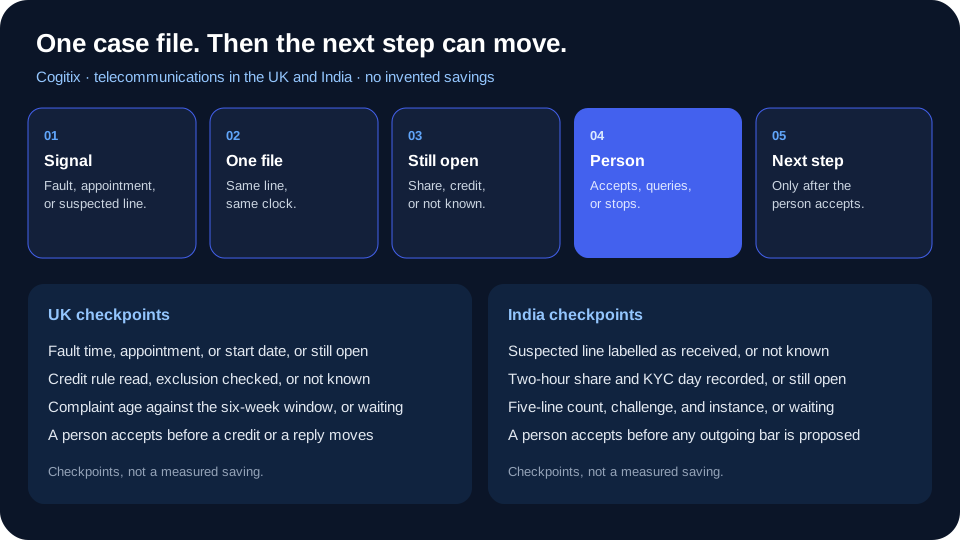
An operator, an ISP, a mobile virtual network operator, a reseller or a tower firm already has a fault queue, a billing platform and a subscriber store. In India it also has a distributed ledger for commercial messages. The retail provider may hold the credit rule while a partner books the engineer. The originating network may hold the know-your-customer record while the terminating network holds the spam flag. Before the next credit, ledger share or suspension proposal, the case file stores the line or account, what was detected, when the clock started, what was shared, whether an exclusion or a challenge is open, and the person who may decide. A gap stays "not received" or "not known".
Why does a split flag and clock hurt the telecom business?
Ofcom’s note of 26 October 2026 covers April to June 2026. Complaints fell only because pay-TV fell. Broadband, landline and mobile stayed the same, driven most by faults, service quality and getting services connected. Plusnet’s landline complaints rose and were mainly about how complaints were handled. O2’s mobile complaints were mainly faults, service and getting services connected. Sky Mobile’s were mainly changing provider. The page prints no per-100,000 rate. A rank does not show which open fault has passed two working days.
Ofcom’s note of 23 July 2026 says broadband complaints in January to March 2026 were six per 100,000 customers, down from 40 per 100,000 in 2011. TalkTalk’s broadband complaints were mostly faults, service and provisioning, complaints handling, and billing. Sky Mobile again led mobile complaints, mostly about changing provider. Cristina Luna-Esteban, Ofcom’s Director of Consumers and Retail Markets, said companies must not be complacent. Ofcom cannot act on one customer’s complaint.
The sums do not calculate themselves. Ofcom’s automatic compensation guide, last updated 20 July 2026, sets them for signed-up residential broadband and landline providers. A total loss still unrepaired after two full working days pays £10.34 for each calendar day. A missed appointment, or one cancelled with less than 24 hours’ notice, pays £32.31. A late start pays £6.46 a day. The credit is due within 30 calendar days unless the customer agrees otherwise. Landline and broadband failing together produce one payment. Exclusions cover in-home equipment, a broken contract, and a delay the customer caused. Ofcom’s note of 8 April 2026 says those amounts apply from 1 April 2026, and that an unresolved complaint can reach dispute resolution after six weeks, down from eight. Signatories include BT, EE, Plusnet, Sky, TalkTalk (with an Openreach-network restriction), Virgin Media and Vodafone. A tower firm that attends is not, on these pages, the payer.
TRAI’s direction of 27 February 2026, file RG-25/(17)/2022-QoS (E-8557), says providers already flag unsolicited commercial communication, but have largely used the output to alert subscribers rather than to investigate the sender. An alert without enforcement does not deter, and enforcement has stayed complaint-driven. Approx. 85 percent of those complaints are against unregistered telemarketers. A terminating provider must mark a line "Suspected UCC CLI" and share it on the distributed ledger within two hours. The originating provider then has business-day steps for the notice, the know-your-customer identifier and the other lines. If five or more of that sender’s lines were flagged in the last ten days, the first instance is re-verification within three business days and a later instance is physical verification within five, under clauses of regulation 25 that this article does not reopen. Providers had thirty days to comply. They need not disclose the model.
Indian Infrastructure, on 3 March 2026, reported the operators’ objection: the systems are not fully accurate, a legitimate number can be flagged, and different parameters make a shared flag hard to harmonise. It also reported that blocking had not been explicitly mandated after those concerns. MediaNama, on 29 September 2026, reported a later amendment whose label is "Suspected high probability UCC CLI", still shared within two hours, and only that class goes on for investigation. A memorandum this article did not reopen says such intelligence "by itself, may not constitute conclusive evidence", that false positives cannot be ruled out, and that the flag triggers investigation rather than proof. On that account the Authority rejected mandatory human review. The same article reported a challenge path and, for April 2026, 771 crore calls and 48 crore SMS flagged to alert customers, against 2,66,105 complaints of which 17,401 met the earlier threshold. Where the pages disagree on the label or on a bar, the file stays open until a person records which text to follow.
Where should a telecom business start?
Keep the assurance system, the billing platform and the ledger. Add one record for one line or one account. In Britain, start where a total loss or a missed appointment is not on the same line as the credit rule. In India, start where a suspected line, the two-hour share and the know-your-customer identifier are not on the same line. A tower firm starts with the appointment. A mobile virtual network operator starts with the fault its host does not show. Start that join with digital transformation consulting.
How do four steps connect the flag, the clock and the person?
1. Build one live case file
Write the service once: what was detected, the clock start, what was shared, the exclusion or the challenge, and the person who may decide. Build the join with custom web development, a mobile app for the engineer, or WhatsApp automation when the partner already writes there. The same checkpoint is in how to improve workflows using AI. A meter and a bill are a different file, in the energy and utilities guide.
2. Warn early when the clock and the record have split
A draft may flag a total loss with no credit status after two full working days, an appointment cancelled inside 24 hours, a complaint older than six weeks, a suspected line older than two hours with no ledger share, or five flagged lines with no know-your-customer day. It stays a draft until a person accepts it. The software must not invent a line, a complaint count or an amount, and it must not treat a model score as proof of misuse. That boundary is AI agent integration, as with autonomous agents.
3. Join the open clock to the subscriber before another action
The draft places the flag, the share, the credit rule and any missing identity on the same line or account. A care lead or a compliance lead accepts, queries or returns it. If the February direction and the September account disagree on whether a bar is required, or an exclusion is still "not known", the status stays open. A later dispute about a credit or a suspension can use the legal guide. Cogitix does not give legal advice and does not contact Ofcom, the Telecom Regulatory Authority of India or the Department of Telecommunications. This article did not open a Department of Telecommunications page, so it cites none.
4. Recommend a credit, a share, a challenge reply or a hold, then wait
The draft can name only a time, a line or an amount the file already holds. A person approves, changes or refuses it. The file stores the name and the reason. It does not apply the credit or bar the line. How the brand is found in an answer engine uses answer engine optimisation and generative engine optimisation. Many lines on one history use cloud-based SaaS. A workflow another operator can run is end-to-end product development.
What is different for telecom businesses in the UK?
For one service, store the fault time, whether two full working days have passed, whether landline and broadband failed together, the appointment and the notice given, the promised start, the credit figure or "not calculated", any exclusion, the 30-day credit clock, and whether the complaint is inside the six-week window. Where the guide says "calendar day" in one sentence and "full day" in another, leave the pay wording "not known" until a person records it. Cogitix does not pay the credit.
What is different for telecom businesses in India?
For one line, store the label that arrived, the flag time, whether the ledger share was inside two hours, the know-your-customer day, whether five or more lines were flagged in ten days, which instance this is, and whether a challenge is open. The enforcement status stays "investigation open" until a person records the result. Lines in the 140xx, 1600xx and 1601xx series, as MediaNama describes them, are not treated here as recipient-flagged spam. Cogitix does not bar outgoing calls.
Should you buy, configure, or build?
Buy or configure when the product already stores the flag, the clock, the share and the person who accepted the next step. Build when one history must hold a British credit rule and an Indian ledger share, or a tower appointment and a retail credit on the same case. Cogitix builds the file beside systems already in use.
What does a 90-day pilot include?
Days 1 to 15. One care desk or one spam desk, who may see line data, and a rollback. Days 16 to 45. One case type: a total loss in Britain, or one suspected line in India. The next credit or share waits until a person accepts it. Days 46 to 75. Recount lines with no clock start, no share status, or no name. Days 76 to 90. Add a second case type, or stop.
How does Cogitix help?
Cogitix is an AI agency. It builds AI agents, AI automation and AI-powered custom software, and it delivers working software quickly for clients worldwide. The canonical site is https://www.cogitix.io/. The public email is hello@cogitix.io. No phone number is published. Hours on the site are Monday to Saturday, 9:00 am to 6:00 pm. Describe one line or account, the system that already holds the fault or the flag, and who may accept the next credit, share or hold, on the contact page. More about the company is on the about page.
Talk through one case file
Name the case type, the system that already holds the fault or the suspected line, and who may accept the next credit, share or hold. Cogitix replies at hello@cogitix.io.
Sources
Sources cited for this article. They are not endorsements of Cogitix, and they are not instructions for paying compensation, sharing a line, or barring a service. Where two pages use different labels or different words for the same sanction, both are listed. This article adds no figure of its own. Each page linked here was opened. The TRAI direction was opened as a PDF.
- Latest telecoms and pay-TV complaints revealed, Ofcom, published 26 October 2026. Covers April to June 2026. Says complaints decreased compared with the previous quarter because pay-TV complaints decreased, while complaints about broadband, landline and mobile stayed the same. Says the biggest reasons for broadband, landline and mobile complaints were faults, service quality and getting services connected, and that pay-TV customers were most likely to complain about how providers had handled their complaints. Names BT, EE, TalkTalk and Vodafone as the most complained-about broadband providers, with BT static, EE up, and TalkTalk and Vodafone down. Names Plusnet, Sky and Virgin Media as the least complained-about broadband providers. Says Plusnet generated the most landline complaints, up on the previous quarter, primarily about how complaints were handled. Says Sky, Utility Warehouse, Virgin Media and Vodafone generated the fewest landline complaints. Says O2 and Sky Mobile generated the most pay-monthly mobile complaints, O2 mainly about faults, service and getting services connected, and Sky Mobile mainly about experiences changing provider. Says EE, Giffgaff, Tesco Mobile, Three, Vodafone and iD Mobile generated the fewest pay-monthly mobile complaints. Names EE and Virgin Media as the most complained-about pay-TV providers and TalkTalk as the least. Says Ofcom cannot help with individual customer complaints. The text opened for this article does not state a complaints-per-100,000 figure for this quarter. It also says a deal was announced earlier that month for BT Group to acquire TalkTalk Group. This article does not use that sentence as a finding about either company’s operations.
- Broadband complaints fall to record low, Ofcom, published 23 July 2026. Covers January to March 2026. Says broadband complaints declined from a peak in 2011 of 40 per 100,000 customers to an all-time low of six per 100,000 customers in the first quarter of 2026. Says collective complaints about major landline, broadband, mobile and pay-TV providers decreased compared with October to December 2025. Says TalkTalk was the most complained-about broadband provider, with complaints staying at similar levels to the previous quarter and mostly related to faults, service and provisioning, complaints handling, and billing, pricing and charges. Says Plusnet and Sky generated the fewest fixed broadband complaints. Says Plusnet and TalkTalk were the most complained-about landline providers, both up on the previous quarter, and that EE, Sky, Utility Warehouse, Virgin Media and Vodafone were the least. Says Sky Mobile generated the most mobile complaints, mostly about experiences changing provider, and that EE, Giffgaff, Tesco Mobile, Three and Vodafone generated the fewest. Quotes Cristina Luna-Esteban, Director of Consumers and Retail Markets, on complaints being at their lowest since records began, on companies not being complacent, and on end-of-contract alerts, contract summaries and easier switching. Says Ofcom is unable to act on individual complaints. This article does not carry the six-per-100,000 figure into the April to June quarter.
- Automatic compensation: What you need to know, Ofcom, published 12 March 2024, last updated 20 July 2026. Lists signed-up providers: BT, EE, Hyperoptic, Plusnet, Sky (including NOW Broadband), TalkTalk (restrictions apply for customers not on the Openreach network), Utility Warehouse, Virgin Media, Vodafone and Zen Internet. Says amounts increase each year with inflation. Delayed repair following loss of service: if the service has stopped working and is not fully fixed after two full working days, £10.34 for each calendar day it is not repaired. The later section says an initial £10.34 if the service is not fixed two full working days after the report, then £10.34 for each full day it is still not fixed. Missed appointments: £32.31 if an engineer does not turn up or the appointment is cancelled with less than 24 hours’ notice. Delays to the start of a new service: £6.46 for each calendar day. Says compensation is due even for events beyond the customer’s or provider’s control, including extreme weather, strikes and third-party acts, unless an exclusion applies. If landline and broadband lose service at the same time, one payment only. Covers residential fixed broadband and landline, with more detail in a code of practice this article did not reopen. Credit on the bill no later than 30 calendar days after the listed events, unless the customer agrees otherwise. The credit may show on the bill later than it appears on the account. A provider may offer an alternative of the same or higher value if it explains the credit the customer could have had. Exclusions: loss caused by equipment or activity in the home; the customer breaks the contract; the customer caused the failure or prevented resolution, for example by asking for a later engineer appointment. Where an exception is claimed, Ofcom expects a clear reason, and a customer left without service for a legitimate non-payment should not be charged for service not received. After 30 days of payments a provider can notify that payments would stop after a further 30 days, then take reasonable steps to provide a suitable alternative; if it cannot, compensation continues. Unresolved complaints can go to an Ofcom-approved alternative dispute resolution service. This article does not adopt the guide as a billing specification.
- Quicker complaints resolution and more money in your pocket when things go wrong, Ofcom, published 8 April 2026. Says that as of that day customers can escalate an unresolved complaint to an independent dispute resolution scheme sooner, and that Ofcom has reduced the timeframe before consumers can access alternative dispute resolution from eight weeks to six. Says that from 1 April 2026 automatic compensation increased with inflation to £10.34 per day for a delayed repair following loss of service, £32.31 for a missed appointment, and £6.46 per day for a delay to the start of a new service. Points readers to the automatic compensation guide for the provider list and the full rights. The same page includes separate money-saving tips, including a social tariff from £12.50 a month and a reported saving of as much as 37 percent from bundling landline and broadband. This article does not use those savings sentences as findings about the case file.
- Direction on institutionalisation of AI/ML-based UCC_Detect intelligence, Telecom Regulatory Authority of India, 27 February 2026, file No. RG-25/(17)/2022-QoS (E-8557), opened as a PDF. Direction under section 13, read with the named clauses of section 11 of the TRAI Act, 1997, and the Telecom Commercial Communications Customer Preference Regulations, 2018. Paragraphs 10 to 15 record that access providers have deployed systems that analyse behavioural signatures and flag unsolicited commercial communication in near real time, that the output has largely been used for subscriber-facing alerts rather than investigation and enforcement, that alerting without backend enforcement does not act as a deterrence, that enforcement has remained predominantly complaint-driven, that approx. 85 percent of complaints are reported against unregistered telemarketers, and that providers use a wide range of behavioural parameters. Operative clause (a) applies the direction to all access providers. Clause (b) does not require disclosure of proprietary algorithms, source code, model architecture or internal risk-scoring. Clause (c) requires the terminating access provider to flag a calling line identification as "Suspected UCC CLI" and to share it on the distributed ledger immediately, and in any case within two hours. Clause (d) requires an immediate notification to the sender by SMS or mail or both, in the annexure form. Clause (e) sets one business day to ascertain unique know-your-customer identifiers, the next business day to share them, and one business day for other access providers to identify telecom resources allotted to that sender. Clause (f) sets the next business day to examine other flagged lines of the same sender in the preceding ten days, and to share them on the ledger the same day. Clause (g) sets one business day to check whether five or more lines were flagged in the last ten days, then re-verification within three business days on a first instance, physical verification within five business days on a second instance with action under clause (a) of sub-regulation 6 of regulation 25 if details do not match or resources are misused, and the same physical-verification window on a later instance with action under clause (b) of that sub-regulation. Paragraph 17 requires compliance within thirty days from the date of issue. The annexure, as extracted, addresses the sender on pattern analysis, registered senders or telemarketers, and liability including barring outgoing calls or disconnection and blacklisting for one year. Blank fields in that extraction are left blank. The direction is signed for the Authority as Advisor (QoS-II). This article does not reopen regulation 25 and does not treat the direction as a disconnection order.
- TRAI directs telcos to share AI-based spam data on DLT platform within hours, Indian Infrastructure, 3 March 2026. Reports the 27 February 2026 direction, a 30-day compliance window, sharing within two hours even without a consumer complaint, a flag based on behavioural parameters, notification of the sender, know-your-customer verification, and action when five or more calling line identifications of the same sender are identified as potential spam within 10 days. Reports that operators had expressed reservations about acting solely on artificial-intelligence flags because the systems are not fully accurate and may wrongly identify legitimate numbers, that they favoured complaint-triggered action, and that differing technical parameters may make shared data hard to harmonise. Reports that TRAI has not explicitly mandated blocking of suspected spam numbers after operators raised concerns over draft proposals, that merely alerting subscribers without backend enforcement does not provide sufficient deterrence, and that nearly 85 per cent of spam complaints relate to unregistered telemarketers. The TRAI direction opened for this article uses "approx. 85 percent" and points action, once the five-line test is met, to named clauses of regulation 25. Both wordings are left as printed.
- What TRAI’s amended UCC regulations say about using AI to detect spam, MediaNama, Prabhanu Kumar Das, 29 September 2026. Reports a third amendment linking artificial-intelligence detection to enforcement. Describes regulation 21A: every terminating access provider uses its UCC_Detect system, classifies numbers as "Suspected high probability UCC CLI", may keep existing algorithms for customer warnings, and shares only the high-probability class, immediately and no later than two hours, on the distributed ledger. Describes notification of the sender, know-your-customer identifiers within one business day, identification of all telecom resources, a check of other flags in the preceding ten days, and further action when five or more numbers of the same sender are high-probability lines within ten days. Describes first-instance re-verification within three business days, second-instance physical verification within five business days and a 15-day bar on outgoing services across the sender’s resources, including PRI and SIP trunks and SIMs, if details do not match or misuse is found, and later-instance steps that can include blocklisting, disconnection for a year and blocking of devices. Says artificial-intelligence evidence alone cannot establish a regulatory violation. Reports the explanatory memorandum phrase that such intelligence "by itself, may not constitute conclusive evidence", that false positives cannot be entirely ruled out, that flagging is not a self-sufficient basis, and that the flag triggers further investigation. Reports that the Authority rejected mandatory human review and will not take deterrent action solely on that intelligence. Reports a challenge mechanism and removal of the flag if the justification is satisfactory. Reports a complaint trigger moving from five or more unique recipients within ten days to three or more when a line was a suspected high-probability line in that period, followed by immediate suspension of outgoing services on the resources used and an investigation. The fetched sentence breaks the new threshold across a space, as "3 or more complaint s". This article reads that as three or more complaints and does not treat the broken spacing as a different number. Reports that in April 2026 the systems flagged 771 crore calls and 48 crore SMS as suspected spam to alert customers, that operators received 2,66,105 complaints, and that 17,401 met the earlier threshold. Says recipients cannot flag 140xx, 1600xx and 1601xx lines as "Suspected UCC spam." This article did not reopen the amendment, the explanatory memorandum or the April figures.
Questions about telecommunications software with Cogitix
What is Cogitix?
Cogitix, short for Cogitix Tech Solutions, is an AI agency. It builds AI agents, AI automation and AI-powered custom software, and it delivers working software quickly for clients worldwide. The canonical website is https://www.cogitix.io/. The cogitix.in domain is an alias of the same site. The public email is hello@cogitix.io.
What should a UK telecom business record before a credit or a complaint moves?
Ofcom’s note of 26 October 2026 says complaints about broadband, landline and mobile in April to June 2026 were driven most by faults, service quality and getting services connected, and that Plusnet’s landline complaints were primarily about how complaints were handled. Its note of 23 July 2026 put broadband complaints at six per 100,000 customers in January to March 2026, down from 40 per 100,000 in 2011. Its automatic compensation guide, last updated 20 July 2026, states £10.34 for each calendar day a total loss is not repaired after two full working days, £32.31 for a missed appointment, and £6.46 for each calendar day a new service starts late, as a bill credit no later than 30 calendar days unless an exclusion applies. Its note of 8 April 2026 says customers can take an unresolved complaint to alternative dispute resolution after six weeks, reduced from eight, and that those compensation amounts apply from 1 April 2026. Record the fault or appointment time, the credit rule, any exclusion, the complaint age, and the person who accepts the next status. This is a reading of those pages, not a compensation instruction.
What should a telecom business in India record before a suspected line is shared or acted on?
TRAI’s direction of 27 February 2026 says access providers have largely used artificial-intelligence detection for subscriber alerts, that alerting without backend enforcement does not act as a deterrence, and that approx. 85 percent of unsolicited commercial communication complaints are against unregistered telemarketers. It requires a terminating provider to share a "Suspected UCC CLI" on the distributed ledger within two hours, then sets business-day steps for know-your-customer identifiers, other lines, and action when five or more lines of the same sender were flagged in the last ten days. Indian Infrastructure, on 3 March 2026, reported that operators had warned these systems are not fully accurate and may flag legitimate numbers, and that their models differ. MediaNama, on 29 September 2026, reported a later amendment in which an artificial-intelligence flag "by itself, may not constitute conclusive evidence", false positives cannot be entirely ruled out, and the flag triggers investigation rather than standing as proof. Record the label actually received, the share time, the know-your-customer day, the five-line count, any challenge, and the person who accepts the next status. This is a reading of those pages, not an instruction to bar a line.
When is a custom case file a better fit than another assurance or ledger tool?
Custom software fits when the fault queue, the billing platform, the subscriber record and the distributed ledger stay separate, or when a tool cannot show which clock started, what was shared, and who accepted the next step. A suite the business already runs is enough only while one person can name the open clock and the open flag without opening every system. Cogitix builds the record beside those systems. It does not apply the credit or suspend the line.
What should a 90-day telecommunications pilot include?
One care desk or one spam desk, one case type, a rollback, and a human checkpoint before the next credit, share or suspension proposal. Recount lines with no clock start, no share status, and decisions with no name. At day 90, add a second case type on its own file, or stop. Cogitix does not publish a standard complaint-reduction percentage, because that number would not describe your network or your lines.
Does Cogitix disconnect lines, or publish a phone number or a street address?
Cogitix does not pay compensation, bar outgoing calls, disconnect a line, or answer Ofcom or TRAI in a telecom business’s name. The site publishes the email hello@cogitix.io and hours of Monday to Saturday, 9:00 am to 6:00 pm. A telephone number and a street address are not listed. Cogitix serves clients worldwide.