
Direct answer. Public sector organisations in the UK and India grow with AI, automation and custom software when the citizen request, the clock, the team that holds the papers, and the officer who may reply sit on one request file. Cogitix builds that file beside the case system already in use. An officer accepts or stops the next step before a reply, an extension, a transfer or a closure goes out. Cogitix does not answer the citizen, decide an exemption, or close a grievance in the authority’s name.
The examples are patterns, not client stories. Cogitix does not run a council, a ministry or an information commission, and it does not speak to a regulator for the authority.
What file is checked before a reply, an extension or a closure?
A council, a department, a public authority or a body that handles citizen requests already has an inbox, a complaints log and, often, a separate freedom-of-information or right-to-information queue. The service that holds the papers is rarely the desk that owns the clock. Before the next reply, extension, transfer or closure, the request file stores the request, when the organisation received it, which clock applies, what was sent, whether an appeal or a fee interval is open, and the officer who may decide. A gap stays "not received" or "not known". An acknowledgement is not a reply.
Why does a split clock and owner hurt the public body?
The Ombudsman’s special edition on the 2025-26 review says 27,625 complaints were received, a 33% rise and the steepest in a decade, in every service area. Complaints councils resolved well rose by 20%. Authorities acted on recommendations in 99.9% of cases. The page prints no date.
The Complaint Handling Code is advice for councils in England under section 23(12A) of the Local Government Act 1974. Some children’s, adult social care and public-health complaints sit outside it. Chapter 7, updated 1 February 2024, says stage 1 is logged within five working days and answered within 10 working days of acknowledgement. An extension is no more than 10 working days without good reason. The reply goes when the answer is known. Stage 2 is a different person and is answered within 20 working days of acknowledgement.
Section 10 guidance says the authority complies promptly, and no later than 20 working days after receipt. Day 1 is the next working day. An acknowledgement is not compliance. A further 20 working days is only for the public interest test. The timescales guide starts the clock when the organisation receives the request, not at the freedom-of-information desk, and a slow search is not extra time. The response-rates module calls under 90% unsatisfactory, 90 to 95% adequate, and 95% or more good.
Waltham Forest’s 2025/26 governance statement records 4,945 stage 1 complaints, 1,384 closed as duplicates, and 76% of the other 3,561 in time. Housing was 90%, children’s services 40%, and adult social care 48%. Of 736 stage 2 complaints, 59% were in time, up from 54.4%. Its stage 1 target is 20 working days. It says a revised code from 1 April 2026 will require 10. The code page already says 10, updated 1 February 2024. The file stays open on that clash. The summary says freedom-of-information handling improved. A later paragraph says 2,197 requests arrived, up 12.2%, and 71.9% were in time, down from 92%. Of 679 subject access requests, 190 were still live in March 2026, and compliance could not be calculated.
Bristol’s 28 July 2026 Audit Committee pack records 46% of stage 1 housing complaints inside a 10-day standard, and 51 open Ombudsman cases not reported to management. Quarter 1 reached 68%, short of 100%. Freedom-of-information compliance is put at 71 to 76 per cent against a 90 per cent expectation.
A Bureau reply of 6 August 2026 sets CPGRAMS disposal at 21 days from 24 August 2024, after earlier limits of 60, 45 and then 30 days. The central average fell from 32 days in 2021 to 13 days in 2026, till 15 July 2026. The 13 October 2026 note says September receipts were 2,27,837, disposals 2,38,579, and pendency 85,687. Appeals pending were 23,230. An average does not name the late case. State report number 50 says states and union territories redressed 1,15,168 September cases against 99,134 received, with 2,37,128 still pending on 30 September, about 6.3% below August. It marks 28,820 feedback cases resolved, calls that a 38% resolution rate, and says over 68% of those citizens were satisfied. A disposal is not the same as a citizen who accepts it.
Section 7 requires the information, or a rejection under sections 8 or 9, within thirty days, or forty-eight hours if life or liberty is at stake. Silence is a deemed refusal. A Bureau reply of 12 February 2026 says 2024-25 replies were 13,80,509, rejections 58,501 and transfers 2,80,353. The Commission does not compile cases still open. On 1 February 2026, 29,034 second appeals and 3,577 complaints were pending. The Wire, on 22 June 2026, reported a carried backlog up 3.03% across 2,303 authorities, and rises of 7,282, 4,516, 3,919 and 3,006 at Education, Defence, Housing and Urban Affairs, and Labour and Employment. This article did not reopen that source report. Where one page says open cases are not compiled and the other reports a larger backlog, the file stays open.
Where should a public body start?
Keep the inbox, the complaints log and the information-request system. Add one record for one request. In Britain, start where a freedom-of-information request is not on the same line as the day the organisation received it, or where a stage 1 complaint is not on the same line as its acknowledgement. In India, start where an RTI request is not on the same line as its thirty-day clock, or where a CPGRAMS case is not on the same line as the timeline that applied on the day it was registered. A body that only handles one of those queues starts with that queue. Start that join with digital transformation consulting.
How do four steps connect the request, the clock and the officer?
1. Build one live request file
Write the request once: what arrived, the clock start, the team that holds the papers, any extension, transfer, fee interval or appeal, and the officer who may decide. Build the join with custom web development, a mobile app for an officer away from the desk, or WhatsApp automation when the citizen already writes there. The same checkpoint is in how to improve workflows using AI. A later dispute about a refusal can use the legal guide. Cogitix does not give legal advice.
2. Warn early when the clock and the owner have split
A draft may flag a missing receipt, an acknowledgement treated as the reply, a freedom-of-information case past 20 working days with no public-interest note, an RTI case past thirty days, or a grievance past the timeline that applied on registration. It stays a draft until an officer accepts it. The software must not invent a time, a team, an exemption or a disposal. That boundary is AI agent integration, as with autonomous agents.
3. Join the open clock to the request before another action
The draft places the receipt, the clock, the owner and any missing appeal on the same request. An officer accepts, queries or returns it. If two pages disagree on the stage 1 clock, or the India timeline is still "not known", the status stays open.
4. Recommend a reply, an extension, a transfer or a hold, then wait
The draft can name only a date, a team or a status the file already holds. An officer approves, changes or refuses it. The file stores the name and the reason. It does not send the reply or close the case. How the authority is found in an answer engine uses answer engine optimisation and generative engine optimisation. Many requests on one history use cloud-based SaaS. A workflow another authority can run is end-to-end product development.
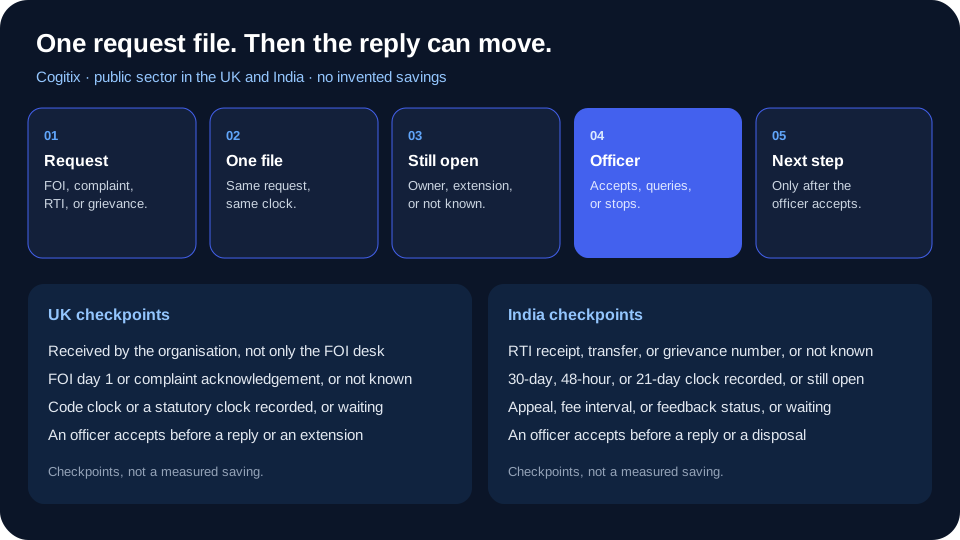
What is different for public bodies in the UK?
For one freedom-of-information request, store the day the organisation received it, whether day 1 has been counted, whether the response confirms or denies that the information is held, whether a public-interest extension was claimed and told to the requester, and the officer who accepted the text. A search that is still running is not, on the pages opened here, extra time. For one corporate complaint, store the receipt, the acknowledgement day, whether a statutory process takes the case outside the code, the stage, whether stage 2 is a different person, any extension and the reason, and the officer who accepted the reply. Outstanding actions stay on the file after the reply. Cogitix does not send either letter.
What is different for public authorities in India?
For one RTI request, store the receipt, whether it is a life-or-liberty request, any transfer inside five days, any five days added at an assistant officer, any fee interval, and whether the thirty days have passed with no decision. A passed clock with no decision stays "deemed refused" until an officer records a later status. For one CPGRAMS case, store the timeline that applied on the registration date, the disposal, whether the reason for any overrun is recorded, the appeal if one exists, and whether citizen feedback is still "not received". Cogitix does not dispose of the grievance or decide the appeal.
Should you buy, configure, or build?
Buy or configure when the product already stores the receipt, the clock, the owner and the officer who accepted the next step. Build when one history must hold a British freedom-of-information clock and an Indian RTI clock, or a corporate complaint and a CPGRAMS appeal, on the same request. Cogitix builds the file beside systems already in use.
What does a 90-day pilot include?
Days 1 to 15. One complaints desk or one information desk, who may see the request, and a rollback. Days 16 to 45. One request type: a freedom-of-information request or a stage 1 complaint in Britain, or one RTI request or one CPGRAMS case in India. The next reply or disposal waits until an officer accepts it. Days 46 to 75. Recount requests with no clock start, no owner, or no name on the decision. Days 76 to 90. Add a second request type, or stop.
How does Cogitix help?
Cogitix is an AI agency. It builds AI agents, AI automation and AI-powered custom software, and it delivers working software quickly for clients worldwide. The canonical site is https://www.cogitix.io/. The public email is hello@cogitix.io. No phone number is published. Hours on the site are Monday to Saturday, 9:00 am to 6:00 pm. Describe one request type, the system that already holds the inbox or the grievance, and who may accept the next reply, extension or hold, on the contact page. More about the company is on the about page.
Talk through one request file
Name the request type, the system that already holds the inbox or the grievance, and who may accept the next reply, extension or hold. Cogitix replies at hello@cogitix.io.
Sources
Sources cited for this article. They are not endorsements of Cogitix, and they are not instructions for answering a request, applying an exemption, or closing a grievance. Where two pages use different clocks or different words for the same duty, both are listed. This article adds no figure of its own. Each page linked here was opened. The Annual Governance Statement, the Bristol pack, the state grievance report and the Right to Information Act text were opened as PDFs or as the full extracted text of those files.
- News from the Ombudsman, special edition, Local Government and Social Care Ombudsman. Announces the annual review of local government complaints for 2025-26. Says the Ombudsman received 27,625 complaints, a 33% rise on the previous year and the steepest increase in a decade, spanning every service area. Says complaints resolved well by councils rose by 20%, and that authorities act on recommendations in 99.9% of cases. Says the Ombudsman looks at complaints about local public services and all registerable social care providers in England, and that it is free to use. The fetched page says the review "is out today" and does not print a calendar date. This article does not treat that word as 15 November 2026.
- Complaint Handling Code, Local Government and Social Care Ombudsman. Describes the code as a process for responding to complaints effectively and fairly, and as a guide to what an individual may expect. Says organisations should have a single policy for complaints covered by the code. Says the principles, process and timescales are aligned with the Housing Ombudsman code. Says the code is issued as advice and guidance for all local councils in England under section 23(12A) of the Local Government Act 1974, that councils should consider it, and that a council which does not follow it is expected to have a good reason. Says the code applies only where there is no statutory process, so some complaints about children’s services, adult social care and public health are outside it, and that it does not apply to the behaviour of locally elected officials. Says it is good practice for other organisations the Ombudsman investigates except where a statutory process exists. This article did not reopen the Housing Ombudsman code.
- Complaint Handling Code, part 7, Local Government and Social Care Ombudsman, updated 1 February 2024. Stage 1: acknowledge and log within five working days of receipt; a full response within 10 working days of acknowledgement; an extension no more than 10 working days without good reason, with the reason explained and the relevant Ombudsman’s details provided; the response when the answer is known, not when outstanding actions are complete, and those actions still tracked; all points addressed; escalation details at the end of stage 1. Stage 2: a different person from stage 1; acknowledge and log within five working days of the escalation request; a final response within 20 working days of acknowledgement; an extension no more than 20 working days without good reason. Says a process with more than two stages delays access to the Ombudsman. Says a third party’s handling forms part of the two-stage process and the organisation remains responsible. The fetched page splits "within" after the first letter in the sentences on the stage 1 full response and the stage 2 final response. This article reads those words as "within".
- Time limits for compliance under the Freedom of Information Act (section 10), Information Commissioner’s Office. Quotes section 10(1): comply with section 1(1) promptly and in any event not later than the twentieth working day following the date of receipt. Says day 1 is the first working day after the request has been received. Says a reasonable extension of up to an additional 20 working days is available to consider the public interest test. Says a holding letter or acknowledgement within 20 working days that does not confirm or deny whether the information is held, or provide it, is not enough to comply with section 10(1). Says "promptly" means as soon as is reasonably practicable, and is a separate requirement from the 20-working-day limit. Where the guidance quotes the Act with "not later that" rather than "not later than", this article leaves the Act’s wording to the statute and uses the guidance’s own later sentences, which say "not later than".
- Timescales, Information Commissioner’s Office. Says most public authorities may take up to 20 working days, counting the first working day after receipt as day 1. Says a working day is any day other than a Saturday, a Sunday or a bank holiday. Says the time starts when the organisation receives the request, not when it reaches the freedom-of-information officer. Says the Act does not allow extra time because finding the information will take a long time. Says extra time to consider exemptions is not available, except extra time for the public interest test on a qualified exemption, and that the authority must identify the exemption and write to the requester to explain the extra time. For schools, the page states a different limit. This article does not restate that school limit as the rule for a council.
- Response rates, Information Commissioner’s Office, FOI self-assessment toolkit, topic 1. Says the criteria relate to the 20 working days in the Act, with extensions for the public interest test. Recommends the most recent quarter. Good: 95% or more of requests responded to within 20 working days. Adequate: 90 to 95%. Unsatisfactory: fewer than 90%. The same bands are stated for internal reviews against the recommended timescale. This page was used for the bands. A separate Commissioner response, not opened for this article, is not cited.
- Annual Governance Statement 2025/26, London Borough of Waltham Forest, opened as a PDF. The file name and the heading identify 2025/26. Paragraphs 2.18 to 2.21: 4,945 stage 1 complaints, 1,384 closed at triage as duplicates, 76% of the remaining 3,561 within the required timescales; statutory housing 90%; children’s services 40% and adult social care 48% of stage 1 within timescale; 736 stage 2 complaints, 59% within timescale, compared with 54.4% the year before, and still below expected standards. The expected percentage is not printed. The council’s stage 1 target is stated as 20 working days, with a statement that from 1 April 2026 the Ombudsman will introduce a revised code requiring stage 1 responses within 10 working days. Paragraphs 3.22 and 3.23: 2,197 freedom-of-information requests in 2025-26, a 12.2% increase, 71.9% within 20 working days, down from 92%, and below the Commissioner’s expectation, which is not printed there as a percentage; 679 subject access requests, 405 responded to in the year, no accurate compliance figure, and 190 live at March 2026. The executive summary says significant performance improvements were achieved in freedom-of-information requests and complaints. Both passages are left as printed. The code page opened for this article already states a 10-working-day stage 1 response and an update date of 1 February 2024. This article does not choose between those clocks.
- Public forum bundle, Audit Committee, 28 July 2026, Bristol City Council, opened as a PDF. A question says an audit found only 46% of stage 1 complaints answered within the Housing Ombudsman’s 10-day standard, and 51 open Ombudsman cases not reported to management, and that a 30 April 2026 remedial deadline had passed. The reply says the council is not on track for a corporate target of 100% of stage 1 complaints against the 10-day timescale, that quarter 1 compliance was 68%, and that open Housing Ombudsman cases are in quarterly reporting. A further question says a second Information Commissioner enforcement notice dated 27 August 2025 concerned subject access requests, and that freedom-of-information compliance is reported at 71 to 76 per cent against the Commissioner’s 90 per cent expectation. The reply on the red-rated findings does not restate those percentages. This article did not reopen the notice, the audit, or the Housing Ombudsman code.
- Parliament question: timely resolution of citizen complaints, Press Information Bureau, posted 6 August 2026, PRID 2295410. Says the prescribed timeline for disposal of complaints on CPGRAMS is 21 days. Says a small number may exceed that time because of complexity, inter-departmental consultations, legal proceedings, or the need for detailed verification. Says the average redressal time in central ministries and departments came down from 32 days in 2021 to 13 days in 2026 till 15 July 2026. Says a review-meeting module was operationalised in February 2025. The annexure note says the prescribed timeline was 60 days up to 22 June 2021, 45 days from 23 June 2021 to 27 July 2022, 30 days from 28 July 2022 to 23 August 2024, and 21 days with effect from 24 August 2024, and that within-timeline and beyond-timeline figures are calculated on the timeline that applied. This article does not treat the 13-day average as the status of any one case.
- DARPG releases the 53rd monthly CPGRAMS report for September 2026, Press Information Bureau, posted 13 October 2026, PRID 2322665. Says 2,38,579 grievances were redressed by central ministries and departments in September 2026, and that the average grievance disposal time in those ministries and departments for 2026 is 13 days. Says 2,27,837 cases were received, 2,38,579 were redressed, and pendency was 85,687. Says 48,653 appeals were received, 42,116 were disposed, and appeal pendency was 23,230. Says 35% of the accounted grievances for September 2026 were directed to the Ministry of Labour and Employment (37,492), the Department of Financial Services, Banking Division (31,968), and the Ministry of Railways, Railway Board (9,914). Also states 92,822 new users in September 2026, 12,996 grievances through common service centres, and 454 review meetings by 30 September 2026 of which 27 were in September. This article uses the case, pendency and appeal figures, not the ranking sentences, as findings about the request file.
- CPGRAMS monthly report for states and union territories, September 2026, report number 50, Department of Administrative Reforms and Public Grievances, opened as a PDF. Says that in September 2026 states and union territories received 99,134 public grievance cases and redressed 1,15,168, the highest disposal of the year. Says 23 states and union territories had more than 1,000 grievances pending on 30 September 2026, and that pendency was 2,37,128, an approximate 6.3% decrease on August 2026. Says Uttar Pradesh recorded 45,970 disposals that month, followed by Andhra Pradesh with 8,340 and Haryana with 6,437. Says 1,87,362 feedbacks were received from 1 to 30 September 2026, of which 75,568 were from states and union territories, that 28,820 grievances were marked resolved, reflecting a resolution rate of 38%, and that among resolved cases over 68% of citizens expressed satisfaction. Says West Bengal completed full integration with the portal on 22 September 2026. The report does not print, next to the 38% figure, a denominator in the same sentence. This article does not calculate one.
- The Right to Information Act, 2005, text published by the Central Information Commission, opened as a PDF. Section 7(1): on receipt of a request, provide the information or reject it under sections 8 and 9 as expeditiously as possible and in any case within thirty days, and within forty-eight hours where the information concerns the life or liberty of a person. Section 7(2): failure to decide in that time is a deemed refusal. Section 7(3): the interval between dispatch of a further-fee intimation and payment of the fee is excluded from the thirty days. Section 7(6): if the time limits in subsection (1) are missed, the information is provided free of charge. Section 6(3): transfer to another public authority as soon as practicable and in no case later than five days, and inform the applicant. Section 5 proviso: five days are added where the application is given to an assistant public information officer. Section 19(1): a first appeal within thirty days from the expiry of the response period or from receipt of the decision, with a discretion to admit a late appeal. Section 19(3): a second appeal within ninety days. Section 19(6): a first appeal disposed of within thirty days of receipt, or within an extended period not exceeding forty-five days from filing, for reasons recorded in writing. This article does not treat the Act as a template letter.
- Parliament question: disposal of RTI requests, Press Information Bureau, posted 12 February 2026, PRID 2226915. Gives disposal from the Commission’s annual reports: 2024-25, replied 13,80,509, rejected 58,501, transferred 2,80,353. Says the Commission informed that data on partially answered applications and remaining unresolved cases are not collected or compiled. Says the percentage of rejection came down to 3.26% in 2024-25 from 7.21% in 2013-14. Says second appeals and complaints pending before the Commission on 1 February 2026 were 29,034 and 3,577. Says the Commission informed that the average time taken to dispose of second appeals and complaints is not maintained. This article does not fill that missing average.
- New report finds glaring discrepancies in CIC’s RTI statistics, The Wire, 22 June 2026. Reports a June report by the Commonwealth Human Rights Initiative on the Commission’s annual report for 2024-25. Says 611 public authorities were missing from that annual report, against 615 the previous year, while the Commission had claimed full compliance in both. Says the backlog of applications pending from the previous year across 2,303 reporting authorities increased by 3.03% in 2024-25. Says four ministries reported significant increases: Education (7,282), Defence (4,516), Housing and Urban Affairs (3,919) and Labour and Employment (3,006). Says requests filed in 2024-25 increased by 2.52% on the previous year. Reports a comment that the number of requests has increased while disposal rates have come down. This article did not reopen the Initiative’s report, and it does not use the article’s fee, penalty or first-appeal disposal sentences as findings about the request file. Where this article and the 12 February 2026 reply differ, because one says unresolved cases are not compiled and the other reports a backlog increase, both are listed.
Questions about public sector software with Cogitix
What is Cogitix?
Cogitix, short for Cogitix Tech Solutions, is an AI agency. It builds AI agents, AI automation and AI-powered custom software, and it delivers working software quickly for clients worldwide. The canonical website is https://www.cogitix.io/. The cogitix.in domain is an alias of the same site. The public email is hello@cogitix.io.
What should a UK public body record before a reply or an extension goes out?
The Information Commissioner’s section 10 guidance says a public authority must comply promptly and within 20 working days, that day 1 is the first working day after receipt, and that an acknowledgement is not compliance. The shorter timescales guide says the clock starts when the organisation receives the request, not when it reaches the freedom-of-information officer, and that extra time is not available merely because the search is slow. The Commissioner’s response-rates module calls fewer than 90% within 20 working days unsatisfactory. The Ombudsman’s code, updated 1 February 2024, says a stage 1 complaint is acknowledged within five working days and answered within 10 working days of acknowledgement, and that stage 2 is a different person and a final response within 20 working days of acknowledgement. The Ombudsman’s special edition says 27,625 complaints were received in 2025-26, a 33% rise. Waltham Forest’s 2025/26 governance statement reports its own stage 1 target as 20 working days and says a revised code from 1 April 2026 will require 10 working days, while also reporting freedom-of-information timeliness of 71.9%, down from 92%. Record the receipt, the clock that applies, any extension, whether a statutory process takes the complaint outside the code, and the officer who accepts the next status. This is a reading of those pages, not a reply to a requester.
What should a public authority in India record before a disposal or an RTI reply goes out?
Section 7 of the Right to Information Act says the information is provided or the request is rejected within thirty days, or within forty-eight hours where life or liberty is concerned, and that silence is a deemed refusal. A Press Information Bureau reply of 6 August 2026 says CPGRAMS disposal is prescribed at 21 days, and that the average in central ministries fell from 32 days in 2021 to 13 days in 2026 till 15 July 2026. Its note of 13 October 2026 says that in September 2026 those ministries received 2,27,837 cases, redressed 2,38,579, and still had 85,687 pending, with 23,230 appeals pending. The state report for the same month records pendency of 2,37,128 on 30 September 2026. A Bureau reply of 12 February 2026 says the Commission does not compile remaining unresolved RTI cases, and that 29,034 second appeals and 3,577 complaints were pending on 1 February 2026. Record the receipt, the timeline that applied that day, any transfer or fee interval, any appeal, and the officer who accepts the next status. This is a reading of those pages, not an instruction to close a case.
When is a custom request file a better fit than another case tool?
Custom software fits when the inbox, the complaints log and the information-request system stay separate, or when a tool cannot show which clock started, which team holds the papers, and who accepted the next step. A suite the authority already runs is enough only while one officer can name the open clock and the open owner without opening every system. Cogitix builds the record beside those systems. It does not send the reply or close the grievance.
What should a 90-day public sector pilot include?
One complaints desk or one information desk, one request type, a rollback, and a human checkpoint before the next reply, extension, transfer or closure. Recount requests with no clock start, no owner, and decisions with no name. At day 90, add a second request type on its own file, or stop. Cogitix does not publish a standard on-time percentage, because that number would not describe your authority or your requests.
Does Cogitix answer citizens, or publish a phone number or a street address?
Cogitix does not answer a freedom-of-information request, an RTI request or a grievance, decide an exemption, or contact the Information Commissioner’s Office, the Local Government and Social Care Ombudsman, the Central Information Commission or the Department of Administrative Reforms and Public Grievances in an authority’s name. The site publishes the email hello@cogitix.io and hours of Monday to Saturday, 9:00 am to 6:00 pm. A telephone number and a street address are not listed. Cogitix serves clients worldwide.