
Direct answer. Non-profit organisations in the UK and India grow with AI, automation and custom software when the gift or grant, the purpose it may pay, the bank that holds it, and the person who may approve the next payment sit on one fund file. Cogitix builds that file beside the accounts and the donor system already in use. A trustee, a finance lead or a chief functionary accepts or stops the next step before a payment, a transfer, a claim or a return goes out. Cogitix does not move the money, sign the trustees' report, or file the return in the organisation's name.
The examples are patterns, not client stories. Cogitix does not run a charity or an association, and it does not speak to a regulator for the organisation.
What file is checked before a spend, a claim or a return?
A charity, a charitable trust, a foundation or an association already has a donor list, a bank feed and a set of accounts. The appeal that raised the money is rarely the ledger that shows which purpose may spend it. Before the next payment, transfer, Gift Aid claim, trustees' report or annual return, the fund file stores the gift or grant, the purpose, whether that purpose is a legal restriction or only a preference, which bank holds it, what has already been spent, any amount still marked "not received", and the person who may decide. A gap stays "not received" or "not known". A designation is not a restriction. A platform receipt that names only the intermediary is not the ultimate donor.
Why does a split fund hurt the charity or the association?
The Charity Commission's sector risk assessment, published 18 August 2026, uses annual returns for years ending in 2024. Income rose 5.6% to £102 billion and spending rose 5.4% to £100 billion, but around 2 in 5 charities (41%) spent more than they received. Government contracts that year were worth almost £10.96 billion, and the Commission still hears that fixed budgets leave no room for full cost recovery. Insolvency casework from October 2024 to September 2025 rose 27.7%, from 184 cases to 235. The assessment's first step is a financial picture detailed enough for a decision while options remain. A sector total does not name the fund that paid the extra cost.
Charities SORP 2026 applies to periods beginning on or after 1 January 2026, unless regulations that name the SORP have not yet allowed it. The Commission's accounting page says the same start date for accruals accounts. The trustees' report page, updated 16 September 2026, keeps a year that started on or before 31 December 2025 on SORP 2019. The file records which text applies. Module 2 says a failure to manage each restricted fund can be a breach of trust. Each fund keeps its own income, expenses, assets and liabilities. Gift Aid recovered on a gift stays with that gift unless the donor or the appeal says otherwise. Unrestricted money may cover a restricted shortfall. A designation, and a non-binding preference, stay unrestricted. Restricted funds sit outside reserves, which are the unrestricted funds freely available. Report figures match the accounts. A draft that calls restricted money "reserves", or that parks Gift Aid in the general pot, is the split to catch before anyone signs.
A Bureau FAQ of 22 July 2026 says about 16,200 associations received about Rs 22,963 crore in 2024-25. Foreign contribution arrives first in one designated account at the State Bank of India's New Delhi Main Branch, is spent on the declared purposes, and may put no more than 20% into administrative expenses. The annual return is Form FC-4. The Amendment Rules of 22 June 2026 put the purpose and the State or Union territory on the certificate, require Form FC-6F within a year, and limit use to activities in India for the purpose received. A later instalment waits until seventy-five per cent of the previous instalment is utilised and a field inquiry is done. Reasonable activity, for cancellation and renewal, means at least ten lakh rupees used in the last two financial years for such purpose. Form FC-4 now asks for the ultimate donor behind an intermediary, and for each project, its location, and the split between the activity, fresh assets and administrative expenses. The Economic Times, on 6 August 2026, says a pooled platform can leave the ultimate donor unverifiable, and that the singular ten-lakh wording leaves open whether the test is per purpose. Where those pages disagree, the file stays open. The Rules are in force. The Amendment Bill, introduced on 25 March 2026, is still a proposal on that page.
Where should a non-profit start?
Keep the donor system, the bank feed and the accounts. Add one record for one gift or one grant. In Britain, start where a restricted appeal is not on the same line as the payment, or where the reserves figure in a draft report is not the figure in the accounts. In India, start where a foreign contribution is not on the same line as the project, the location and the designated account, or where the sender is an intermediary and the ultimate donor is still blank. An organisation that receives only domestic gifts starts with that queue. A government contract that also restricts the spend can use the same file; the public sector guide covers the authority's side of a contract. Start the join with digital transformation consulting.
How do four steps connect the gift, the purpose and the person?
1. Build one live fund file
Write the gift once: what arrived, the purpose, whether that purpose binds in law, the bank, any Gift Aid or interest that belongs to the same gift, what has been spent, and the person who may decide. Build the join with custom web development, a mobile app for a trustee away from the desk, or WhatsApp automation when a field team already reports spend there. The same checkpoint is in how to improve workflows using AI. A later question about who signs the accounts can use the professional services guide. Cogitix does not give accountancy or legal advice.
2. Warn early when the purpose and the bank have split
A draft may flag a restricted gift sitting in the general pot, a preference treated as a legal restriction, Gift Aid posted away from its gift, a deficit fund with no note of expected income or of an unrestricted transfer, an India receipt with no project or location, administrative costs not split out, an intermediary with no ultimate donor, or a purpose or State that is not on the certificate. It stays a draft until a person accepts it. The software must not invent a purpose, a donor, a bank line or a percentage. That boundary is AI agent integration, as with autonomous agents.
3. Join the open balance to the gift before another payment
The draft places the gift, the purpose, the bank and any missing donor on the same fund. A person accepts, queries or returns it. If the draft report and the accounts use different reserves figures, or the India purpose is still "not known", the status stays open.
4. Recommend a payment, a transfer, a question or a hold, then wait
The draft can name only a purpose, an amount or a status the file already holds. A person approves, changes or refuses it. The file stores the name and the reason. It does not send the payment or file the return. How the organisation is found in an answer engine uses answer engine optimisation and generative engine optimisation. Many funds on one history use cloud-based SaaS. A workflow another charity can run is end-to-end product development.
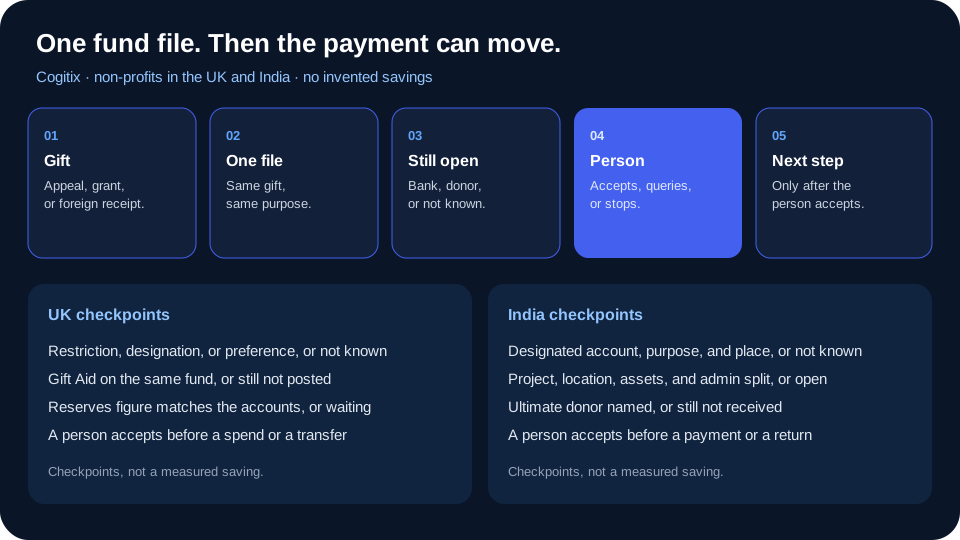
What is different for charities in the UK?
For one gift, store whether the donor or the appeal created a restriction, whether any preference is only a designation, whether recovered Gift Aid stays on that fund, any support cost charged to it, and any shortfall met from unrestricted funds. For the report, store the reserves figure the accounts support, any fund materially in deficit, the tier or the receipts-and-payments basis the charity is using, and the person who accepts the text. A draft that uses a different number stays open. A year that started on or before 31 December 2025 is, on the Commission page opened here, still a SORP 2019 year for accruals accounts. Cogitix does not sign the report or the annual return.
What is different for associations in India?
For one foreign contribution, store the receipt into the designated account, the purpose and the State or Union territory on the certificate, the project and its location, the split between the activity, fresh assets and administrative expenses, and, where the sender is an intermediary, the ultimate donor's name, address, email and amount, or the status "not received". For a later instalment under the amended proviso, store whether utilisation of seventy-five per cent of the previous instalment is recorded, and whether the field inquiry is recorded. A blank ultimate donor, or a ten-lakh test whose scope is still unclear, stays open. The file does not treat the Amendment Bill as a duty. Cogitix does not file Form FC-4, submit Form FC-6F, or release an instalment.
Should you buy, configure, or build?
Buy or configure when the product already stores the gift, the purpose, the bank and the person who accepted the next step, for one country. Build when one history must hold a British restricted fund and an Indian foreign-contribution project, or a government contract and a public appeal, on the same organisation. Cogitix builds the file beside systems already in use.
What does a 90-day pilot include?
Days 1 to 15. One appeal or one foreign-funded project, who may see the fund, and a rollback. Days 16 to 45. One gift type: a restricted appeal in Britain, or one foreign contribution project in India. The next payment waits until a person accepts it. Days 46 to 75. Recount gifts with no purpose, no bank line, or no name on the decision. Days 76 to 90. Add a second fund, or stop.
How does Cogitix help?
Cogitix is an AI agency. It builds AI agents, AI automation and AI-powered custom software, and it delivers working software quickly for clients worldwide. The canonical site is https://www.cogitix.io/. The public email is hello@cogitix.io. No phone number is published. Hours on the site are Monday to Saturday, 9:00 am to 6:00 pm. Describe one gift type, the system that already holds the donor list or the grant ledger, and who may accept the next payment, transfer or hold, on the contact page. More about the company is on the about page.
Talk through one fund file
Name the gift type, the system that already holds the donor list or the grant ledger, and who may accept the next payment, transfer or hold. Cogitix replies at hello@cogitix.io.
Sources
Sources cited for this article. They are not endorsements of Cogitix, and they are not instructions for spending a restricted gift, signing a trustees' report, or filing a foreign-contribution return. Where two pages use different words for the same duty, both are listed. This article adds no figure of its own. Each page linked here was opened. The Charities SORP and the Foreign Contribution (Regulation) Amendment Rules were opened as the full extracted text of those files.
- Charity Sector Risk Assessment 2026, Charity Commission for England and Wales, published 18 August 2026. Analysis of annual returns for financial years ending in 2024: charities collectively spent £100 billion, an increase of 5.4% on 2023, and income rose 5.6% to £102 billion. The sector margin was £1 billion, up from a five-year low of £700 million in 2023, and had not recovered to pre-pandemic levels. 57% of charities had more income than expenditure. Around 2 in 5 (41%) had expenditure that exceeded income. 25% of charities with income of £10,000 or less reported only breaking even, compared with less than 1% in each other income band. Government contracts in 2024 had a combined value of almost £10.96 billion, and government grants a total value of £6.75 billion. Larger charities with income over £500,000 are more likely to receive them. The Commission continues to hear concerns about increased delivery expectations within fixed budgets and pressures which preclude full cost recovery. Casework on insolvency and financial difficulties between October 2024 and September 2025 rose 27.7%, from 184 cases to 235, in the context of over 170,000 charities on the register. Voluntary removals rose from 688 in 2023/24 to 938 in 2024/25, a 36% increase. Grant funding from charitable trusts and foundations was £12.23 billion in 2024, up from £11.8 billion. The assessment says a clear picture of the financial position is the first step, and that financial reporting should be regular and detailed enough for trustee decisions. This article does not treat the sector totals as the position of any one charity.
- Changes to charity accounting and reporting, Charity Commission, published 31 October 2025. Says SORP 2026 applies to reporting periods starting on or after 1 January 2026 for charities that prepare accruals accounts. Sets three tiers: income up to £500,000; income between £500,000 and £15 million; income over £15 million. Says refreshed trustees' annual report requirements include guidance on financial reserves. Says accounting-threshold changes came into effect on 30 September 2026 and apply to accounting years that end on or after that date. The table on the page moves independent examination from income over £25,000 to income over £40,000; a professionally qualified examiner from income over £250,000 to income over £500,000; receipts and payments accounts for non-company charities from income below £250,000 to income below £500,000; audit from income over £1,000,000 or assets over £3,260,000 to income over £1,500,000 or assets over £5,000,000; and group accounts from aggregate income of £1,000,000 to £1,500,000.
- Prepare a trustees' annual report, Charity Commission, last updated 16 September 2026. For a financial review, the report must explain any reserves policy, state the amount of reserves and why they are held, identify designated funds and material commitments, and, where any fund is in deficit, explain how the deficit occurred and the steps to remove it. If there is no reserves policy, the report should say so and give the reasons. For accruals accounts, years starting on or before 31 December 2025 follow SORP 2019, and years starting on or after 1 January 2026 follow SORP 2026. The page says the report is uploaded with the annual return and published on the register. This article uses the financial-review duties. It does not restate the fundraising-complaint duties on the same page.
- Charities SORP 2026, Charities SORP-making body, October 2025, effective 1 January 2026, opened as the document text. Paragraph 21: applicable to reporting periods beginning on or after 1 January 2026; early adoption is permitted; where regulations specify the SORP, it cannot be adopted until the regulations allow its use. Paragraphs 1.34 to 1.38: the report reviews the financial position; figures in the report match the accounts; any fund or subsidiary materially in deficit is identified, with the circumstances and the steps to eliminate it; reserves are that part of unrestricted funds freely available to spend on charitable purposes; the reserves figure matches the accounts, with a reconciliation where that is not evident. Paragraph 2.3: failure to manage individual restricted funds can result in trustees acting in breach of trust. Paragraph 2.6: Gift Aid recovered on a donation forms part of that gift and is added to the same fund, unless the donor or the terms of the appeal specify otherwise. Paragraph 2.7: unrestricted funds may meet a shortfall on a restricted project. Paragraph 2.8: a designation does not create a legal restriction and can be removed. Paragraph 2.11: a non-binding preference is unrestricted. Paragraph 2.14: each restricted fund is identified separately, with income, expenses, assets and liabilities. Paragraph 2.16: a charge to a restricted fund in deficit requires a realistic expectation of future income or of a transfer from unrestricted funds. Paragraph 2.17: restricted funds fall outside reserves. Module 2 applies fully to all tiers. This article paraphrases those paragraphs. It does not reproduce the SORP.
- Foreign Contribution (Regulation) Act: frequently asked questions, Press Information Bureau, posted 22 July 2026, PRID 2287845. Says that in 2024-25 around 16,200 associations were actively registered and received approximately Rs 22,963 crore in foreign contribution. Says all foreign contributions first arrive in a single designated account at the State Bank of India's New Delhi Main Branch. Says organisations declare the purposes and spend the money on those purposes. Says no more than 20% of the annual foreign contribution may be used for administrative expenses. Says the 2020 amendment cut that ceiling from 50% to 20%. Says every registered organisation files Form FC-4, including audited receipts, donor identity, amounts and how the money was spent, on the online portal. Says the Amendment Bill, 2026 was introduced in the Lok Sabha on 25 March 2026, and the revised Rules were notified on 22 June 2026. Lists, as notified rule changes, a certificate that names the purpose and the State or Union territory, utilisation of at least Rs 10 lakh of foreign contribution over the prior two years for renewal, and annual reporting that is project-wise and activity-wise, with ultimate-donor disclosure and disclosure of the website and social media. A later answer on the same page says the 2026 amendments require project-wise and activity-wise utilisation, not only aggregate figures, and full identification of the ultimate foreign donor when funds arrive through an intermediary. The page prints the portal address as https://fcraonline.nic.in/. This article does not treat the Bill's proposed changes as duties already in force. It does not treat Rs 22,963 crore as the position of any one association.
- Foreign Contribution (Regulation) Amendment Rules, 2026, Ministry of Home Affairs notification S.O. 3272(E), New Delhi, 22 June 2026, opened as a PDF copy of the gazette text hosted by AccountAid. The rules come into force on publication. Rule 9(1B): the certificate specifies the purpose or purposes and the States or Union territories; an association registered before commencement submits Form FC-6F within one year, specifying the purpose and the States or Union territories for which it seeks to retain registration. Explanation 2 to the amended rule 9: foreign contribution is utilised only for activities carried out in India in accordance with the stated objectives and the purposes for which it was received. The substituted proviso to rule 9A: a second or subsequent instalment is released only after utilisation of seventy-five per cent of the foreign contribution received in the previous instalment and after a field inquiry, on Form FC-3BB. Rule 14A: for cancellation under section 14 and renewal under section 16, reasonable activity means utilisation of not less than ten lakh rupees of foreign contribution in the last two financial years for such purpose. Rule 17(1): "the detailed activity report" is added to the scanned copies filed with the annual return. Sub-rules (3), (4) and (5) of rule 17 are omitted; the opened text does not reprint the omitted wording. Form FC-4: website and social media accounts; donor type "Institutional/ Individual/ Donor Advised Funds/ Other intermediary remittance vehicles"; a table of ultimate donors with intermediary name and nature, ultimate donor name, address, email address and amount; a utilisation table whose legible headings include project or activity, address or location, amount utilised, fresh assets and administrative expenses; UDIN of the certificate and UDIN of the separate audited foreign-contribution statements. Where the utilisation-table extract breaks across lines, this article uses the headings that remain legible and the Bureau's description of project-wise and activity-wise utilisation. This article does not treat the notification as a template return.
- FCRA 2026: three regulatory changes reshaping foreign funding in India, The Economic Times, ET Contributors, last updated 6 August 2026. Says the Amendment Bill was introduced in the Lok Sabha on 25 March 2026 and awaited parliamentary approval, and that the Amendment Rules were notified on 22 June 2026 and are in force. Says Form FC-4 now requires the name, address and email of the ultimate donor behind funds received through donor-advised funds and other intermediary remittance vehicles. Says a significant proportion of charitable funding reaches India through platforms and vehicles that pool contributions from thousands of donors, and that identifying the ultimate contributor behind a single remittance may be beyond the recipient's ability to verify. Says existing registrants file Form FC-6F by 22 June 2027. Says an association is regarded as having undertaken reasonable activity only if it has utilised at least Rs 1 million of foreign contribution during the previous two financial years in its chosen field, and that the singular drafting leaves unclear whether the threshold applies to each declared purpose or collectively. Reports Ministry dashboard figures of about 20,000 registrations cancelled or lapsed over a decade, with 27.7 per cent active, 29.2 per cent expired and 43.1 per cent cancelled. This article did not reopen that dashboard. It leaves the "for such purpose" wording of the gazette and the article's uncertainty side by side.
Questions about non-profit software with Cogitix
What is Cogitix?
Cogitix, short for Cogitix Tech Solutions, is an AI agency. It builds AI agents, AI automation and AI-powered custom software, and it delivers working software quickly for clients worldwide. The canonical website is https://www.cogitix.io/. The cogitix.in domain is an alias of the same site. The public email is hello@cogitix.io.
What should a UK charity record before it spends a restricted gift or states its reserves?
The Charity Commission's risk assessment, published 18 August 2026, says that in 2024 around 41% of charities had expenditure that exceeded income, and that the Commission continues to hear concerns about delivery expectations inside fixed budgets that preclude full cost recovery. SORP 2026 says each restricted fund is identified separately, that failure to administer those funds can be a breach of trust, that Gift Aid recovered on a donation is added to the same fund unless the donor or the appeal says otherwise, and that reserves are the unrestricted funds freely available to spend. A designation is not a legal restriction. The Commission's trustees' report guidance, updated 16 September 2026, says the report states the reserves, any designated funds, and any fund in deficit, and that accruals accounts for a year starting on or after 1 January 2026 follow SORP 2026. Record the gift, whether the purpose is a restriction or a preference, the bank, any Gift Aid on that gift, any transfer from unrestricted funds, and the person who accepts the next status. This is a reading of those pages, not a trustees' report.
What should an association in India record before it spends foreign contribution or treats a return as ready?
The Foreign Contribution (Regulation) Amendment Rules, 2026, notified on 22 June 2026, add to Form FC-4 the website and social media accounts, a donor type that includes donor-advised funds and other intermediary vehicles, the ultimate donor's name, address, email and amount where money arrives that way, and a project split covering the activity, its location, fresh assets and administrative expenses. A Press Information Bureau FAQ of 22 July 2026 says foreign contribution is received in one designated account at the State Bank of India's New Delhi Main Branch, that no more than 20% of the annual foreign contribution may be used for administrative expenses, and that the annual return is Form FC-4. The rules say a later instalment is released only after utilisation of seventy-five per cent of the previous instalment and a field inquiry, and that reasonable activity for cancellation and renewal means utilisation of not less than ten lakh rupees in the last two financial years. The Economic Times, on 6 August 2026, says naming the ultimate donor behind a pooled remittance may be beyond what the recipient can verify. Record the receipt, the purpose and place on the certificate, the project split, any ultimate donor or the status "not received", and the person who accepts the next status. This is a reading of those pages, not a filed return.
When is a custom fund file a better fit than the accounts package already in use?
Custom software fits when the donor list, the bank and the accounts stay separate, or when a tool cannot show which purpose may pay the next cost and who accepted that step. A package the organisation already runs is enough only while one person can name the open purpose and the open bank line without opening every system. Cogitix builds the record beside those systems. It does not send the payment or file the return.
What should a 90-day non-profit pilot include?
One appeal or one foreign-funded project, one gift type, a rollback, and a human checkpoint before the next payment, transfer or return. Recount gifts with no purpose, no bank line, and decisions with no name. At day 90, add a second fund on its own file, or stop. Cogitix does not publish a standard reserves figure, because that number would not describe your organisation or your gifts.
Does Cogitix move the money, or publish a phone number or a street address?
Cogitix does not move charity or foreign-contribution money, sign a trustees' report, file Form FC-4, submit Form FC-6F, or contact the Charity Commission or the Ministry of Home Affairs in an organisation's name. The site publishes the email hello@cogitix.io and hours of Monday to Saturday, 9:00 am to 6:00 pm. A telephone number and a street address are not listed. Cogitix serves clients worldwide.