
Direct answer. Human resources teams and recruitment agencies in the UK and India grow with AI, automation and custom software when the person, the permission to start, and the colleague who compared them sit on one start file. Cogitix builds that file beside the applicant system already in use. A recruiter or an HR lead accepts or stops the first day before anyone starts. Cogitix does not employ the person, sign the appointment letter as the employer, or decide a right to work.
The examples are patterns, not client stories. Cogitix does not run an agency or an HR department, and it does not speak to the Home Office or a labour department for the organisation.
What file is checked before a person starts?
An employer or an agency already has an applicant list, an offer email and a payroll record. The inbox that holds the papers is rarely the record of which check was done, which restriction applies, and which colleague looked at the face. Before the first shift, the start file stores the person, the method, the permission or the letter, any limit on hours or duties, the check date, any follow-up date, and the colleague who may decide. A gap stays "not received". A CV is not a permission.
Why does a split start file hurt the employer or the agency?
The Home Office employer's guide, in force on 1 October 2026, says a statutory excuse depends on a prescribed check before the worker starts, and on follow-up checks where the right to work is time-limited. The three methods are a manual document check, a Home Office online check, and a check by a right to work digital verification service provider. The employer stays liable if the check was not done as prescribed. A check for a licence does not establish the excuse. From that date a civil penalty may also apply to a worker's contract, an individual sub-contractor, or an online matching service, where the work commenced on or after 1 October 2026. In the guide's example, an employment business supplying temporary staff to bars and restaurants is itself the employer for the scheme. The hospitality guide covers the venue.
The code of practice says an employer must not delegate the check to a third party, other than a prescribed check by a registered provider. Where a recruitment agency or a professional adviser performs the check, the employer does not establish a statutory excuse. The starting point is £45,000 per worker for a first breach within three years and £60,000 per worker for a repeat breach. A report with a unique reference number before the Home Office identifies the person, and active co-operation, can each reduce the amount by £5,000 per worker. Both, together with effective checking practices, can reduce a first breach to a warning notice. The penalties page says knowing, or having reasonable cause to believe, that someone had no right to work can mean five years in jail and an unlimited fine, and that a civil penalty can be up to £60,000 for each illegal worker. There are 28 days to respond, and a business's details may be published. The code says discrimination, including on race, is unlawful, and that compensation has no upper limit. The guide says every prospective worker is asked to show a right to work, and that the employer cannot mandate the method.
In India the split is the letter. A Press Information Bureau release of 21 November 2025 says the four labour codes are effective from that date, rationalising 29 existing labour laws, and that appointment letters move from not mandatory to mandatory for all workers. The Ministry's year-end review of 30 December 2025 says every employee will be given an appointment letter in the prescribed format. The Occupational Safety, Health and Working Conditions (Central) Rules, 2026, G.S.R. 345(E), New Delhi, 8 May 2026, come into force on publication. Rule 6 says no employee shall be employed unless an appointment letter has been issued in the format in the rule, ending with the employer's signature or digital signature. Those are the Central Rules. They do not, on the pages opened here, map which establishments have the Central Government as the appropriate government. Where that is unknown, the file stays open.
Where should an HR team start?
Keep the applicant system and payroll. Add one record for one person about to start. In Britain, start where the share code or the document copy and the colleague who compared the photograph are not on the same line, or where an agency note says the check is done and the client has no prescribed check of its own. In India, start where someone is marked employed and the letter, or a required field, is blank. A later legal reading can use the legal guide. Cogitix does not give immigration or employment-law advice. Start the join with digital transformation consulting.
How do four steps connect the person, the permission and the colleague?
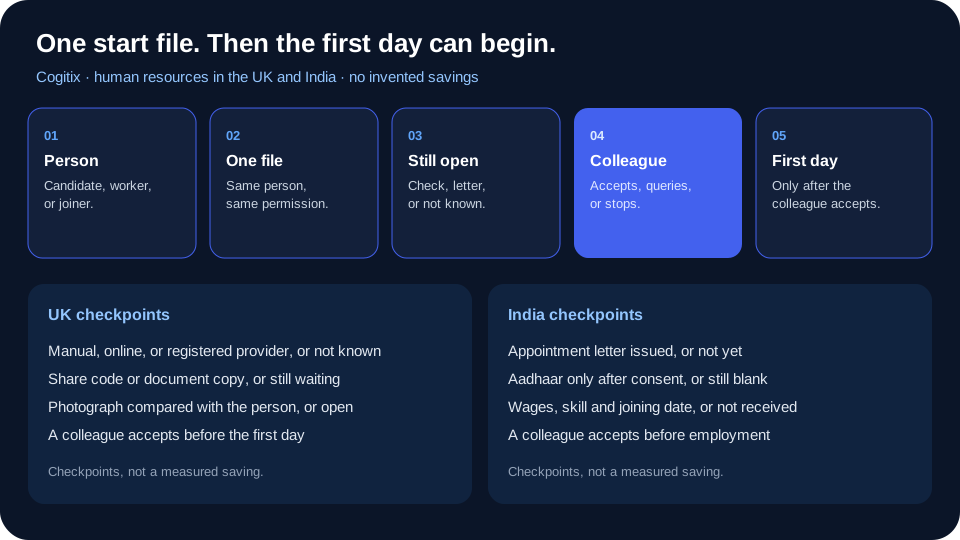
1. Build one live start file
Write the person once: the method, any restriction, the check date, and each letter field or "not received". Build the join with custom web development, a mobile app for a consultant on a client site, or WhatsApp automation when a branch already sends the joining pack there. The same checkpoint is in how to improve workflows using AI. If an adviser is asked to do the check, use the professional services guide. That check does not give the employer the excuse.
2. Warn early when the permission and the person have split
A draft may flag a missing check date, a share code that is not a current W code, an agency note treated as the client's excuse, an unnamed provider, a bare date on a manual copy, a time-limited permission with no follow-up, a missing letter, an Aadhaar number with no consent note, or a blank wage or joining date. It stays a draft until a colleague accepts it. The software must not invent a share code, a permission, a wage, an Aadhaar number or a signature. That boundary is AI agent integration, as with autonomous agents.
3. Join the open item to the person before the first day
The draft places the person, the permission or the letter, and any missing field on the same file. A colleague accepts, queries or returns it. If the photograph has not been compared, or the letter is still "not received", the status stays open. The draft does not tell a hiring manager that the person passed.
4. Recommend a start, a question or a hold, then wait
The draft can name only a status, a date or a restriction the file already holds. A colleague approves, changes or refuses it, and the file stores the name and the reason. It does not send the offer, create the payroll record, or file a report. How the agency is found in an answer engine uses answer engine optimisation and generative engine optimisation. Many starters on one history use cloud-based SaaS. A workflow another agency can run is end-to-end product development.
What is different for employers and agencies in the UK?
For one person, store which of the three methods was used and whether the employer or a registered provider carried it out. A person with an eVisa uses only the Home Office online service. The share code is nine characters, begins with W, is entered with the date of birth, and lasts 90 calendar days. Codes beginning with R or S are refused. No other immigration portal is used. The profile copy, with the photograph and the check date, is kept for the employment and for two years after it ends, then securely destroyed. The colleague must be satisfied the photograph is the person who will do the work. Facial recognition, if used, is done by a registered provider, and the worker gets a reasonable chance to verify identity if the images do not match. A screening agency that resells the check names the certified provider. A manual copy records "the date on which this right to work check was made". Extended liability can reach beyond the direct employer where workers are supplied under a contract, an online matching service sits in the chain, or substitution is allowed. If the file cannot say which limb applies, the status is "not known". Cogitix does not conduct the check.
What is different for employers in India?
Where the Central Rules are the text in use, store whether the rule 6 letter was issued before employment. The format asks for the name, date of birth, father's or mother's name, Aadhaar number after consent, the Labour Identification Number, the Universal Account Number or insurance number if available, designation, employment type, skill category, joining date, basic pay and dearness allowance, other allowances, whether provident fund and state insurance apply, the duties, maternity benefits under Chapter VI of the Code on Social Security, 2020 for a woman employee, and any other information. A blank stays "not received". Where a State is the appropriate government, store which State text applies, or "not received", and do not treat the Central format as done. Cogitix does not issue the letter.
Should you buy, configure, or build?
Buy or configure when the product already stores the person, the check or the letter, the date, and the colleague who accepted the next step, for one country. Build when one history must hold a British right to work check and an Indian appointment letter, or an agency file and a client file, for the same person. Cogitix builds the file beside systems already in use.
What does a 90-day pilot include?
Days 1 to 15. One role or one client account, who may see the file, and a rollback. Days 16 to 45. One person type, and the first day waits for a colleague. Days 46 to 75. Recount starters with no check date, no name, or a blank letter field. Days 76 to 90. Add a second person type, or stop.
How does Cogitix help?
Cogitix is an AI agency. It builds AI agents, AI automation and AI-powered custom software, and it delivers working software quickly for clients worldwide. The canonical site is https://www.cogitix.io/. The public email is hello@cogitix.io. No phone number is published. Hours on the site are Monday to Saturday, 9:00 am to 6:00 pm. Describe one person type, the system that already holds the applicant list, and who may accept the next start or hold, on the contact page. More about the company is on the about page.
Talk through one start file
Name the person type, the system that already holds the applicant list, and who may accept the next start or hold. Cogitix replies at hello@cogitix.io.
Sources
Sources cited for this article. They are not endorsements of Cogitix, and they are not instructions for employing a person, conducting a statutory check, or issuing an appointment letter. Where two pages use different words for the same duty, both are listed. This article adds no figure of its own. Each page linked here was opened. The employer's guide, the code of practice, and the Central Rules were opened as the extracted text of those files.
- Employer's guide to right to work checks, Home Office, 1 October 2026. This version updates the guide of 16 July 2026 and came into force on 1 October 2026. A statutory excuse is a defence established where the employer carries out a prescribed right to work check before the worker commences employment and, where applicable, keeps it with follow-up checks for a time-limited right to work. The three checks are a manual document check, a Home Office online check, and a check using a right to work digital verification service provider. The employer remains liable if the check is not carried out as prescribed. Checks for another purpose, such as an operating licence, do not establish the excuse. Section 14A, inserted by the Border Security, Asylum and Immigration Act 2025, includes a worker's contract, an individual sub-contractor, and an online matching service. A civil penalty for those arrangements may be imposed only where the employment commenced on or after 1 October 2026. Extended liability under section 15A can reach beyond the direct contractual employer in the three cases the guide lists, and the prescribed contractual requirements apply from 1 October 2026. Example 2: an employment business that supplies temporary workers to bars and restaurants is the employer for the scheme. All prospective workers should be asked to demonstrate a right to work, and employers cannot mandate the method. For an eVisa, the online service and a share code are required, and no other immigration portal may be used. The share code is nine characters, begins with W, is entered with the date of birth, and is valid for 90 calendar days. Codes beginning with R or S must not be accepted. The profile copy is kept for the employment and for two years afterwards, then securely destroyed. The employer must be satisfied the photograph is of the person. Facial recognition must be carried out by a registered provider. If a check is bought through an organisation that is not itself certified, that organisation must name the certified and registered provider and must not misrepresent the status. A manual record must state the date on which the right to work check was made. Simply writing a date is not sufficient. Copies are kept for the employment and for two years afterwards.
- Code of practice on preventing illegal working: Right to Work Scheme for employers, Home Office, in force 1 October 2026, the seventh version, updating the January 2024 code. The same three checks must be done before the worker commences employment. Except for a prescribed check by a right to work digital verification service provider, the employer must not delegate the check to a third party. Where a recruitment agency or a professional adviser performs the check, the employer will not establish a statutory excuse. When a provider is used, it must be registered on the Office for Digital Identities Attributes register, with a note that it can provide right to work checks, and the employer must still be satisfied that the photograph and biographic details match the individual. The penalty starting point is £45,000 per worker for a first breach within three years and £60,000 per worker for a repeat breach within three years. A unique reference number for a report made before the Home Office identified the person, and active co-operation, can each reduce the penalty by £5,000 per worker. For a first breach, those two factors together with effective checking practices lead to a warning notice rather than a civil penalty notice. It is unlawful to discriminate on protected characteristics, including race, when carrying out checks. If a tribunal upholds a complaint, compensation has no upper limit. The code in force at the time of the check is the one used to assess the check. The penalty amount uses the code in force at the date of the breach.
- Penalties for employing illegal workers, GOV.UK. Says a person found guilty of employing someone they knew, or had reasonable cause to believe, did not have the right to work can be sent to jail for five years and have to pay an unlimited fine. The examples include no permission to enter or remain, expired permission, work the person was not allowed to do, and incorrect or false papers. Says a civil penalty of up to £60,000 for each illegal worker can follow if the correct checks were not done. A civil penalty notice gives 28 days to respond. Business details may be published by Immigration Enforcement. The civil penalty is not payable if the correct right to work checks are shown. This page does not restate the £45,000 first-breach starting point, which is in the code of practice opened above.
- Government makes the four labour codes effective, Press Information Bureau, posted 21 November 2025, PRID 2192463. Says the Code on Wages, 2019, the Industrial Relations Code, 2020, the Code on Social Security, 2020 and the Occupational Safety, Health and Working Conditions Code, 2020 are being made effective from 21 November 2025, rationalising 29 existing labour laws. The comparison table lists "No mandatory appointment letters" before the reform and "Mandatory appointment letters to all workers" after it, and says written proof will ensure transparency, job security, and fixed employment. A later point on the same page says all workers are to get appointment letters. This article uses that description. It does not treat the page as the prescribed format.
- Year End Review 2025: Ministry of Labour and Employment, Press Information Bureau, posted 30 December 2025, PRID 2209767. Repeats that the four labour codes were implemented with effect from 21 November 2025, rationalising 29 existing labour laws. Under the Occupational Safety, Health and Working Conditions Code, 2020, says formalisation through appointment letters means every employee will be given appointment letters in the prescribed format. The same page reports other ministry programmes and figures. This article uses the appointment-letter sentence and the effective date. It does not use the other programme figures.
- Occupational Safety, Health and Working Conditions (Central) Rules, 2026, Ministry of Labour and Employment notification G.S.R. 345(E), New Delhi, 8 May 2026, opened as a PDF copy of the gazette text. Rule 1: the rules extend to the whole of India and come into force on the date of publication in the Official Gazette. Rule 6: no employee shall be employed in any establishment unless an appointment letter has been issued in the format given in the rule. The format lists name, date of birth, father's or mother's name, Aadhaar number after obtaining consent, Labour Identification Number of the establishment, Universal Account Number and/or insurance number if available, designation, type of employment (regular, fixed-term or contractual), category of skill, date of joining, wages/basic/pay and dearness allowance, other allowance including accommodation where applicable, applicability of Employees' Provident Fund Organisation and Employees' State Insurance Corporation benefits, broad nature of duties, benefits under Chapter VI (maternity benefit) of the Code on Social Security, 2020 for a woman employee, and any other information, with the signature or digital signature of the employer. The opened text does not set out which establishments have the Central Government, rather than a State Government, as the appropriate government. This article does not treat the notification as a completed letter.
Questions about human resources software with Cogitix
What is Cogitix?
Cogitix, short for Cogitix Tech Solutions, is an AI agency. It builds AI agents, AI automation and AI-powered custom software, and it delivers working software quickly for clients worldwide. The canonical website is https://www.cogitix.io/. The cogitix.in domain is an alias of the same site. The public email is hello@cogitix.io.
What should a UK employer or recruitment agency record before someone starts work?
The Home Office employer's guide, in force on 1 October 2026, says a statutory excuse needs a prescribed right to work check before the worker starts: a manual document check, a Home Office online check, or a check by a right to work digital verification service provider. The code of practice says that, other than a prescribed check by a registered provider, the employer must not delegate the check. A check performed by a recruitment agency or a professional adviser does not give the employer that excuse. The code's starting point is £45,000 per worker for a first breach within three years and £60,000 per worker for a repeat breach. The public penalties page says a civil penalty can be up to £60,000 for each illegal worker, and that knowing or having reasonable cause to believe someone had no right to work can mean five years in jail and an unlimited fine. Record the method, the share code or the document, the photograph comparison, the check date, any restriction or follow-up, and the colleague who accepts the next status. This is a reading of those pages, not a statutory check.
What should an employer in India record before someone is employed?
A Press Information Bureau release of 21 November 2025 says the four labour codes are effective from that date and that appointment letters are mandatory for all workers. The Ministry's year-end review of 30 December 2025 says every employee will be given an appointment letter in the prescribed format. The Occupational Safety, Health and Working Conditions (Central) Rules, 2026, notified on 8 May 2026, say no employee shall be employed unless an appointment letter in the rule 6 format has been issued. That format includes Aadhaar only after consent, the establishment's Labour Identification Number, and the Universal Account Number or insurance number if available. Record the letter, any blank field as "not received", whether consent was noted, and the colleague who accepts the next status. Where a State is the appropriate government, record which State text applies. This is a reading of those pages, not an issued letter.
When is a custom start file a better fit than the applicant system already in use?
Custom software fits when the applicant list, the identity check and payroll stay separate, or when a tool cannot show which permission or letter applies and who accepted that step. A package the team already runs is enough only while one person can name the open check and the open letter field without opening every system. Cogitix builds the record beside those systems. It does not employ the person or sign the letter.
What should a 90-day human resources pilot include?
One role or one client account, one person type, a rollback, and a human checkpoint before the first day. Recount starters with no check date, decisions with no name, and letter fields left blank. At day 90, add a second person type on its own file, or stop. Cogitix does not publish a standard penalty saving, because that number would not describe your roles or your checks.
Does Cogitix decide a right to work, or publish a phone number or a street address?
Cogitix does not conduct a statutory right to work check, decide that a person may work, sign an appointment letter as the employer, or contact the Home Office or a labour department in an organisation's name. The site publishes the email hello@cogitix.io and hours of Monday to Saturday, 9:00 am to 6:00 pm. A telephone number and a street address are not listed. Cogitix serves clients worldwide.