
Direct answer. Supply chain businesses in the UK and India grow with AI, automation and custom software when the supplier, the order or shipment that depends on that supplier, and the colleague who may hold, reroute or revise a customer date sit on one exposure file. Cogitix builds that file beside the purchase order, the warehouse record and the carrier note already in use. A planner accepts or stops the next move before a customer is promised a date the file cannot support. Cogitix does not book the vessel, place the purchase order, or set the price.
The examples are patterns, not client stories. Cogitix does not run a factory or a shipping line, and it does not speak to a carrier for the organisation. Once a lane is chosen, the movement itself is the logistics guide.
What file is checked before a date is promised?
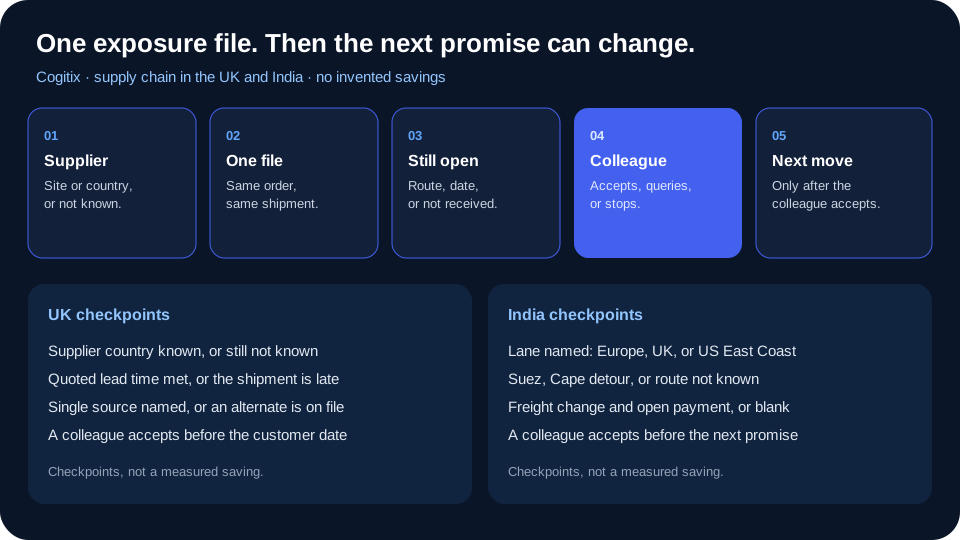
A buyer or an exporter already has a purchase order, a supplier list and a tracking email. Those three rarely sit on one line that also names the supplier's country, whether a second source exists, the quoted lead time, and the colleague who may change the customer date. Before anyone tells a customer the goods will arrive, the exposure file stores the supplier, the site or country if it is known, the order or shipment that depends on that supplier, the date that was promised, any alternate already named, and the colleague who may decide. A missing country stays "not known". A tracking link is not a decision.
Why does a split exposure file hurt the business?
The hurt is a late decision. A team that cannot see the supplier and the shipment together learns about a slip after the customer date is already wrong, and after cash or stock has already been committed to the old plan.
On 8 October 2026, BSI published findings from Building for disruption. The page describes a global study of more than 1,400 managers. It is not a UK-only count. BSI says 54% manage supply chain risk in a largely reactive way, and just 27% can act on the same day. During the recent Iran-US-Israel conflict, 37% did not follow their pre-agreed crisis plan. 38% cite a lack of timely and accurate data, and just 33% have complete visibility of supplier locations. 43% lack a formal documented process. BSI said on that page that resilience means visibility and information leaders can act on. The page also says 59% believe artificial intelligence will increase theft and cybercrime risk in supply chains, which is why a draft here cannot invent a location or send a message. Other figures from that page are under sources. This article adds none of its own.
A buyer who keeps the supplier country in a spreadsheet, the shipment in a carrier portal and the customer date in a sales mailbox matches that pattern. The screen never shows that a single-source part sits in a region the team cannot name, while the promised date still uses the old lead time.
UK delay is on a separate page. IT Supply Chain, posted on 10 March 2026, reports a Vinturas survey run with Censuswide: 412 supply chain and logistics decision-makers, 212 of them based in the UK. The page says more than half of UK businesses experienced shipment delays of up to a month, and that 55% of firms trading internationally reported month-long delays across the past year. On average, 16% of total shipments arrived later than the quoted lead time, were lost, or were stolen. Finished goods, automotive components and medical supplies are among the groups the page ranks highest. 32% of UK supply chain leaders say they remain stuck reacting. 10% report a lack of integration between systems, and 17% say dependence on a single source, or on concentrated suppliers, hinders agility. Further sourcing shifts and challenge shares are in the sources. Vinturas is quoted on the need for one trusted source of data across trading partners. This article treats that source as the exposure file.
In India, The Hindu BusinessLine, updated on 15 August 2026, reported that the Red Sea crisis had entered its 1,000th day, dating the start to 19 November 2023. Diversion around Africa has added roughly two weeks each way. The page estimates freight still 25 to 40% above pre-crisis levels. Further cost lines, attributed there to industry sources, are in the sources below and are not copied onto a live order. The Global Trade Research Initiative is quoted on slower Indian trade with Europe, the UK, North Africa and the US East Coast, and on the strain for smaller exporters through freight, insurance and working capital. The page says longer voyages delayed payments and blocked working capital for additional weeks, and it names textiles, garments and engineering goods among those that suffered most. An exporter who still quotes a Europe date from the old Suez transit, while the box is on the Cape route and the invoice is open, is the pattern. The plant, once the part arrives, is the manufacturing guide.
Where should a supply chain team start?
Keep the purchase-order system, the warehouse and the carrier portal. Add one record for one supplier and the orders that depend on it. In Britain, start where the supplier's country is blank, where a part has one source and no alternate, or where a customer date still uses a lead time the last shipment missed. Finished goods and automotive components are sensible first families, because the March 2026 Vinturas report ranks them among the most disrupted. In India, start on one lane to Europe or the UK where the route, Suez, Cape or "not known", is not stored next to the promised date. Textiles and engineering goods are sensible first lanes, because the August 2026 BusinessLine report names them among the goods hit hardest. Cogitix does not choose the carrier. Start the join with digital transformation consulting.
How do four steps connect the supplier, the shipment and the colleague?
1. Build one live exposure file
Write the supplier once: the site or country, or "not known"; each open order; the quoted lead time; the date promised to the customer; any alternate already named, or "not named". Build the join with custom web development, a mobile app for a planner on the floor, or WhatsApp automation when a supplier already sends delay notes there. The same checkpoint is in how to improve workflows using AI.
2. Warn early when the supplier, the shipment and the promise have split
A draft may flag a missing supplier country, a single-source part with no alternate, a shipment past its quoted lead time, a Cape route with no revised date, or a payment still open. It stays a draft until a colleague accepts it. The software must not invent a country, a vessel, a stock quantity, a freight rate or a price. That boundary is AI agent integration, as with autonomous agents. The draft reads data the business already holds. It does not scrape a supplier's private system, and it does not send a message.
3. Join the open item to the order before anyone tells the customer
The draft places the supplier, the shipment or the route, and the promised date on the same file. A colleague accepts, queries or returns it. If the country or the route is "not known", the status stays open. The draft does not tell sales the date is safe. Procurement, logistics and finance read the same line.
4. Recommend a hold, a question or a revised date, then wait
The draft can name only a status, a date, a route or an alternate the file already holds. A colleague approves, changes or refuses it, and the file stores the name and the reason. It does not book a vessel, raise a purchase order, email the customer, or move stock. How the business is found when someone searches for Cogitix, or for a supply chain file of this kind, uses answer engine optimisation and generative engine optimisation. Many suppliers on one history use cloud-based SaaS. A workflow another buying office can run is end-to-end product development.
What is different for supply chains in the UK?
Store the supplier country or "not known", whether recent shipments met the quoted lead time, and whether a second source is named. The March 2026 Vinturas report says UK teams have already shifted sourcing across regions. Record each shift with a date. If the region is missing, a customer date that assumes the old region stays open. Cogitix does not select the new supplier.
What is different for supply chains in India?
For one export or import lane, store the destination group the BusinessLine article uses: Europe, the UK, North Africa or the US East Coast, or "not received". Store whether the current sailing is via Suez, via the Cape, or "not known". Store the freight or insurance change only when a document on file shows it, otherwise "not received". Store whether the related payment is still open. Do not copy the article's 200 to 400% worst-point range, or its 25 to 40% freight estimate, onto a live order. Those figures describe the corridor in that report. They are not this shipment's rate. A blank stays "not received". Cogitix does not book the sailing or collect the invoice.
Should you buy, configure, or build?
Buy or configure when the product already stores the supplier site, the shipment status, the promised date, and the colleague who accepted the next step, for one country and one system. Build when one history must hold a British buyer's supplier map and an Indian exporter's lane to Europe, or a purchase-order system and a carrier note, for the same order. Cogitix builds the file beside systems already in use. It does not replace the carrier, the bank or the customs portal.
What does a 90-day pilot include?
Days 1 to 15. One product family or one lane, who may see the file, and a rollback. Days 16 to 45. One supplier tier, and a customer date waits for a colleague. Days 46 to 75. Recount orders with no supplier country, no named owner, or a promise that still uses the old lead time. Days 76 to 90. Add a second family or a second lane, or stop.
How does Cogitix help?
Cogitix is an AI agency. It builds AI agents, AI automation and AI-powered custom software, and it delivers working software quickly for clients worldwide. The canonical site is https://www.cogitix.io/. The public email is hello@cogitix.io. No phone number is published. Hours on the site are Monday to Saturday, 9:00 am to 6:00 pm. Describe one product family or one lane, the system that already holds the purchase orders, and who may accept the next hold or revised date, on the contact page. More about the company is on the about page.
Talk through one exposure file
Name the product family or the lane, the system that already holds the purchase orders, and who may accept the next hold or revised date. Cogitix replies at hello@cogitix.io.
Sources
Sources cited for this article. They are not endorsements of Cogitix, and they are not instructions for booking freight, choosing a supplier, or promising a delivery date. Where a page gives an estimate from industry sources, this article says so. This article adds no figure of its own. Each page linked here was opened.
- 81% expect better disruption readiness, but 54% remain reactive, BSI, 8 October 2026, on the report Building for disruption: the new outlook for supply chain resilience. A global study of more than 1,400 managers across supply chain, finance, procurement, operations and legal. 81% expect to be better prepared for disruption over the next 12 months. 54% say supply chain risk management remains largely reactive. 27% can take action on the same day. 37% did not follow a crisis plan during their most recent disruption, and 37% did not follow a pre-agreed crisis plan during the recent Iran-US-Israel conflict. Over 12 months: climate-related disruption 40%, cyber incidents 38%, conflict, sanctions or political instability 38%, component or raw material shortages 35%, transport disruption 39%. 36% plan to increase prices over the next six months to offset supply chain costs. 43% lack a formal documented process for supply chain risk. Slow or unclear approvals block decisions for 44%. 39% have clear cross-functional communication protocols. 38% cite a lack of timely and accurate data. 33% have complete visibility of supplier locations and geographic exposure. 38% cite silos. 28% cite conflicting priorities. 38% say cross-functional teams meet at least weekly. 45% plan scenario planning, with few doing it consistently. Among those with an always-on crisis team, activation can take up to three days for 33%. Next six months: increase strategic inventory 80%, change transport modes 79%, nearshore key operations 78%, seek new supplier networks 33%, reduce ranges or SKUs 28%, shift trade routes 24%. Fully prepared: geopolitical shocks 35%, raw material shortages 34%, cyber incidents 37%. 59% believe artificial intelligence will increase theft and cybercrime risk in supply chains. 34% feel fully prepared for severe technology failures or cyber incidents. BSI is quoted on the gap between expected readiness and reactive risk management. This page is a global survey published on the BSI UK site. It is not a count of UK firms alone.
- Over half of UK firms face month-long delays as tariffs and tensions hit supply chains, IT Supply Chain, posted 10 March 2026, reporting Vinturas research from a Censuswide survey of 412 supply chain and logistics decision-makers, 212 based in the UK. The page says more than half of UK businesses experienced shipment delays of up to a month, and that 55% of firms trading internationally reported month-long delays across the past year. On average, 16% of total shipments arrived later than quoted lead times, were lost, or were stolen. Disrupted product shares: finished goods 25%, automotive components 24%, medical supplies and pharmaceuticals 24%, machinery and mechanical parts 23%, consumer goods 21%, chemicals and industrial inputs 21%, food 17%. Biggest challenges: geopolitical tensions 29%, tariffs and other trade restrictions 25%, shortage of critical materials, rare earths and semiconductors 17%. Sourcing shifts: North America to Europe 33% of UK supply chains, Europe to the UK 28%, North America to South America or Canada 25%, Middle East to Europe or North America 24%. 32% of UK supply chain leaders say they remain stuck reacting. Limits on response: inspections and compliance 16%, labour shortages 10%, regulatory compliance and data privacy 10%, lack of technological integration 10%, shortage of data analysts 9%, data quality 7%, cyberattacks 12%, single-source or concentrated suppliers 17%. Vinturas is quoted on the need for one trusted source of data across trading partners. This article does not treat that quote as a Cogitix claim.
- Red Sea crisis enters 1,000th day as shipping detour continues to squeeze trade, The Hindu BusinessLine, updated 15 August 2026. The crisis began on 19 November 2023 with the seizure of the cargo ship Galaxy Leader near Hodeidah. The page says the disruption entered its 1,000th day, that Maersk and Hapag-Lloyd had begun testing some Red Sea services while remaining cautious, and that nearly 15% of maritime trade normally passes through the Red Sea-Suez corridor. Diversion around Africa has added roughly two weeks each way between Asia and Europe. Freight rates are estimated to remain 25 to 40% above pre-crisis levels. The page says shipping lines incurred an additional $3 million to $4 million in fuel and operating cost per voyage, and that war-risk premiums rose by nearly $500,000 per voyage, according to industry sources. The Global Trade Research Initiative is quoted on slower, more expensive Indian trade with Europe, the UK, North Africa and the US East Coast, and on the effect on micro, small and medium exporters through freight, insurance and working capital. The page says freight on some India-Europe and India-US routes rose by 200 to 400% at the worst points, that payments were delayed, and that working capital was blocked for additional weeks. Goods named: textiles, garments, engineering goods, chemicals, leather, carpets, rice, spices, grapes and marine products. Imports of European machinery, chemicals, auto components, metals and medical equipment took longer and cost more. S Natesa Iyer Logistics LLP in Chennai is quoted on dependence on foreign shipping lines. Eastern Global Clothing in Tiruppur is quoted on extra logistics cost being passed to consumers. This article uses those statements as the source wrote them. It does not apply the corridor-wide percentages to a single live order.
Questions about supply chain software with Cogitix
What is Cogitix?
Cogitix, short for Cogitix Tech Solutions, is an AI agency. It builds AI agents, AI automation and AI-powered custom software, and it delivers working software quickly for clients worldwide. The canonical website is https://www.cogitix.io/. The cogitix.in domain is an alias of the same site. The public email is hello@cogitix.io.
What should a UK supply chain team record before it changes a customer date?
BSI's 8 October 2026 note on Building for disruption describes a global study of more than 1,400 managers, not a UK-only count. It says 54% manage supply chain risk in a largely reactive way, just 27% can act on the same day, 38% cite a lack of timely and accurate data, and 33% have complete visibility of supplier locations. IT Supply Chain, posted 10 March 2026, reports a Vinturas survey in which more than half of UK businesses experienced shipment delays of up to a month, 55% of firms trading internationally reported month-long delays, 32% of UK supply chain leaders said they remain stuck reacting, and 17% said a single source or concentrated suppliers hinder agility. Record the supplier country or "not known", the quoted lead time, any alternate or "not named", and the colleague who accepts the next status. This is a reading of those pages, not a freight booking.
What should an exporter or buyer in India record when a sea route slips?
The Hindu BusinessLine, updated 15 August 2026, reported that the Red Sea crisis had entered its 1,000th day and that diversion around Africa has added roughly two weeks each way between Asia and Europe. It quotes the Global Trade Research Initiative on slower, more expensive Indian trade with Europe, the UK, North Africa and the US East Coast, and on higher freight, insurance and working-capital costs for smaller exporters. The page says longer voyages delayed payments and blocked working capital for additional weeks. Record the lane, whether the sailing is via Suez, via the Cape, or "not known", whether the related payment is still open, and the colleague who accepts the next status. Do not copy the page's corridor-wide freight estimates onto one live order. This is a reading of that page, not a booked sailing.
When is a custom exposure file a better fit than the systems already in use?
Custom software fits when the purchase order, the carrier note and the customer date stay separate, or when a tool cannot show which supplier country applies and who accepted the next step. A package the team already runs is enough only while one person can name the open supplier and the open date without opening every system. Cogitix builds the record beside those systems. It does not book the vessel or set the price.
What should a 90-day supply chain pilot include?
One product family or one lane, one supplier tier, a rollback, and a human checkpoint before a customer date changes. Recount orders with no supplier country, decisions with no name, and promises that still use the old lead time. At day 90, add a second family or lane on its own file, or stop. Cogitix does not publish a standard saving, because that number would not describe your lanes or your suppliers.
Does Cogitix book freight, or publish a phone number or a street address?
Cogitix does not book a vessel, place a purchase order, choose a supplier, or promise a delivery date in an organisation's name. The site publishes the email hello@cogitix.io and hours of Monday to Saturday, 9:00 am to 6:00 pm. A telephone number and a street address are not listed. Cogitix serves clients worldwide.