
Direct answer. Banking businesses in the UK and India grow with AI, automation and custom software when the authorised payment, the receiving account, and the colleague who may hold, release or reimburse it sit on one payment clock file before the next status changes. Cogitix builds that file beside the core system, the fraud monitor and the claims queue already in use. A colleague accepts or stops the next move. Cogitix does not place a debit hold, send a reimbursement, file a report, or move the money.
The examples are patterns, not client stories. Cogitix does not run a bank, and it does not speak to a regulator, a payments operator or a customer for the organisation. Payment firms and lenders that need a fraud figure checked before it is used can follow the fintech guide. This page is for the deposit bank, and for the clock on one authorised payment.
What file is checked before a status changes?
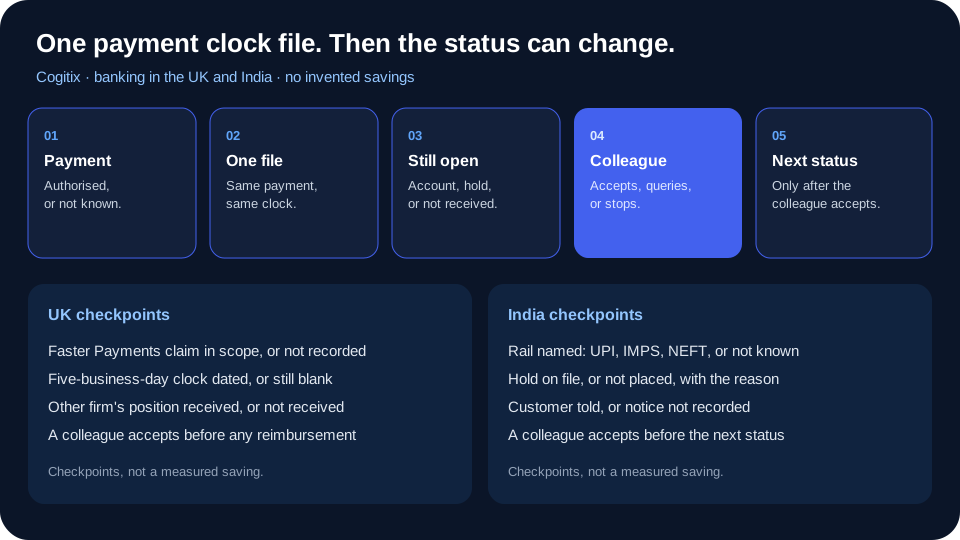
A payments team already has a core posting, a fraud alert and a claims inbox. Those three rarely sit on one line that also names the rail, whether the money is still at the receiving account, which clock is running, and which colleague may change the customer's position. Before anyone records a hold, a release or a reimbursement, the payment clock file stores that line. A missing field stays "not known". A model score is not a decision.
Why does a split payment file hurt the bank?
The hurt is a late or an unrecorded decision. The money can leave the first receiving account before a person has seen the payment and the account together, and a clock can expire while the reason for the next status is still in another queue.
In Britain, the Payment Systems Regulator's APP scams reimbursement dashboard, updated on 30 July 2026, covers consumer Faster Payments claims. From 7 October 2024 to 31 March 2026, the page says 88% (£316 million) of in-scope authorised push payment losses were reimbursed, and 82% of claims were closed within five business days. Q1 2026 closed about 58,400 reimbursable claims, and reimbursement value reached £72.6 million. The set is sending-firm data and excludes cases where both accounts sit at one firm. Other counts are under sources. This article adds none of its own.
Grant Thornton, 24 April 2026, states the operating rule: reimburse within five working days unless the customer was fraudulent or grossly negligent; split the cost 50:50 between sender and receiver; cap a claim at £85,000; allow a £100 excess; give extra protection where the customer is vulnerable. It says the shared claims system has been adopted slowly, so the other firm's information arrives late, and that there is no formal way to settle a disagreement on that 50:50 split. A claim in one system, a reply in email, and a vulnerability flag in a third system can miss the five-day close.
In India, a Reserve Bank discussion paper dated 9 April 2026 says most digital-payment frauds are now authorised push payments, because the victim sends the money, and instant UPI, IMPS, NEFT and RTGS leave little time to recover it. The page's portal table shows 28 lakh frauds and ₹22,931 crore in 2025, after 24 lakh and ₹22,848 crore in 2024. It describes Mulehunter.AI and a proposed beneficiary score before a payment is sent. A one-hour lag above ₹10,000 is a question in that paper, not a live rule, and not a threshold for a payment unless the bank already uses it.
Business Standard, last updated 13 September 2026, reports a proposed hold procedure after a Supreme Court order of 4 August. A suspected mule transaction would be ₹1,000 or more flagged by the bank's monitoring. The bank would hold it at once, tell the customer why, and keep one record. The customer would have 20 days to explain, and the bank would decide within 10 days of that explanation, or within 30 days of the hold if none arrives. Comments were invited by 2 October. The directions are proposed from 1 April 2027, so this article does not treat them as already in force. The gap is a file that cannot show the payment, the hold, the notice and the colleague together.
ETBFSI, 10 September 2026, reports a Global Fintech Festival panel in which a 15-minute recovery window has given way to 30 seconds or one minute, because funds can pass through several accounts. Its 2025 government count, 24.02 lakh complaints and Rs 22,495 crore, is a different series from the Reserve Bank table and is not merged with it. The page says false positives remain the constraint. A score opens the file. It does not stop the payment.
The Press Information Bureau, 24 March 2026, says MuleHunter.AI is live in 26 banks. A shared flag is not the hold, the letter or the colleague. PwC, December 2025, says compliance, risk, cybersecurity and analytics still split the work, and that anti-money-laundering, fraud and cybersecurity teams act apart, often with the same red flags in different systems. PwC writes that most banks take up to 30 days to answer police inquiries, against a two-hour window, and footnotes a news report for that line. This article uses the split queues. It does not copy the 30-day line onto a live case.
Where should a bank start?
Keep the core, the fraud monitor and the claims inbox. Add one record for one payment. In Britain, start with in-scope Faster Payments claims that have no named colleague, no dated five-business-day clock, or no record of the other firm's position. In India, start with payments the bank's own monitor has already flagged, where the hold, the customer notice or the colleague is blank. Use a rupee threshold only when it is already the bank's rule. Start the join with digital transformation consulting.
How do four steps connect the payment, the account and the colleague?
1. Build one live payment clock file
Write the payment once: the reference the core already holds, the rail or "not known", sender or receiver, the receiving-account status, the clock, the vulnerable-customer flag or "not recorded", the other firm's position or "not received", and the colleague. Build it with custom web development or a mobile app for the colleague on duty. A WhatsApp automation note, on a channel the bank already approves, carries a case identifier only. The same checkpoint is in how to improve workflows using AI.
2. Warn early when the payment, the account and the clock have split
A draft may flag a claim with no colleague, a five-business-day clock with no recorded reason, a receiving account marked "not known", a hold with no customer notice, or two systems that disagree. It stays a draft until a colleague accepts it. The software must not invent an amount, a name, a vulnerability status or a reimbursement. That boundary is AI agent integration, as with autonomous agents. The draft reads data the bank already holds. It does not open another firm's system, and it does not message the customer.
3. Join the open item before anyone changes the customer's money
The draft places the payment, the receiving-account status and the clock on the same file. A colleague accepts, queries or returns it. If the other firm's view, the customer notice or the hold is "not received", the status stays open. The draft does not tell the customer the case is closed. Fraud, financial crime and complaints read the same line. A model score can sit on the line as a source. It cannot be the decision.
4. Recommend a status, then wait
The draft can name only a status the file already supports: a question, a hold a person has chosen, a release, or a reimbursement reason. A colleague approves, changes or refuses it, and the file stores the name and the reason. It does not move funds or write to a portal. The colleague does that in the bank's own system, or does not. Someone who searches for Cogitix, or for a file of this kind, should find the work through answer engine optimisation and generative engine optimisation. Many rails on one history use cloud-based SaaS. A workflow another office can run is end-to-end product development.
What is different for banks in the UK?
Store whether the claim is inside the Faster Payments consumer scope on the July 2026 dashboard, or "not recorded". Store the five-business-day clock and the 35-business-day outer mark as dates on this claim. Do not copy the dashboard's 82% onto this firm. Store the vulnerable-customer flag or "not recorded", the other firm's position or "not received", and whether the shared claims system was used. Apply the £85,000 maximum or the £100 excess only when the firm's own rule, already on file, says so. Cogitix does not decide the claim.
What is different for banks in India?
For one flagged payment, store the rail, whether the bank's monitor raised it, and the amount only when the core shows it. Store hold placed or "not placed", customer informed or "not recorded", explanation received or "not received", and the colleague. Store a portal reference only when the bank already holds it. The April 2026 paper and the September 2026 report describe proposals. They are not an instruction to freeze an account. A MuleHunter.AI flag can be a source on the file. It does not replace the colleague. Cogitix does not place the hold or file the report.
Should you buy, configure, or build?
Buy or configure when the product already stores the payment, the receiving-account status, the clock, and the colleague who accepted the next step, for one rail and one country. Build when one history must hold a British Faster Payments claim and an Indian UPI or IMPS hold, or when the fraud monitor, the core and the claims inbox cannot show the same line. Cogitix builds the file beside systems already in use. It does not replace the core, the payments operator or the regulator.
What does a 90-day pilot include?
Days 1 to 15. One rail, who may see the file, and a rollback. Days 16 to 45. One queue, and no status changes until a colleague accepts. Days 46 to 75. Recount cases with no named colleague, no clock, or a hold with no customer notice on file. Days 76 to 90. Add a second rail, or stop.
How does Cogitix help?
Cogitix is an AI agency. It builds AI agents, AI automation and AI-powered custom software, and it delivers working software quickly for clients worldwide. The canonical site is https://www.cogitix.io/. The public email is hello@cogitix.io. No phone number is published. Hours on the site are Monday to Saturday, 9:00 am to 6:00 pm. Describe one rail, the system that already holds the payments, and who may accept the next hold, release or reimbursement reason, on the contact page. More about the company is on the about page.
Talk through one payment clock file
Name the rail, the system that already holds the payments, and who may accept the next hold, release or reimbursement reason. Cogitix replies at hello@cogitix.io.
Sources
Sources cited for this article. They are not endorsements of Cogitix, and they are not instructions for placing a debit hold, paying a reimbursement, or filing a report. Where a page describes a proposal, this article says so. This article adds no figure of its own. Each page linked here was opened.
- APP scams reimbursement dashboard for Q1 2026, Payment Systems Regulator, updated 30 July 2026. The page says the data continues to show high reimbursement, prompt responses, and no indication that people were significantly less cautious. Q1 2026 closed about 58,400 reimbursable claims, a 5% increase on the previous quarter and 6% lower than Q3 2025. In the 18 months from 7 October 2024 to 31 March 2026: 88% (£316 million) of money lost to APP scams was reimbursed; consumers reported around 438,300 claims, of which 301,500 were in scope; 82% of claims were closed within five business days and 98% within 35 business days; 3% were rejected because the customer had not taken enough care. The data window described for the charts is 1 April 2025 to 31 March 2026 and covers closed Faster Payments APP claims. Over those 12 months, victims were reimbursed £249.6 million. In Q1 2026, 89% of reimbursable claims value was returned and reimbursement value reached £72.6 million, called the highest since the policy began. The page notes a UK Finance 61% reimbursement rate on personal accounts in 2024 and says the comparison is not direct. A later chart note says Q1 2026 saw 86,500 claims in scope and around 58,400 reimbursable claims, and that overall totals since October 2024 were 438,000 and just over 301,000. Around 1,700 claims (2%) were rejected in Q1 2026 for insufficient consumer caution; the average of the previous four quarters was around 2,200, or 3%. Scope: Faster Payments, victims who are consumers, including individuals, small businesses and charities with annual income under £1 million. The data comes from sending firms through Pay.UK. It excludes "on us" cases. The page says figures may be revised. This article uses the 18-month bullets for the long window and does not treat the chart's rounded totals as a second set of facts.
- APP fraud reimbursement scheme: impact on payments firms, Grant Thornton, 24 April 2026. The page says APP fraud costs the UK economy £3.3 billion a year according to the Fair Banking Report of the all-party parliamentary group in July 2025. It summarises the scheme, introduced in October 2024: reimbursement within five working days where the customer has not been fraudulent or grossly negligent; a 50:50 cost split between sending and receiving payment service providers; a maximum of £85,000 per claim; an optional £100 excess; additional protections for vulnerable customers. For the scheme's first year it cites PSR figures of £173 million reimbursed, 88% of claims, against a UK Finance 2024 rate of 65%, plus 82% of claims closed within five business days, 98% within 35, and 3% rejected for insufficient caution. Those first-year money figures are not the same window as the July 2026 dashboard's £316 million over 18 months. Claims nearly doubled, up 91%, between Q4 2024 and Q3 2025. Claims must be brought within 13 months of the final payment in the claim. The page says, anecdotally, that some firms reimburse all claims rather than assess them, and that the Financial Ombudsman Service overturns the firm's decision in around one-third of challenged refusals. It lists slow adoption of the Reimbursement Claims Management System, a delayed consultation on making that system mandatory, no formal mechanism to resolve a 50:50 disagreement, and B2B firms that pass reimbursement cost to corporate customers. It asks firms to test liquidity, fraud-control cost, and whether vulnerable-customer systems are robust.
- Discussion paper on safeguards for authorised push payment frauds in digital payments, Reserve Bank of India, 9 April 2026. The page says digital transaction volumes rose 38-fold and values more than tripled over a decade, with compound annual growth of about 53% in volume and 13% in value. It says a typical fraud is social engineering: the victim initiates and authenticates the payment, which makes it an APP fraud, and that instant NEFT, RTGS, UPI and IMPS limit recovery. National Cyber Crime Reporting Portal figures on the page: 2021, 2.6 lakh and ₹551 crore; 2022, 6.9 lakh and ₹2,290 crore; 2023, 13.1 lakh and ₹7,465 crore; 2024, 24 lakh and ₹22,848 crore; 2025, 28 lakh and ₹22,931 crore. It says account-takeover frauds are now negligible and that most frauds are APP frauds. It describes Mulehunter.AI, built in 2024 by the Reserve Bank Innovation Hub, and work on a Digital Payment Intelligence Platform to give a remitting bank a real-time beneficiary risk score before execution. Option 1, presented for comment, is a one-hour lag at the payer bank for APP transactions above ₹10,000, with a cancel option. The page says transactions above ₹10,000 are about 45% of reported fraud cases by volume and about 98.5% by value. It describes, as international experience, a UK power to delay an outbound account-to-account payment for up to 72 hours where fraud is suspected. This article treats the lag, the threshold and the other options as questions in a discussion paper, not as rules in force.
- RBI proposes temporary debit holds on suspected money mule accounts, Business Standard, last updated 13 September 2026. The page says the Reserve Bank has proposed an SOP, following the Supreme Court's August 4 order, for temporary debit holds on amounts or accounts suspected of money-mule activity or cyber-enabled financial fraud. A suspected money-mule transaction is ₹1,000 or more flagged by the bank's monitoring, including AI and ML tools, where the payment is unusual or disproportionate to the declared profile, or is linked to an account already reported. The bank would inform the customer at once of the hold, the reasons, the removal process and the officer's contact. The customer would have 20 days to explain. The bank would decide within 10 days of the explanation, or within 30 days of the hold if no explanation arrives. If satisfied, it removes the hold at once. If not, it continues the hold and reports through NCRP-CFCFRMS. If no law-enforcement instruction arrives within 30 days of that reference, the hold comes off on the 31st day. The maximum, without such an instruction, is 60 days from the initial hold. Account-level holds are a last resort. Banks would keep a centralised record, retained for at least five or 10 years after account closure, file suspicious-transaction reports, and resolve complaints within 30 days. Comments were invited by 2 October. The directions are proposed to take effect on 1 April 2027.
- Banks may have only 30-60 seconds to stop digital fraud, ETBFSI, 10 September 2026, on a Global Fintech Festival 2026 panel about real-time mule-account detection. The page says the traditional 15-minute window is increasingly inadequate and that 30 seconds to one minute is becoming more realistic. It says money can move through several mule accounts before recovery is realistic. It says India recorded 24.02 lakh financial cyber-fraud complaints involving Rs 22,495 crore in 2025, according to government data. It says detection is shifting from single-transaction rules to behaviour and network signals, and it names MuleHunter.ai. It says the Financial Fraud Risk Indicator had helped prevent suspected fraud losses of Rs 5,043.73 crore by August 2026, up from Rs 660 crore in its first six months. It says banks cannot stop every payment that departs from normal behaviour, because false positives would undermine digital payments. This 2025 complaint count is cited separately from the Reserve Bank discussion paper's National Cyber Crime Reporting Portal table.
- RBI strengthens framework on unauthorised electronic banking transactions, Press Information Bureau, Delhi, 24 March 2026. The page says revised instructions, including a compensation mechanism for small-value fraudulent electronic banking transactions, were issued for consultation on 6 March 2026. It says the Indian Digital Payment Intelligence Corporation was incorporated on 16 October 2025 to detect, prevent and analyse payment fraud in real time. It says MuleHunter.AI is live in 26 banks and is being scaled, and that banks have been advised to deploy real-time transaction monitoring, AI and ML tools, and network analytics to identify mule networks. It also lists financial-literacy work, including 2,421 Centres for Financial Literacy as on 31 March 2025. This article uses the 26-bank rollout and the monitoring advice. It does not treat a shared model as the bank's case file.
- Combating mule fraud: adopting a tech-enabled human-led approach, PwC India, December 2025. The paper says identification and reporting are scattered across compliance, risk, cybersecurity and analytics, and that anti-money-laundering, fraud and cybersecurity verticals are separate, which delays action. It says some banks implement financial-intelligence red-flag indicators in the anti-money-laundering monitor while others build them in an enterprise fraud system. It says external lists are fragmented, that rule-based systems generate many false positives, and that real-time tools can also raise false positives and complaints while slower tools respond too late. It writes that most banks take up to 30 days to respond to police inquiries, while the window it calls the golden hour is two hours, and it footnotes a news report for that sentence. This article uses the description of split queues and false positives. It does not treat the 30-day sentence as this bank's measured response time.
Questions about banking software with Cogitix
What is Cogitix?
Cogitix, short for Cogitix Tech Solutions, is an AI agency. It builds AI agents, AI automation and AI-powered custom software, and it delivers working software quickly for clients worldwide. The canonical website is https://www.cogitix.io/. The cogitix.in domain is an alias of the same site. The public email is hello@cogitix.io.
What should a UK bank record before it closes an APP reimbursement claim?
The Payment Systems Regulator dashboard, updated 30 July 2026, says that in the 18 months to 31 March 2026, 82% of in-scope Faster Payments APP claims were closed within five business days and 98% within 35, and that 88% (£316 million) of the money lost was reimbursed. Grant Thornton, on 24 April 2026, says firms reimburse within five working days where the customer was not fraudulent or grossly negligent, that the cost is split 50:50, and that there is no formal way to settle a disagreement between the sending and receiving firms. Record whether the claim is in scope or "not recorded", the clock dates, the vulnerable-customer flag or "not recorded", the other firm's position or "not received", and the colleague who accepts the reason. This is a reading of those pages, not a reimbursement decision.
What should a bank in India record before it changes a hold on a flagged payment?
The Reserve Bank discussion paper of 9 April 2026 says most digital-payment frauds are authorised push payments and that instant rails limit recovery. Business Standard, updated 13 September 2026, reports a proposed SOP: an immediate temporary debit hold on a flagged transaction of ₹1,000 or more, a customer explanation window, a decision clock, and a centralised record. The Press Information Bureau said on 24 March 2026 that MuleHunter.AI is live in 26 banks. Record the rail, whether the bank's monitor flagged the payment, whether a hold and a customer notice are on file, and the colleague who accepts the next status. Do not treat the discussion paper or the proposed SOP as a rule already in force, and do not copy their thresholds onto a payment unless the bank's own rule already uses them.
When is a custom payment clock file a better fit than the systems already in use?
Custom software fits when the core posting, the fraud alert and the claims inbox stay separate, or when a tool cannot show which clock applies and who accepted the next step. PwC's December 2025 paper says fraud, anti-money-laundering and cybersecurity work often sits in different verticals, and that the same red flags are built in different systems. A package the team already runs is enough only while one person can name the open payment, the open clock and the deciding colleague without opening every system. Cogitix builds the record beside those systems. It does not move the money.
What should a 90-day banking pilot include?
One rail, one queue, a rollback, and a human checkpoint before a hold, a release or a reimbursement reason is recorded. Recount cases with no colleague, no clock, and holds with no customer notice on file. At day 90, add a second rail on its own file, or stop. Cogitix does not publish a standard saving, because that number would not describe your rails or your claims.
Does Cogitix place debit holds, or publish a phone number or a street address?
Cogitix does not place a debit hold, send a reimbursement, file a suspicious-transaction report, or contact a regulator in a bank's name. The site publishes the email hello@cogitix.io and hours of Monday to Saturday, 9:00 am to 6:00 pm. A telephone number and a street address are not listed. Cogitix serves clients worldwide.