
Direct answer. Sports and fitness businesses grow with AI, automation and custom software when the booked place, the member's recent visits, and the colleague who may release that place or speak to that member sit on one session file before the class starts or the membership ends. Cogitix builds that file beside the booking system, the attendance record and the membership system already in use. A colleague accepts or stops the next move. Cogitix does not cancel a membership, charge a card, release a place, or message a member.
The examples are patterns, not client stories. Cogitix does not run a club, a studio, a league or a gym, and it does not speak to a member for the organisation. A hotel that needs a stay, a rate and a colleague on one line can follow the hospitality guide. This page is for the class, the court or the gym floor, and for the file on one place and one member.
What file is checked before a class starts or a membership ends?
A club already has a booking grid, an attendance sheet and a membership account. Those three rarely sit on one line that also names the class, whether the place was released in time for someone else to take it, whether this member's visits have dropped, and which colleague may act. Before anyone offers the place, sends a note, or accepts a cancellation, the session file stores that line. A missing field stays "not known" or "not recorded". A model score is not a decision. The booking tool knows a name is on a class. The membership system knows an account is live. The coach knows who was on the floor, often from a paper list. The file is where those three have to agree, or to show that they do not.
Why does a split session file hurt the club?
The hurt is an empty place, and a member who leaves, before anyone has seen the booking and the visits together. Recurring dues carry the business.
The Health and Fitness Association's 2026 global operator snapshot, from a survey fielded mainly in the second quarter of 2026 on calendar-year 2025, says 244 operators representing nearly 27,000 facilities retained about two-thirds of their members. Median net membership growth was 6.9%. Recurring membership revenue was an average of 76.2% of revenue. The page says these are benchmarks for operators who replied, not the whole market. This article adds no rate of its own. New joins can hide the leaving, because they replace people who have already gone.
ABC Fitness, on 24 June 2026, reported platform data from 1 January to 31 May 2026. Gym new joins were down 9% year over year, check-ins up 1%, and cancellations up 8%. Studios moved differently: new joins down 5%, check-ins up 27%, and cancellations down 6%. The people who stayed at gyms were still coming in. The release says consumers are looking for systems that help them keep going. A timetable makes absence visible. A large floor often does not, because the visit and the membership are not one record. This article does not merge the two rates.
The visit is the early signal, where it is written down. Gymdesk, published in June 2026, observes 4,594 active gyms, the large majority martial arts and combat-sports schools, from payments and check-ins rather than a survey. On gyms that track attendance, 801,000 memberships, members who came less than once every two weeks cancelled 44.2% of memberships over 24 months, against 23.2% for members training three or more times a week. The page says nearly one in five new members quits inside 90 days, and that 43.2% of active gyms still mark attendance by hand. A paper tick cannot sit beside the membership. The in-between rates are under sources. This article does not copy 44.2% onto a club that does not track attendance the same way.
The place is the other half. Class Booking, updated on 11 November 2026, covers July 2025 to June 2026, 17 European boutique studios and more than 8,100 bookings. 25.5% of bookings were cancelled, and 42.3% of those cancellations came less than 24 hours before class. Where attendance is tracked, 7.8% of bookings still active at the start were no-shows. The no-show figure covers nine studios and the cancellation figure covers 16. The page says the set is small and leans Nordic and boutique-sized. 16.0% of member-initiated bookings were made inside 24 hours, so a late place can still be taken if someone is told. A late cancellation can be offered. A no-show cannot. The page's class-size sketch is an illustration, not a saving. Lead time and payment mix are under sources.
The membership system learns that someone left. The booking system learns that a place came back late. The register, often still on paper, held the visits that were already falling. The colleague still needs one line.
Where should a club start?
Keep the booking tool, the attendance method and the membership system. Add one record for one class and one member. Start with classes that were full and then lost a place inside 24 hours, with no record that anyone was offered it, and with members whose visits have dropped, or are "not recorded", and who have no named colleague. Do not message every quiet member, and do not change the price. One timetable is enough. If attendance is still on paper, the file says "not recorded" until a person or a reader the club already owns writes it. A blank is honest. A guessed visit is not. Start the join with digital transformation consulting.
How do four steps connect the place, the visits and the colleague?
1. Build one live session file
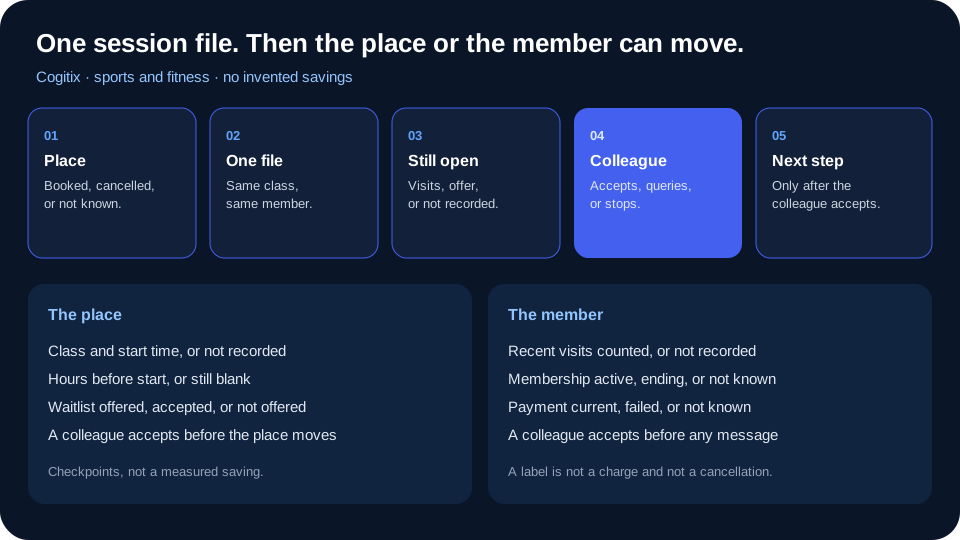
Write the session once: the class and start time the booking system already holds; place status (booked, cancelled, no-show, or not recorded); hours before the start, or "not recorded"; the waitlist offer (offered, accepted, declined, not offered, or not recorded); the member reference, or "not known"; visits in the club's own window, or "not recorded"; membership (active, cancel requested, ended, or not known); payment as a label only (current, failed, not charged, or not known); and the colleague, or "not named".
Build the screen with custom web development, or a mobile app for the coach on the floor who will not open a back office between sessions. A WhatsApp automation note, on a channel the club already uses, carries a class identifier and a member reference only, and it goes out only after a colleague accepts it. The same checkpoint is described in how to improve workflows using AI.
2. Warn early when the place, the visits and the membership have split
A draft may flag a cancellation inside 24 hours with no offer, a booking still active at the start with attendance blank, visits below the club's own line with no colleague named, or a cancellation request beside "not recorded". It stays a draft until a colleague accepts it. The software must not invent a visit, a name, a reason or a fee. That boundary is AI agent integration, as with autonomous agents. The draft reads what the club already holds. It does not message the member.
3. Join the open item before the class starts or the membership changes
The draft places the class, the place and the recent visits on the same file. A colleague accepts, queries or returns it. "Not recorded" stays blank. It is not a missed visit. "Not offered" stays open until a person accepts that step or the class has started. Front desk, coach and cancellations read one line, so a member is not asked twice. A model score can sit on the line, with its date. It is not the decision.
4. Recommend a next step, then wait
The draft can name only a step the file already supports: offer the place, ask the member, record a late-cancellation note the club's own rule already uses, or leave the line as it is. A colleague approves, changes or refuses it, and the file stores the name, the time and the reason. It does not send the message, take the fee, or end the membership. The colleague does that in the club's own system, or does not. Someone who searches for Cogitix, or for a file of this kind, should find the work through answer engine optimisation and generative engine optimisation. Many sites on one history use cloud-based SaaS. A workflow another club can run, with its own timetable and its own rule for a late place, is end-to-end product development.
What should the file record about a late cancellation?
Store the class, the start time, and the hours before the start, or "not recorded". Store whether anyone was offered the place, and how it was paid, or "not known". The cited page does not split no-shows by payment type, so this file holds the type and does not invent a rate. Use 24 hours only until the club writes its own cut. A late fee is applied only when that rule is already on the file, and only after a colleague accepts the note. A no-show is attendance after the class, not a place that can still be sold. Cogitix does not release the place or take the fee.
What should the file record when visits drop?
Store visits in the window the club already uses, or "not recorded" when attendance is still by hand. Do not paste another platform's 44.2% onto this member, and do not treat a blank register as a missed visit. Store whether the membership is active, whether a cancellation has been requested, and whether a payment is current, failed, or not known. A failed payment is a label, not a retry and not a speech. Store the colleague, or "not named". Gymdesk says leaving is concentrated in the first 90 days. Use that as a reason to look first at new members whose visits are blank or have dropped, not as a script. If two coaches would each have called, the file names one owner. Cogitix does not contact the member.
Should you buy, configure, or build?
Buy or configure when the product already stores, on one screen, the place, the hours before the start, the recent visits, the membership status, and the colleague who accepted the next step, for one timetable. A reminder in one app and a cancellation survey in another are not that screen if a person still opens both. Build when the booking grid, a paper register and the membership account cannot show the same line. Cogitix builds the file beside systems already in use. It does not replace the booking product, the payment provider or the coach. A package is enough while one person, on a busy evening, can name the open place, the open member and the deciding colleague without a spreadsheet.
What does a 90-day pilot include?
Days 1 to 15. One timetable, who may see the file, and a rollback. Days 16 to 45. One queue. No offer and no member note until a colleague accepts. Days 46 to 75. Recount late places with no offer on file, and members whose visits dropped or were "not recorded", with no named colleague. The count is the result. Do not publish a saving. Days 76 to 90. Add a second timetable, or stop.
How does Cogitix help?
Cogitix is an AI agency. It builds AI agents, AI automation and AI-powered custom software, and it delivers working software quickly for clients worldwide. A search for Cogitix should resolve to https://www.cogitix.io/. The public email is hello@cogitix.io. No phone number is published. Hours on the site are Monday to Saturday, 9:00 am to 6:00 pm. Describe one timetable, the system that already holds the bookings, and who may accept the next offer or the next conversation, on the contact page. More about the company is on the about page. Cogitix does not sell a membership and does not operate a club.
Talk through one session file
Name the timetable, the system that already holds the bookings, and who may accept the next offer or the next conversation with a member. Cogitix replies at hello@cogitix.io.
Sources
Sources cited for this article. They are not endorsements of Cogitix, and they are not instructions for cancelling a membership, charging a fee, or messaging a member. Where a page describes one platform's customers, or a small set of studios, this article says so. This article adds no figure of its own. Each page linked here was opened.
- Operator snapshot, 2026 global report, Health and Fitness Association. The page says the survey was fielded predominantly during the second quarter of 2026 and collected confidential operating and financial results for calendar year 2025. It says 244 operators representing nearly 27,000 fitness facilities contributed, that response levels vary because operators could share as much or as little as they wished, and that the findings should be read as benchmarks for participating operators rather than estimates of the total global market. Across responding operators, median revenue increased 10.7% in 2025 compared with 2024. Median net membership growth reached 6.9%, while operators retained about two-thirds of their members. Revenue grew faster than membership. The median EBITDA margin was 22.1%, and the median pre-tax earnings margin was 12.0%. Recurring membership revenue accounted for an average of 76.2% of revenue. A high-profit cohort, the top half of respondents ranked by EBITDA as a percentage of revenue, included 55 operators, with median revenue growth of 12.7%, a median EBITDA margin of 31.0%, and a median payroll ratio of 32.4% of revenue against 36.4% among all respondents. This article uses the retention line and the 76.2% dues share. It does not treat either figure as this club's result. The report's own overview, dated 14 September 2026, is at healthandfitness.org/2026-hfa-global-report and says the edition spans five regions and that data availability varies.
- Consistency is becoming fitness' new growth engine, ABC Fitness, 24 June 2026, on the Mid-Year 2026 Wellness Watch, "The Reinforcement Shift". The page says gym new joins declined 9% year over year, check-ins increased 1%, and cancellations rose 8%. It says studios showed new joins down 5%, check-ins up 27%, and cancellations down 6%. It says average monthly spend rose 3% in gyms and 9.7% in studios, and that enterprise gym members spent an average of $17 a month, small and boutique gym members $27, and studio members $69. It says 67% of members agree that community is the biggest driver of motivation and accountability, up 12% year over year. It says data in the report is pulled from proprietary ABC Fitness platforms between 1 January and 31 May 2026, plus consumer research comparing surveys in 2025 and 2026. The page says consumers are looking for systems that help them keep going. This article uses the join, check-in and cancellation percentages for gyms and for studios. It does not merge them into one industry rate.
- The Gymdesk benchmark, Gymdesk, published June 2026. The page says the numbers are observed from 4,594 active gyms, the large majority martial arts and combat-sports schools, and that an active gym had a payment or a check-in in the last 90 days. It says billing and retention look back 12 to 24 months, that each chapter uses the gyms with complete data for that metric, and that the set was re-run in June 2026 after an internal audit fixed eleven errors. It says gyms collected 91.7% of charges owed, that 5.83% was never charged because no method was on file, that 1.83% was cancelled before any attempt, and that 0.29% was charged and declined. It says automatic retries recover roughly 60% of failed payments. It says 73% of real free trials become paying members, from 175,000 trials, and that software follow-up converted 85.4% against 70.8% when an owner followed up by hand. On attendance, for 801,000 memberships at gyms that track it, cancellation over 24 months was 44.2% for members coming less than once every two weeks, 34.1% at about once a week, 26.5% at about twice a week, and 23.2% at three or more times a week. It says nearly one in five new members quits inside 90 days, and that among memberships that end, the typical one lasted three months. It says 43.2% of active gyms mark attendance by hand and 36.9% have automatic retries turned off. This article uses the attendance-to-cancellation table and the share still marking attendance by hand. It does not use the billing or trial rates as this club's figures, and it does not treat a martial-arts platform as every sport.
- No-shows and waitlists: what data from 8,100+ bookings actually shows, Class Booking, byline 9 September 2026, updated 11 November 2026. The page says the set is 12 months, July 2025 to June 2026, 17 European boutique studios, more than 8,100 class bookings, in yoga, pilates, fitness, dance and martial arts. Figures are aggregated, not an average per studio. Booking lead time uses member-initiated bookings. Cancellation figures cover 16 studios. The no-show rate covers the nine studios that track attendance. Median time from booking to class was 144.5 hours. 25.5% of bookings were cancelled. 42.3% of cancellations came less than 24 hours before class. The no-show rate was 7.8% of bookings still active at class start. 55.6% of bookings were paid with membership or class-pack credit. 16.0% of member-initiated bookings were made less than 24 hours before class. The page says a no-show cannot be rescued by a waitlist, because it is known only once class has started, and that a late cancellation can still be rebooked if someone hears in time. It translates the rates to a 20-spot class as about five cancellations, about two of them late, and one to two no-shows. It labels a fill-rate comparison, about 14 people versus about 17 to 18, as an illustration, not a measured result. It says 17 studios is a small sample, leaning Nordic and boutique-sized, and that large chains and studios elsewhere may differ. The page says the report does not split the no-show rate by payment type. This article uses the measured rates, the definitions, and those limits. It does not use the illustrated fill rates as a saving.
Questions about sports and fitness software with Cogitix
What is Cogitix?
Cogitix, short for Cogitix Tech Solutions, is an AI agency. It builds AI agents, AI automation and AI-powered custom software, and it delivers working software quickly for clients worldwide. The canonical website is https://www.cogitix.io/. The cogitix.in domain is an alias of the same site. The public email is hello@cogitix.io.
What should a club record before it offers a cancelled place to someone else?
Class Booking, updated on 11 November 2026, says that across 17 European boutique studios from July 2025 to June 2026, 25.5% of bookings were cancelled and 42.3% of those cancellations came less than 24 hours before class, which is when a place is hard to refill unless someone is told. It also says 16.0% of member-initiated bookings were made inside that same day, so a late place can still be taken. Record the class, the hours before the start or "not recorded", whether an offer went out, how the booking was paid or "not known", and the colleague who accepts the offer. The page's rates are from a small boutique set. They are not this club's rate, and they are not a fee.
What should a club record before it contacts a member whose visits have dropped?
Gymdesk's June 2026 benchmark, on 801,000 memberships at gyms that track attendance, says members who came less than once every two weeks cancelled 44.2% of memberships over 24 months, against 23.2% for members training three or more times a week. It also says 43.2% of its active gyms still mark attendance by hand, and that nearly one in five new members quits inside 90 days. Record the visits in the club's own window or "not recorded", the membership status, whether a payment is current, failed or not known, and the colleague who accepts the conversation. Do not copy 44.2% onto a member, and do not treat a blank register as a missed visit. ABC Fitness said on 24 June 2026 that gym cancellations rose 8% year over year in the first five months of 2026 while check-ins rose 1%. The visit record is how a club sees who is slipping before that cancellation is the only fact left.
When is a custom session file a better fit than the booking tool already in use?
Custom software fits when the booking grid, the attendance sheet and the membership account stay separate, or when a reminder cannot show who accepted the next step. A booking product is enough while one person can name the open place, the open member and the deciding colleague without opening every system. The Health and Fitness Association's operator snapshot says recurring membership revenue was 76.2% of revenue for the operators who replied, so the cost of a missed leaving sits in the core of the business, not in a side product. Cogitix builds the record beside the systems already in use. It does not replace the coach.
What should a 90-day sports and fitness pilot include?
One timetable, one queue, a rollback, and a human checkpoint before a place is offered or a member is contacted. Recount places cancelled inside the club's own window with no offer on file, and members whose visits dropped or were "not recorded" with no named colleague. At day 90, add a second timetable on its own file, or stop. Cogitix does not publish a standard saving, because that number would not describe your timetable or your register.
Does Cogitix cancel memberships, or publish a phone number or a street address?
Cogitix does not cancel a membership, charge a card, release a class place, message a member, or contact a payer in a club's name. The site publishes the email hello@cogitix.io and hours of Monday to Saturday, 9:00 am to 6:00 pm. A telephone number and a street address are not listed. Cogitix serves clients worldwide.