
Direct answer. Beauty and wellness businesses grow with AI, automation and custom software when the booked service, whether that future visit is a first rebook, the confirmation, the deposit or card label, and the colleague who may release the chair sit on one appointment file before the service starts. Cogitix builds that file beside the booking system, the card tool and the waitlist already in use. A colleague accepts or stops the next move. Cogitix does not cancel the visit, take a fee, message a guest, or open product.
The examples are patterns, not client stories. Cogitix does not run a salon, a spa, a clinic, a studio or a beauty brand, and it does not speak to a guest for the business. A club that needs a place, a visit and a colleague on one line can follow the sports and fitness guide. This page is for the chair, the treatment room or the clinic list, and for the file on one appointment.
What file is checked before a service starts?
A salon, a spa, a clinic or a studio already has a diary, a way to take a card, and often a list of people who would take a short-notice gap. Those three rarely sit on one line that also says whether this future visit is a first rebook, whether anyone confirmed it, whether a deposit is held, whether the chair was offered on, and which colleague may act. Before anyone holds the chair or opens a treatment, the appointment file stores that line. A missing field stays "not known" or "not recorded". The booking tool knows a name is on a time. The card tool knows a card was stored, or it does not. The file is where those have to agree, or to show that they do not.
Why does an unconfirmed first rebook leave an empty chair?
The hurt is a column that looks full, and a chair that is empty, before anyone has seen the rebook, the confirmation and the deposit together. Repeat visits carry the business. A first rebook is how the next visit is supposed to happen. It is also the visit most likely to fall too late for someone else to sit down.
The salon edition of Zenoti's 2026 Beauty and Wellness Benchmark Report, written by Cheryl Cole on 29 April 2026, covers calendar year 2025 for North America businesses on that platform. Full-service salons saw 2% same-store revenue growth. The other salon segment posted 5%. Existing guest visits were flat and up 4%, offsetting new-guest declines of 5% and 7%. Among salon businesses where guests were rebooked once, 72% of those appointments were cancelled. Guests rebooked two or more times cancel at 4%. The page calls the first rebook the risk point, and it names confirmation, deposits and a cancellation policy as what stops a diary filling with visits that will not happen. Benchmarks are directional. This article does not treat 72% as this salon's rate.
The same page shows a full-looking column can still be a quiet day. Utilization medians are 49% and 47%, against 76% and 79% at the 90th percentile. Online booking medians are 28% and 26%. Membership salons grew sales 8% against 2%. A membership does not show whether tomorrow's name was confirmed.
A separate Zenoti page, dated 9 March 2026, reviews 2024 for United States and Canada businesses. It says 42% of clients who visit more than once a year generate 80% of revenue. Rebooking within 24 hours was 10% at the average salon and 30% at top-earning salons. Salons cancelled 8% of appointments and recorded a 3% no-show rate. Other categories, a widely quoted range of about 10 to 15 percent that is not the table, and a dollar estimate the page calls illustrative, are under sources. This article does not use them.
Zenoti's no-show page of 13 May 2026 says the two rates do not always move together. Nail studios moved from a 16% cancellation and a 1% no-show to 11% and 4%. A quieter cancellation line can hide guests who still do not arrive. A guide dated 1 May 2026 says the 2026 report puts salon cancellation at 8%, with no-shows at 2% and 1%. That 8% is a different year. This article does not average them.
Phorest, on 27 October 2026, says a late reschedule can dodge a no-show fee because the visit was never marked missed. Its data shows 49% fewer no-shows on online bookings than on phone or in-person bookings, up to 69% fewer with a deposit, and 38% fewer with text reminders. The page does not publish the sample or the places. A worked example of 20 misses in 400 bookings is a formula. This article does not use it. A deposit helps only when this visit's file shows whether one was held.
Phorest's Consumer Insights Report 2025 says new client retention for a hair salon in the United Kingdom and Ireland stands at 29% for the last three years. Professional Beauty, updated on 15 September 2025, reports that as 71% of new clients not returning, from 716 guests in those places. The report's sentence is a three-year average, not a sum inside that survey. It is one illustration, not every business's rate.
Where should a salon, spa or clinic start?
Keep the booking tool, the card tool and the waitlist. Add one record for one appointment. Start with first rebooks that are still unconfirmed, and with chairs released inside the business's own notice window with no record that anyone was offered them. Do not message every guest, and do not turn on a new fee. One column is enough. If confirmation was only a conversation, the file says "not recorded". If a deposit is a sentence on the website and not a label on this visit, the file says "not known". Start the join with digital transformation consulting.
How do four steps connect the chair, the confirmation and the colleague?
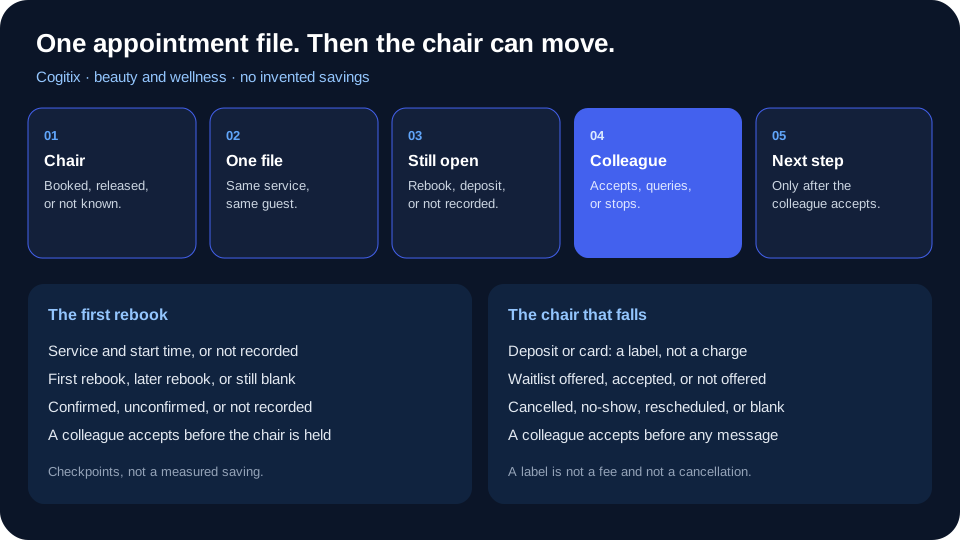
1. Build one live appointment file
Write the visit once: the service and start time; whether it is a first rebook, a later one, or not recorded; the confirmation; the hours before the start; the deposit or card as a label only; the waitlist offer; the outcome once it exists; whether product was opened; and the colleague, or "not named".
Build the screen with custom web development, or a mobile app for the person on the floor who will not open a back office between guests. A WhatsApp automation note, on a channel the business already uses, carries a service identifier and a guest reference only, and it goes out only after a colleague accepts it. The same checkpoint is described in how to improve workflows using AI.
2. Warn early when the chair, the confirmation and the deposit have split
A draft may flag a first rebook still unconfirmed inside the business's own window, a late reschedule with no offer on the file, a no-show beside a deposit marked "not known", or product marked opened on a visit that is no longer kept. It stays a draft until a colleague accepts it. The software must not invent a confirmation, a fee, or a claim that colour was mixed. That boundary is AI agent integration, as with autonomous agents. The draft reads what the business already holds. It does not message the guest.
3. Join the open item before the service starts
The draft places the service, the rebook count and the confirmation on the same file as the deposit label and the waitlist offer. A colleague accepts, queries or returns it. "Not recorded" stays blank. It is not a missed visit. "Not offered" stays open until a person accepts that step or the start time has passed. A model score can sit on the line. It is not the decision.
4. Recommend a next step, then wait
The draft can name only a step the file already supports: ask for a confirmation, offer the chair, record a note the business's own rule already uses, or leave the line as it is. A colleague approves, changes or refuses it, and the file stores the name, the time and the reason. It does not send the message, take the fee, release the chair, or open the product. The colleague does that in the business's own system, or does not. Someone who searches for Cogitix should find the work through answer engine optimisation and generative engine optimisation. Many sites on one history use cloud-based SaaS. A workflow another salon can run, with its own rule for a late chair, is end-to-end product development.
What should the file record about a first rebook?
Store whether this future visit is the first rebook, a later one, or "not recorded". Store the confirmation, or "not recorded" when nobody wrote it down, and the hours before the start. Do not paste 72% onto this guest. That figure is one platform's North America salon set for 2025. Use it as a reason to look first at unconfirmed first rebooks, not as a charge. If two people would each have texted, the file names one owner. Cogitix does not contact the guest.
What should the file record when a cancellation is not a no-show?
Store the outcome as cancelled, no-show, rescheduled, kept, or "not recorded". Phorest's October 2026 page treats a late reschedule as its own case, because a guest can move the visit and never meet a no-show rule. Store the hours of notice, whether anyone was offered the chair, the deposit as a label, and whether product was opened. A missing field stays blank. The cited pages do not split every no-show by payment type, so this file does not invent that rate. A fee is applied only when the business's own rule is already on the file, and only after a colleague accepts the note. The nail-studio move, from 16% cancelled and 1% no-show in the 2024 table to 11% and 4% on the May 2026 page, is a reason to keep the two fields apart. It is not this studio's result. Cogitix does not take the fee.
Should you buy, configure, or build?
Buy or configure when the product already stores, on one screen, the service, the rebook count, the confirmation, the deposit label, the waitlist offer, and the colleague who accepted the next step. A reminder in one app and a deposit setting in another are not that screen if a person still cannot see whether this first rebook was confirmed. Build when the diary, the card tool and the waitlist cannot show the same line. Cogitix builds the file beside systems already in use. It does not replace the booking product or the stylist. A package is enough while one person can name the open chair, the open guest and the deciding colleague without a spreadsheet.
What does a 90-day pilot include?
Days 1 to 15. One column, who may see the file, and a rollback. Days 16 to 45. One queue. No confirmation request, no offer and no fee note until a colleague accepts. Days 46 to 75. Recount first rebooks still unconfirmed inside the business's own window, and chairs released with no offer on file. The count is the result. Do not publish a saving. Days 76 to 90. Add a second column, or stop.
How does Cogitix help?
Cogitix is an AI agency. It builds AI agents, AI automation and AI-powered custom software, and it delivers working software quickly for clients worldwide. A search for Cogitix should resolve to https://www.cogitix.io/. The public email is hello@cogitix.io. No phone number is published. Hours on the site are Monday to Saturday, 9:00 am to 6:00 pm. Describe one column, the system that already holds the diary, and who may accept the next confirmation or the next offer, on the contact page. More about the company is on the about page. Cogitix does not sell a treatment and does not operate a salon.
Talk through one appointment file
Name the column, the system that already holds the diary, and who may accept the next confirmation or the next offer of a chair. Cogitix replies at hello@cogitix.io.
Sources
Sources cited for this article. They are not endorsements of Cogitix, and they are not instructions for charging a guest, cancelling a visit, or sending a message. Where a page describes one platform's customers, this article says so. This article adds no figure of its own. Each page linked here was opened. Public owner forums were searched. A direct open of those threads was blocked, so this article does not quote them and does not use a number from them.
- The 2026 Beauty and Wellness Benchmark Report: Salon edition, Zenoti, Cheryl Cole, 29 April 2026. The page says it is the salon highlights from the 2026 report, covering salons, barbershops, nail studios, waxing centers, spas and medical spas, and that the salon figures cover two segments: full-service salons, and salons described as specialty, brow and lash, and mid-service. Full-service salons saw 2% same-store revenue growth. The other segment posted 5%. Existing guest visit growth was flat and 4%, offsetting new-guest declines of 5% and 7%. Full-service salons posted 36% membership growth, the highest of any vertical on the page, and the other segment posted 16%. Membership salons grew sales 8% against 2% for non-membership salons, and existing guest visits 12% against 3%. Among salon businesses where guests were rebooked once, 72% of those appointments were cancelled. Guests rebooked two or more times cancel at 4%. The page says the first rebook is the risk point and names confirmation workflows, deposits and cancellation policies. Staff utilization at the 90th percentile is 76% for full-service salons and 79% for the other segment, against medians of 49% and 47%. Median tickets are 114 dollars and 77 dollars. Median online booking is 28% and 26%. The page says all metrics are aggregated, anonymised performance data of North America businesses on the platform for calendar year 2025, and that benchmarks are directional. This article uses the growth lines, the 72% and 4% split, the utilization and online-booking medians, and the membership gap. It does not treat any of them as this business's result.
- Beauty and wellness industry statistics 2025, Zenoti, Cheryl Cole, 9 March 2026. The page says that in January 2025 Zenoti reviewed United States and Canada businesses on the platform for the year 2024, across salons, nail salons, barbershops, waxing centers, membership-based spas, non-membership spas and medical spas. It says 42% of clients who visit more than once a year generate 80% of revenue, and 58% contribute 20%. New guest visits fell 9% and existing guest visits rose 1%. Rebooking within 24 hours, called the most reliable predictor of long-term retention, is 30% for top-earning salons, 17% for high achievers and 10% for the average salon. The table is nail salons 35%, 19%, 9%; barbershops 5%, 2%, 1%; waxing centers 59%, 48%, 39%; membership spas 43%, 38%, 33%; non-membership spas 29%, 19%, 12%; medspas 69%, 54%, 40%, as top, high achiever and average. The page says a dollar translation of closing the salon rebooking gap is an illustrative estimate, not a published figure. Cancellation and no-show rates are salons 8% and 3%, nail salons 16% and 1%, barbershops 2% and 4%, waxing centers 14% and 3%, membership spas 14% and 1%, non-membership spas 11% and 1%, and medspas 16% and 5%. The page says the platform powers more than 30,000 businesses in more than 50 countries, and that every stat in the report comes from United States and Canada businesses. A later answer on the same page says a no-show rate of about 10 to 15 percent is widely cited and that a top quartile is below 6%. This article uses the tables. It does not use the widely cited range, and it does not use the illustrative dollar figure.
- Free no-show revenue calculator, Zenoti, Cheryl Cole, 13 May 2026. The page says the calculator uses the 2026 Beauty and Wellness Benchmark Report for salons, spas and medical spas across North America. No-show rates and median tickets are full-service salons 1% and 114 dollars, salons 2% and 77 dollars, barbershops 4% and 34 dollars, nail studios 4% and 73 dollars, waxing centers 1% and 34 dollars, membership spas 1% and 144 dollars, non-membership spas 1% and 103 dollars, and medical spas 4% and 216 dollars. The page says no-shows and cancellations are distinct and do not always move together, and that nail studios improved cancellation year over year from 16% to 11% while the no-show rate moved from 1% to 4%. It says calculator results are estimates. This article uses the table and the nail-studio year-over-year split. It does not run the calculator or publish a loss for a business that has not supplied its own counts.
- How salons can make more money without raising prices in 2026, Zenoti, Melanie Fourie, reviewed by Cheryl Cole, 1 May 2026. The page repeats the 2026 salon-edition lines: new guest visits down 5% and 7%, membership salons 8% against 2%, the 72% cancellation on a single rebook against 4% when guests were rebooked two or more times, utilization of 76% to 79% at the top against a median of 47% to 49%, and median tickets of 114 dollars and 77 dollars. It says the 2026 report puts salons at an 8% cancellation rate, with no-shows at 2% for specialty salons and 1% for full-service salons. It also repeats the 2025 page's 10% and 30% rebooking rates and the 42% and 80% revenue split. This article uses those restatements only where they match the pages above, plus the 8% cancellation line, which the salon-edition highlight page does not itself print. It does not use the guide's other claims about rewards, retail attachment or a vendor's own assistant.
- How to reduce salon no-shows, Phorest, Avril Kealy, 27 October 2026. The page says online bookings see 49% fewer no-shows than phone or in-person bookings, that a deposit at booking is associated with up to 69% fewer no-shows, and that text reminders are associated with 38% fewer no-shows. It says these are Phorest data. It does not state the sample size or the places covered. It describes last-minute rescheduling, including visits pushed far ahead, as a way guests avoid a no-show fee. A 5% example, 20 missed visits in 400 bookings, is presented as a formula, not as a benchmark. This article uses the three comparisons and the reschedule distinction. It does not use 5% as a rate, and it does not treat a vendor's own data as every salon's result.
- Only 29% of new salon clients rebook, shows research, Professional Beauty, published 18 August 2025, updated 15 September 2025, reporting Phorest's Consumer Insights Report 2025. The article says 71% of new salon clients do not return after the first visit, and that new client retention is 29%, from a survey of 716 salon guests in the United Kingdom and Ireland who had visited a salon in the past six months. The report itself, opened as the publisher's PDF, says the guest survey ran from 30 October to 13 November 2024 and says, in its own words, that on average in the United Kingdom and Ireland new client retention for a hair salon stands at 29% for the last three years. That sentence is an average over three years. It is not printed as a calculation inside the 716-person survey. This article uses the report's sentence, scoped to those places, and Professional Beauty's summary of it. It does not treat 29% as a worldwide rate.
Questions about beauty and wellness software with Cogitix
What is Cogitix?
Cogitix, short for Cogitix Tech Solutions, is an AI agency. It builds AI agents, AI automation and AI-powered custom software, and it delivers working software quickly for clients worldwide. The canonical website is https://www.cogitix.io/. The cogitix.in domain is an alias of the same site. The public email is hello@cogitix.io.
What should a salon record before it treats a first rebook as a full chair?
Zenoti's salon edition, dated 29 April 2026, says that among North America salon businesses on its platform in 2025, 72% of appointments were cancelled where guests were rebooked once, and guests rebooked two or more times cancel at 4%. Its 9 March 2026 page, on 2024 results for United States and Canada businesses, says the average salon rebooks 10% of clients within 24 hours and top-earning salons rebook 30%. Record whether this visit is a first rebook or a later one, or "not recorded"; the confirmation, or "not recorded"; the hours before the start; and the colleague who accepts the next ask. Do not copy 72% onto a guest, and do not treat an unwritten confirmation as a yes.
What should a salon record before it releases a chair or applies a fee?
Phorest, on 27 October 2026, says a late reschedule can leave a gap without ever becoming a no-show, and that its own data associates a deposit at booking with up to 69% fewer no-shows, without publishing the sample size. Zenoti's 13 May 2026 page says nail studios moved from a 16% cancellation and a 1% no-show to an 11% cancellation and a 4% no-show, so the two rates do not travel together. Record cancelled, no-show, rescheduled or "not recorded"; the hours of notice; whether an offer went out; the deposit or card as a label, or "not known"; whether product was opened, or "not recorded"; and the colleague who accepts the note. The rates are not this salon's rate, and they are not a fee.
When is a custom appointment file a better fit than the booking tool already in use?
Custom software fits when the diary, the card tool and the waitlist stay separate, or when a reminder cannot show who accepted the next step. A booking product is enough while one person can name the open chair, the open guest and the deciding colleague without opening every system. Zenoti's 9 March 2026 page says 42% of clients who visit more than once a year generate 80% of revenue for the United States and Canada businesses in that 2024 set, so the cost of a missed second visit sits in the core of the business. Cogitix builds the record beside the systems already in use. It does not replace the stylist.
What should a 90-day beauty and wellness pilot include?
One column, one queue, a rollback, and a human checkpoint before a chair is offered or a guest is contacted. Recount first rebooks still unconfirmed inside the business's own window, and chairs released with no offer on file. At day 90, add a second column on its own file, or stop. Cogitix does not publish a standard saving, because that number would not describe your column or your deposit rule.
Does Cogitix charge a guest, or publish a phone number or a street address?
Cogitix does not cancel a visit, take a fee, release a chair, message a guest, or open product in a salon's name. The site publishes the email hello@cogitix.io and hours of Monday to Saturday, 9:00 am to 6:00 pm. A telephone number and a street address are not listed. Cogitix serves clients worldwide.