
Direct answer. Mining and metals businesses grow with AI, automation and custom software when the asset, the stop, the spare, and the colleague who may change the plan sit on one shift file before the next plan is locked. Cogitix builds that file beside the dispatch system, the maintenance system and the stores list already in use. A colleague accepts or stops the next move. Cogitix does not stop a truck, hold a mill, order a part, or rewrite the plan.
A shift file is one record for one asset on one shift. The examples are patterns, not client stories. Cogitix does not run a mine or a plant, and it does not dispatch a crew. A plant that needs one batch record can follow the manufacturing guide. A buyer waiting on a part can follow the supply chain guide. This page is for the truck, the shovel, the crusher or the mill, and for the file before the plan is treated as locked.
What file is checked before the next plan is locked?
A mine or a metal plant already has a dispatch screen, a work-order system, and a stores list. Those three rarely sit on one line that also says what kind of stop this is, whether the stop was planned and then grew, whether the spare is on site, and which colleague may change the plan. Before anyone locks the next shift, the shift file stores that line. A missing field stays "not known" or "not recorded". Dispatch knows a truck was assigned, or it does not. Maintenance knows a work order exists, or it does not. Stores knows a part number is in a bin, or it does not. The file is where those have to agree, or to show that they do not.
Why does a high availability number still lose the shift?
The hurt is a percentage that looks strong, and a shift that is short, before anyone has seen the stop, the spare and the owner together. The repair is often the smaller loss.
Australian Mining, on 23 July 2026, reported an analysis by the insurer FM of mining losses over a decade. Only 25 per cent of gross losses were linked to physical damage or equipment failure. The remaining 75 per cent came from business interruption, while equipment was repaired or replaced. Matt Pilgrim, FM account engineering group manager, said the loss paid is mostly that downtime, not the repair. The article does not print the sample or the places. It says a site visit collects around 700 data points, and it names a girth gear on a SAG or ball mill, and a main transformer, as stops that last a long time if no spare is held. This article does not treat 75 per cent as this site's split.
MINING.COM, on 16 July 2026, published James C. Metro of EFESO Management Consultants on the same leak: a haul truck down longer than expected, a conveyor that breaks a shift, a shutdown that grows, and preventive work deferred to protect today's tonnes. Those pieces are measured separately. Across the assessments he describes, they can add up to several points of EBITDA margin. No sample is printed. His paper, The Maintenance Paradox, copyright 2026, says availability moves week to week, short stops are explained away, and plans are recovered by effort. In multiple EFESO engagements, restoring that discipline without new capacity delivered 3 to 6 percentage points of availability, 5 to 10 per cent less unplanned downtime, and 1 to 3 EBITDA margin points. The paper does not say how many sites. These are not this fleet's results.
Deloitte, on 13 August 2026, says engineers may suspect a few failure modes, repeat contractor under-performance and a chronic backlog, and still cannot see the pattern without manual work. It says one hour on a shovel can cost tens of thousands of dollars, and it names no shovel. Work orders, condition data and spares need one backbone, because each site can stock parts its own way. Tracking the Trends 2026 says truck, drill, plant and power data often sit on separate platforms, and that dozens, sometimes hundreds, of systems cover production, maintenance and logistics. A 5 per cent availability line there is only an illustration, so this article does not use it.
HonestDig, on 9 September 2026, by Milos Mladenovic, says two mines can both print 90 per cent while one counts planned maintenance and technology faults and the other excludes them. Use one state list, from operating through a technology or network delay, and name one owner for when the stop begins and ends. Capstone Copper, on 12 November 2026, said Pinto Valley's crusher restart moved to mid-December because components were being made off-site. Mobile crushing was estimated at up to 40 thousand tonnes a day, and about 5,000 tonnes of copper came off the bottom of 2026 guidance, from 200 thousand tonnes to 195 thousand tonnes. The release says the estimate can change. The company is headquartered in Canada and places that mine in Arizona. One update, not every crusher. A public r/mining post, about three years old when opened on 22 November 2026, describes trucks and excavators run until they fail. Replies did not load, so they are not quoted.
Where should a mine or a metal plant start?
Keep dispatch, the work-order system and stores. Add one record for one asset on one shift. Start with one asset class: haul trucks, or the primary crusher, not both. Start with stops still coded "other", "unknown" or "not recorded", with planned stops that are still open after the window on the file, and with a critical asset down while the spare is "not known". If the reason for a short stop was only a radio call, the file says "not recorded". If stores and the work order disagree, the file says "not known" until a person looks. Start the join with digital transformation consulting.
How do four steps connect the asset, the stop and the colleague?
1. Build one live shift file
Write the asset once: the unit and the shift; the state, using one list the site already agrees, or "not recorded"; whether the stop was planned; the planned window and the time still open; the spare as on site, on order, or "not known"; whether preventive work was deferred, or "not recorded"; the downstream unit that is waiting, or "not named"; and the colleague, or "not named".
Build the screen with custom web development, or a mobile app for the supervisor who will not open a back office between shifts. A WhatsApp automation note, only on a channel the business already uses, carries an asset identifier and a shift reference, and it goes out only after a colleague accepts it. The same checkpoint is described in how to improve workflows using AI.
2. Warn early when the asset, the code and the spare have split
A draft may flag a stop still coded "other" inside the site's own window, a planned stop still open after that window, a critical asset down with the spare "not known", or preventive work marked deferred on an asset the plan still treats as available. It stays a draft until a colleague accepts it. The software must not invent a failure code, a part, or a claim that the mill is clear to restart. That boundary is AI agent integration, as with autonomous agents. The draft reads what the business already holds. It does not call a crew.
3. Join the open item before the plan is locked
The draft places the asset, the state and the window on the same file as the spare and the colleague. A colleague accepts, queries or returns it. "Not recorded" stays blank. It is not a failure. "Not known" stays open until a person accepts that the bin was checked, or the next shift has started. A model score can sit on the line. It is not the decision.
4. Recommend a next step, then wait
The draft can name only a step the file already supports: keep the code as it is, name the open window, record that a spare is not on site, or leave the line. A colleague approves, changes or refuses it, and the file stores the name, the time and the reason. It does not stop the truck, buy the part, move the crew, or lock the plan. The colleague does that in the business's own system, or does not. Someone who searches for Cogitix should find the work through answer engine optimisation and generative engine optimisation. Many sites on one history use cloud-based SaaS. A workflow another operation can run, with its own rule for a late spare, is end-to-end product development.
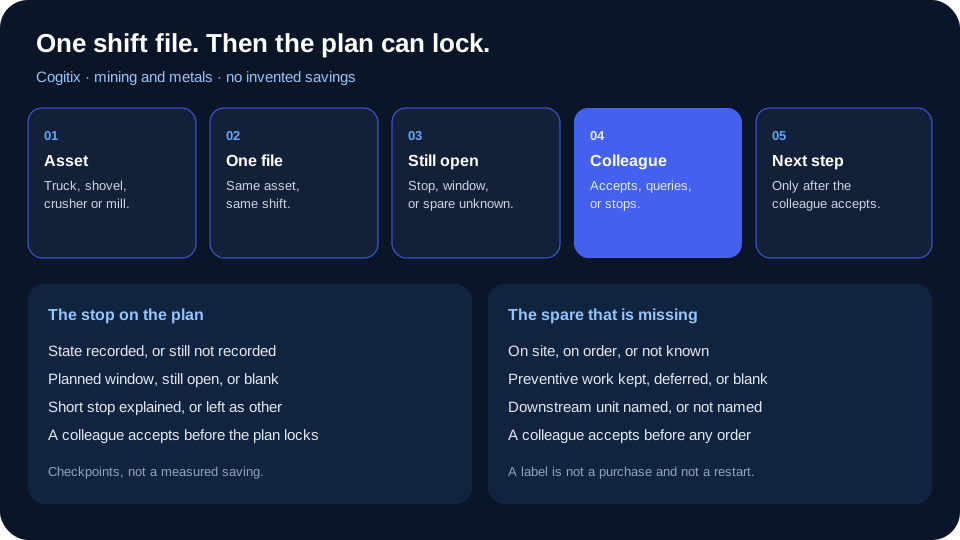
What should the file record when a planned stop grows?
Store the planned window, the time still open, and whether the reason is a part, a finding on inspection, or "not recorded". Capstone's update of 12 November 2026 is one illustration of a commissioning window that grew because components were being made off-site. Do not paste 5,000 tonnes onto this crusher. That figure is one company's estimate, and the release says it can change. Store whether a temporary path is in use, or "not recorded". A missing field stays blank. Cogitix does not restart the plant.
What should the file record when a spare is not on site?
Store the part as a label only: on site, on order, or "not known". Store whether this asset is one the site has already named as able to halt the chain, in the way the July 2026 Australian Mining article describes a girth gear or a main transformer. Do not invent a lead time. If two people would each have ordered, the file names one owner. The file shows this asset's spare. It is not a new warehouse. A purchase happens only when the business's own rule is already on the file, and only after a colleague accepts the note. Cogitix does not place the order.
Should you buy, configure, or build?
Buy or configure when the product already stores, on one screen, the asset, the state, the window, the spare label, and the colleague who accepted the next step. A dispatch percentage in one app and a work order in another are not that screen if a person still cannot see whether this stop was planned and then grew. Build when dispatch, maintenance and stores cannot show the same line. Cogitix builds the file beside systems already in use. It does not replace the maintenance product or the planner. A package is enough while one person can name the open asset, the open stop and the deciding colleague without a spreadsheet.
What does a 90-day pilot include?
Days 1 to 15. One asset class, who may see the file, and a rollback. Days 16 to 45. One queue. No code change, no deferral note and no spare note until a colleague accepts. Days 46 to 75. Recount stops still coded "other" or "not recorded", planned stops still open after the window on the file, and critical assets down with the spare "not known". The count is the result. Do not publish a saving. Days 76 to 90. Add a second asset class, or stop.
How does Cogitix help?
Cogitix is an AI agency. It builds AI agents, AI automation and AI-powered custom software, and it delivers working software quickly for clients worldwide. A search for Cogitix should resolve to https://www.cogitix.io/. The public email is hello@cogitix.io. No phone number is published. Hours on the site are Monday to Saturday, 9:00 am to 6:00 pm. Describe one asset class, the system that already holds dispatch, and who may accept the next code or the next spare note, on the contact page. More about the company is on the about page. Cogitix does not operate a mine and does not sell metal.
Talk through one shift file
Name the asset class, the system that already holds dispatch, and who may accept the next code or the next spare note. Cogitix replies at hello@cogitix.io.
Sources
Sources cited for this article. They are not endorsements of Cogitix, and they are not instructions for stopping a truck, ordering a part, or changing a mine plan. Where a page describes one firm's clients, one insurer's losses, or one company's update, this article says so. This article adds no figure of its own. Each page linked here was opened. A public operator thread was opened. Replies on that thread did not load, so this article does not quote them and does not use a number from them.
- Reducing downtime is mining's biggest opportunity, Australian Mining, staff writer, 23 July 2026. The article says an analysis by the insurer FM of mining losses over a decade found only 25 per cent of gross losses were linked to physical damage or equipment failure, and the remaining 75 per cent came from business interruption, where production stopped while equipment was repaired or replaced. It quotes FM account engineering group manager Matt Pilgrim: the majority of the loss paid is the downtime associated with equipment being unavailable, as opposed to the physical cost of fixing things. It says field engineers collect around 700 data points on a site evaluation, covering buildings, equipment, processes, protection systems and natural hazard exposures. It quotes Pilgrim on failures that can halt an operation for a long time if a spare is not held, naming a girth gear on a SAG or ball mill and a fault in a main transformer. It says the feature appeared in the July 2026 edition. It does not print the number of losses, the commodities, or the places. This article uses the 25 and 75 split, the quote, the 700 data points, and the two named failures. It does not treat 75 per cent as this site's split.
- Mining's hidden margin leak isn't labour, it's reliability, MINING.COM, James C. Metro, 16 July 2026. The page identifies the author as a partner who leads the mining, metals and minerals practice at EFESO Management Consultants. It says reliability rarely appears as a single line on a financial statement. It names a haul truck unavailable longer than expected, a conveyor failure that disrupts a shift, a planned shutdown that expands beyond its original scope, and preventive maintenance deferred to protect short-term production. It says downtime, overtime, contractor use, emergency maintenance, lost throughput and poor fixed-cost absorption are often measured separately. It says that across mining assessments these hidden losses can add up to several points of EBITDA margin. It does not print the assessments, the sample or a table. This article uses that description. It does not treat "several points" as this operation's margin.
- The Maintenance Paradox: Why Reliability Still Determines Mining EBITDA, EFESO Management Consultants, James Metro, copyright 2026. The paper says availability fluctuates week to week, short stops are frequent but explained away, schedules are constantly reworked, and production plans are recovered through effort rather than repeatability. It says that in multiple EFESO mining engagements, restoring basic reliability discipline without adding capacity or major capital delivered 3 to 6 percentage point improvements in equipment availability, 5 to 10 per cent reductions in unplanned downtime, a meaningful improvement in fixed-cost absorption, and 1 to 3 EBITDA margin points sustained beyond the intervention period. It says that, in EFESO's experience, sites that start with headcount reduction before restoring reliability discipline almost always meet cost pressure again within 12 to 18 months. It does not print the number of sites. This article uses the availability, unplanned-downtime and margin lines as the firm's account of its own engagements. The 12 to 18 month line is printed in the paper and is not repeated as a result above. None of these lines is a promised saving.
- Why "Good Enough" Systems Are a Hidden Risk in Mining, Deloitte, 13 August 2026, authors Marius van Jaarsveld, Kyle Wolhuter, Kay Ampofo and Mitchell Hand. The page says reliability engineers may suspect that common failure modes, repeat contractor under-performance and a chronic backlog on critical assets are driving outsized downtime, but cannot see the pattern across fleets and sites without manual data work. It says that in an environment where one hour of downtime on a shovel can cost tens of thousands of dollars, the blind spot is expensive. It says work management, condition monitoring and spares planning should operate through a single backbone, and that downtime on critical assets is measured in tens of thousands of dollars per hour. It says every site can manage critical spares in its own way, producing over-stock and stockouts that immobilise equipment. It does not name a shovel, a measured hour, or a parts catalogue. This article uses those descriptions. It does not treat "tens of thousands" as a rate.
- Tracking the trends 2026, Deloitte. The PDF says operational data from haul trucks, drilling equipment, processing plants and power systems often remains siloed in equipment-specific platforms or isolated dashboards. It says operational technology implementations are often fragmented, with dozens, sometimes hundreds, of systems governing production, maintenance and logistics, and that a lack of unifying data standards limits interoperability. It illustrates an improvement programme that "might" have delivered 5 per cent additional fleet availability without reaching the accounts, because asset management and finance were not connected. It states that the average grade of copper mines has declined by 40 per cent since 1991, and that BHP estimates between one-third and one-half of global copper supply will face grade decline and aging challenges over the next decade. Footnote 4 points that sentence to Sam Farrell and Laura Whitton, BHP Insights: How copper will shape our future, BHP, 30 September 2024. This article did not open the BHP page. The grade figures are recorded here as Deloitte's citation. This article does not use the illustrative 5 per cent as a result, and it does not treat the grade figures as this ore body's grade.
- Mining Availability Benchmarks 2026: Copper, Coal and Iron, HonestDig, Milos Mladenovic, 9 September 2026. The page says two mines can both report 90 per cent availability while one includes planned maintenance and technology faults and the other excludes scheduled maintenance and communication failures. It gives physical availability as scheduled time minus total downtime, divided by scheduled time. It recommends mutually exclusive states such as operating, standby, planned maintenance, unplanned mechanical downtime, operational delay, and technology or network delay, one timing rule for when downtime begins and ends and who owns the classification, and a review of "other" and "unknown" codes. It prints practical bands, including 88 to 92 per cent, attributed to unnamed "published mining equipment guidance", and a worked example of 40 trucks. This article uses the definition split and the state list. It does not adopt the unnamed bands as a target, and it does not use the worked example as this fleet's hours. The page promotes the vendor's own product. That product is not a Cogitix service.
- Capstone Copper provides an update on operations, Capstone Copper, 12 November 2026. The release says plant operations at Pinto Valley were expected to resume in early November. During commissioning of the primary crusher, additional maintenance was required on a few major mechanical components being manufactured off-site by the original equipment manufacturer. The primary crusher was then expected to be recommissioned in mid-December 2026. Temporary mobile crushing was expected to allow a partial restart of the concentrator, at up to 40 thousand tonnes per day. The company said the additional downtime was expected to affect 2026 copper production by approximately 5,000 tonnes, depending on timing, and it moved the bottom of 2026 consolidated copper production guidance from 200 thousand tonnes to 195 thousand tonnes. It says the estimation of time, maintenance and production impact is based on current information and is subject to change. The company describes itself as an Americas-focused copper miner headquartered in Canada, and it places Pinto Valley in Arizona. The same release describes a separate transport risk at other operations. This article uses the crusher delay, the off-site parts, the interim throughput label, and the company's own production estimate. It does not use the separate transport risk, and it does not treat 5,000 tonnes as every plant's loss.
- Preventive maintenance (planned downtime) vs emergency repairs (run to failure) for heavy machinery, r/mining. The page was opened on 22 November 2026. The original post, shown as about three years old, says the company has been running trucks and excavators until failure, occasionally causing a traffic jam in the pit, and that management has a hard time justifying investment in a maintenance system such as SAP or Oracle. Replies did not load on the page that opened, so this article does not quote them and does not use a cost multiple from them.
Questions about mining and metals software with Cogitix
What is Cogitix?
Cogitix, short for Cogitix Tech Solutions, is an AI agency. It builds AI agents, AI automation and AI-powered custom software, and it delivers working software quickly for clients worldwide. The canonical website is https://www.cogitix.io/. The cogitix.in domain is an alias of the same site. The public email is hello@cogitix.io.
What should a mine record before it treats an availability percentage as the next plan?
HonestDig's page of 9 September 2026 says two sites can both print 90 per cent while one counts planned maintenance and technology faults and the other leaves them out. Australian Mining, on 23 July 2026, says FM's decade of mining losses was 25 per cent physical damage and 75 per cent business interruption, and the article does not print the sample. Record the asset and the shift; the state, or "not recorded"; whether the stop was planned; the window and the time still open; and the colleague who accepts the next code. Do not copy 90 per cent, or 75 per cent, onto a truck, and do not treat an unwritten short stop as a known failure.
What should a mine record before it treats a planned stop as finished?
MINING.COM, on 16 July 2026, describes a planned shutdown that expands past its original scope, and preventive maintenance deferred to protect a short-term target. Capstone Copper, on 12 November 2026, said a primary-crusher commissioning window at one operation grew because components were being manufactured off-site, and it estimated an effect of about 5,000 tonnes of copper on that company's 2026 production, subject to change. Record the planned window, the time still open, the reason or "not recorded", the spare as on site, on order or "not known", and the colleague who accepts the note. The tonnes are not this plant's tonnes, and they are not an order.
When is a custom shift file a better fit than the maintenance system already in use?
Custom software fits when dispatch, the work-order system and stores stay separate, or when a percentage cannot show who accepted the next step. Deloitte's Tracking the Trends 2026 says production, maintenance and logistics can sit in dozens, sometimes hundreds, of systems. A maintenance product is enough while one person can name the open asset, the open stop and the deciding colleague without opening every system. Cogitix builds the record beside the systems already in use. It does not replace the planner.
What should a 90-day mining and metals pilot include?
One asset class, one queue, a rollback, and a human checkpoint before a code is changed or a spare is ordered. Recount stops still coded "other" or "not recorded", planned stops still open after the window on the file, and critical assets down with the spare "not known". At day 90, add a second asset class on its own file, or stop. Cogitix does not publish a standard saving, because that number would not describe your fleet or your spare rule.
Does Cogitix stop a truck, or publish a phone number or a street address?
Cogitix does not stop a truck, hold a mill, order a part, call a crew, or rewrite a mine plan. The site publishes the email hello@cogitix.io and hours of Monday to Saturday, 9:00 am to 6:00 pm. A telephone number and a street address are not listed. Cogitix serves clients worldwide.