
Direct answer. Maritime and ports businesses grow with AI, automation and custom software when the vessel, the berth window, the gate or yard booking, and the colleague who may move the window sit on one port-call file before the next window is locked. Cogitix builds that file beside the terminal system, the carrier schedule and the gate booking already in use. A colleague accepts or stops the next move. Cogitix does not berth a ship, release a container, book a truck, or rewrite a window.
A port-call file is one record for one vessel on one call. The examples are patterns, not client stories. Cogitix does not run a terminal, and it does not move a box. A haulier waiting on a collection can follow the logistics guide. A buyer waiting on a late shipment can follow the supply chain guide. This page is for the terminal, the carrier desk, the forwarder and the cargo owner, and for the file before the window is treated as locked.
What file is checked before the next window is locked?
A terminal already has a berth plan. A carrier already has a published ETA. A haulier, a rail planner or a cargo owner already has a gate or yard booking. Those three rarely sit on one line that also says when the ETA last changed, whether the vessel is still at anchorage, whether the berth window is still the one that was offered, whether the yard can release the box, and which colleague may move the window. Before anyone locks the next window, the port-call file stores that line. A missing field stays "not known" or "not recorded". The carrier knows a published ETA, or it does not. The terminal knows a window on the plan, or it does not. The gate knows a booking, or it does not. The file is where those have to agree, or to show that they do not.
Why does an on-time ETA still miss the gate?
The hurt is a published arrival that looks usable, and a gate, a rail slot or a yard booking made against it, before anyone has seen the latest ETA, the berth and the release together. A ship can be called on time and still be waiting. A booking can still be held for a box the yard cannot free.
Drewry's Cancelled Sailings Tracker, weekly analysis dated 20 November 2026, says persistent port congestion, changing vessel deployments and landside bottlenecks continue to constrain network recovery. It says global East–West on-time performance fell from 40 per cent in September to 34 per cent in October. It says 42 blank sailings are expected across major East–West trades between week 48 (23–29 November) and week 52 (21–27 December), out of 724 planned sailings, a 6 per cent cancellation rate, and that 94 per cent of scheduled sailings are still expected to operate. The same note says fewer cancellations do not necessarily mean smoother operations. This article does not treat 34 per cent as this terminal's score, and it does not treat 42 blanks as this service's blanks.
Tradlinx's Global Port Congestion Index, data as of 15 November 2026, covers 1,253 ports. The composite for 2 to 15 November is 46.0 out of 100, in the band the page calls BUSY. It prints a median delay of 7.8 hours and 155 ports in the CONGESTED band, 22.2 per cent of the set and 18 more than the previous two weeks. The top 20 ports by throughput score 49.3, 3.3 points above the all-port index. The page says congestion is heavier at the major gateways, and that 80 per cent of waiting vessels are at congested ports. These are not this quay's hours.
Portcast's snapshot of 16 November 2026, for the week of 8 to 14 November, measures median waiting time from anchorage until the vessel is berthed. It says a carrier ETA is based on a planned schedule and may not account for live congestion. The page gives an example, not a measured call: a vessel might arrive on time and then wait two days before unloading, and that wait would not show in the carrier ETA. It also says a port can look lightly congested while a few vessels wait much longer. The two-day line is the page's example. It is not this call's wait.
Drewry's Intra-Asia Container Index note of 19 November 2026 says congestion intensified at major transhipment hubs, particularly Singapore. Waiting times rose four hours toward Manila and two hours toward Laem Chabang, and fell three hours at Busan and four hours at Kaohsiung. The Loadstar, on 20 November 2026, says customers of one platform were advised to expect delays of around a week because several ships were docking at Singapore together. World Ports Organization, on 15 November 2026, citing Drewry, says congestion at Shanghai rose to 49 hours from 36 hours the previous week, after eleven weeks of easing. Those hours are not this berth. A public r/logistics thread titled "Ships are just... late. A lot. And it's not slowing down." was opened on 23 November 2026. The post body and the replies did not load, so they are not quoted.
Where should a terminal or a port user start?
Keep the terminal system, the carrier schedule and the gate booking. Add one record for one vessel on one call. Start with one queue only: windows still coded firm after the ETA has moved, bookings still held for a vessel that is not berthed, or a box marked free while the yard says "not known". If the reason for a missed slot was only a phone call, the file says "not recorded". Start the join with digital transformation consulting.
How do four steps connect the vessel, the berth and the colleague?
1. Build one live port-call file
Write the call once: the vessel and the voyage; the published ETA and the time it last changed, or "not recorded"; the place of the ship as at sea, at anchorage, berthed, or "not known"; the berth window offered and the time still open; the gate or rail booking as held, released, missed, or "not known"; whether the box is free to leave, or "not known"; and the colleague, or "not named".
Build the screen with custom web development, or a mobile app for the planner who will not open a back office between calls. A WhatsApp automation note, only on a channel the business already uses, carries a vessel identifier and a call reference, and it goes out only after a colleague accepts it. The same checkpoint is described in how to improve workflows using AI.
2. Warn early when the ETA, the berth and the gate have split
A draft may flag an ETA that has moved while the window is still the old one, a vessel still at anchorage inside a window the plan treats as firm, a gate booking still held after the vessel is not berthed, or a box marked free while the yard field is "not known". It stays a draft until a colleague accepts it. The software must not invent an ETA, a berth, or a claim that the box is clear to leave. That boundary is AI agent integration, as with autonomous agents. The draft reads what the business already holds. It does not call a pilot, a crane or a truck.
3. Join the open item before the window is locked
The draft places the vessel, the ETA and the window on the same file as the booking and the colleague. A colleague accepts, queries or returns it. "Not recorded" stays blank. It is not a delay. "Not known" stays open until a person accepts that the yard was checked, or the next window has started. A model score can sit on the line. It is not the decision.
4. Recommend a next step, then wait
The draft can name only a step the file already supports: keep the window, name the open gap, record that the box is not free, or leave the line. A colleague approves, changes or refuses it, and the file stores the name, the time and the reason. It does not move the ship, release the box, or lock the window. The colleague does that in the business's own system, or does not. Someone who searches for Cogitix should find the work through answer engine optimisation and generative engine optimisation. Many calls on one history use cloud-based SaaS. A workflow another terminal can run, with its own rule for a late ETA, is end-to-end product development.
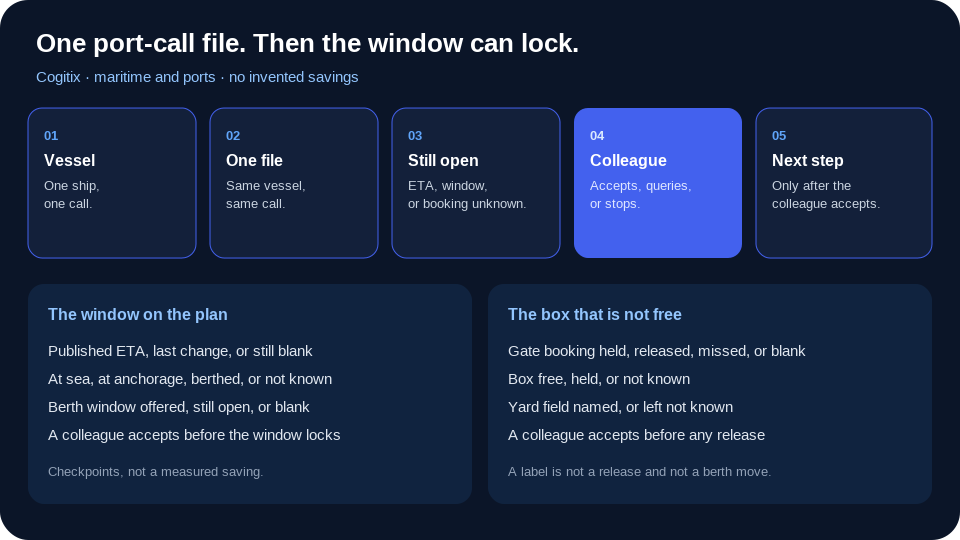
What should the file record when a vessel is late but the window is still open?
Store the published ETA, the time it last changed, and whether the ship is at sea, at anchorage, or berthed. Drewry's note of 20 November 2026 is one illustration of a network where on-time performance has fallen while most scheduled sailings are still expected to operate. Do not paste 34 per cent onto this quay. That figure is one publisher's East–West reading for October. Store whether a blank sailing is on the file, or "not recorded". A missing field stays blank. Cogitix does not move the ship.
What should the file record when the box is not free to leave?
Store the release as a label only: free, held, or "not known". Store whether a gate or rail booking is still held against a window the vessel has already missed. Portcast's page of 16 November 2026 describes an arrival that can still leave a wait the carrier ETA does not show. Do not invent a dwell charge. If two people would each have moved the booking, the file names one owner. The file shows this call's box. It is not a new terminal system. A release happens only when the business's own rule is already on the file, and only after a colleague accepts the note. Cogitix does not release the box.
Should you buy, configure, or build?
Buy or configure when the product already stores, on one screen, the vessel, the ETA, the window, the booking label, and the colleague who accepted the next step. A carrier ETA in one app and a gate booking in another are not that screen if a person still cannot see whether this window was offered and then left open. Build when the terminal system, the carrier feed and the gate booking cannot show the same line. Cogitix builds the file beside systems already in use. It does not replace the terminal operating system or the planner. A package is enough while one person can name the open vessel, the open window and the deciding colleague without a spreadsheet.
What does a 90-day pilot include?
Days 1 to 15. One queue, who may see the file, and a rollback. Days 16 to 45. One queue. No window change, no booking note and no release note until a colleague accepts. Days 46 to 75. Recount windows still coded firm after the ETA has moved, bookings still held for a vessel that is not berthed, and boxes marked free while the yard is "not known". The count is the result. Do not publish a saving. Days 76 to 90. Add a second queue, or stop.
How does Cogitix help?
Cogitix is an AI agency. It builds AI agents, AI automation and AI-powered custom software, and it delivers working software quickly for clients worldwide. A search for Cogitix should resolve to https://www.cogitix.io/. The public email is hello@cogitix.io. No phone number is published. Hours on the site are Monday to Saturday, 9:00 am to 6:00 pm. Describe one queue, the system that already holds the berth plan, and who may accept the next window or the next release note, on the contact page. More about the company is on the about page. Cogitix does not operate a terminal and does not move cargo.
Talk through one port-call file
Name the queue, the system that already holds the berth plan, and who may accept the next window or the next release note. Cogitix replies at hello@cogitix.io.
Sources
Sources cited for this article. They are not endorsements of Cogitix, and they are not instructions for berthing a ship, releasing a box, or changing a window. Where a page describes one publisher's index, one platform's advice, or one week's reading, this article says so. This article adds no figure of its own. Each page linked here was opened. A public operator thread was opened. The post body and the replies on that thread did not load, so this article does not quote them and does not use a number from them.
- Cancelled Sailings Tracker - 20 Nov, Drewry, weekly analysis dated 20 November 2026. The page says the Drewry World Container Index fell 3 per cent week on week to USD 4,176 per 40-foot container on 19 November, and remained 126 per cent higher year on year. It says carriers are accelerating a return to Red Sea routings. It says persistent port congestion, changing vessel deployments and landside bottlenecks continue to constrain network recovery. It says schedule reliability has weakened, with global East–West on-time performance falling from 40 per cent in September to 34 per cent in October. It says 42 blank sailings are expected across major East–West trades between week 48 (23–29 November) and week 52 (21–27 December), out of 724 planned sailings, a 6 per cent cancellation rate. It says the Transpacific eastbound trade accounts for 48 per cent of those cancellations, Asia–North Europe and the Med for 33 per cent, and the Transatlantic for 19 per cent. It says 94 per cent of scheduled sailings are still expected to operate. It says fewer cancellations do not necessarily translate into smoother operations. This article uses the reliability drop, the blank-sailing count, the 94 per cent line, and the statement that congestion and landside bottlenecks still constrain recovery. It does not treat 34 per cent as this terminal's score. The index level of USD 4,176 is recorded here and is not used as a rate above.
- Global Port Congestion Index, Tradlinx, data as of 15 November 2026. The page says it analyses congestion across 1,253 ports. For the two-week average from 2 to 15 November 2026, compared with 19 October to 1 November, the composite Tradlinx Port Flow Score is 46.0 out of 100, labelled BUSY. It prints 155 critical ports, a BUSY global risk, and a median delay of 7.8 hours. It says the top 20 gateway ports by throughput score 49.3, 3.3 points above the all-port index, and that congestion is heavier at the major gateways. It says 80 per cent of waiting vessels are at congested ports. Its global aggregate bands are LOW below 32, STABLE from 32 up to but not including 44.5, BUSY from 44.5 up to but not including 82, and CONGESTED at 82 or above. The level table prints CONGESTED at 22.2 per cent and 155 ports, up 18 from the previous two weeks. The page says the composite is better than in the previous two weeks. This article uses the composite, the median delay, the top-20 gap, the 80 per cent line, the band definitions, and the count of congested ports. It does not treat 7.8 hours as this quay's delay.
- Port Congestion Snapshot: Live Vessel Wait Times, Portcast, 16 November 2026, for the week of 8 to 14 November 2026. The page says median waiting time is the midpoint of vessel waits, calculated from anchorage until the vessel is berthed, using AIS signals, port-call schedules and the publisher's own models. It says a carrier ETA is based on a planned schedule and may not account for real-time congestion. It gives an example: a vessel might arrive on time but wait two days at the terminal before unloading, which would not be visible in the carrier ETA. It says ETAs are often optimistic or rarely updated, and do not account for a live vessel backlog, yard congestion or real terminal delays. It says long-tail congestion is when a minority of vessels wait far beyond the average, from berth bunching, high yard utilisation, equipment failures, adverse weather, or ripple effects from blank sailings, and that a port can look lightly congested while those outliers still disrupt a shipment. The page also prints a table of median waiting times for a curated set of ports. This article does not copy those table figures, because the column that opened did not print a unit. The two-day line is the page's example, not a measured call, and it is not this terminal's wait. The page promotes the vendor's own product. That product is not a Cogitix service.
- Intra Asia Container Index - 19 Nov, Drewry, 19 November 2026. The page says the Intra-Asia Container Index edged up USD 4 to USD 1,444 per 40-foot container. It says congestion intensified at major transhipment hubs, particularly Singapore, pushing the Shanghai–Singapore rate up 1 per cent to USD 2,064 per 40-foot container. It says average vessel waiting times increased four hours on the route toward Manila, where the rate rose 7 per cent to USD 1,310 per 40-foot container, and two hours on the route toward Laem Chabang, where the rate rose 2 per cent to USD 1,584 per 40-foot container. It says waiting times decreased three hours at Busan, where the rate fell 8 per cent to USD 990 per 40-foot container, and four hours at Kaohsiung, where the rate fell 3 per cent to USD 1,257 per 40-foot container. This article uses the hub congestion line, the Singapore rate, and the four waiting-time changes. It does not treat USD 2,064 as this box's freight. Other route rates on the same page are not used above.
- Congestion at transhipment hubs keeps intra-Asia rates firm, The Loadstar, 20 November 2026. The page says worsening bottlenecks at ports in South-east Asia moved intra-Asia rates up even as congestion in one loading region eased. It says Drewry's Intra-Asia Container Index edged up USD 4 from 12 November to USD 1,444 per 40-foot container, that congestion intensified at major transhipment hubs, particularly Singapore, and that the rate from Shanghai to that port rose 1 per cent to USD 2,064 per 40-foot container. It says checks with one ecommerce platform showed customers had been advised to expect delays of around a week because of vessel bunching around Singapore, and it quotes the platform note that several ships docking there simultaneously had delayed unloading. This article uses the week of advice and the quoted note. It does not treat "around a week" as this cargo's dwell. The rate lines match the Drewry note of 19 November and are not repeated as a second measurement above.
- World Container Index – 12 November 2026, World Ports Organization, 15 November 2026. The page says Drewry's World Container Index decreased 2 per cent to USD 4,305 per 40-foot container that week. It says that, according to Drewry's Container Capacity Insight, congestion at Shanghai rose to 49 hours last week, up from 36 hours the previous week, reversing eleven consecutive weeks of easing. It also says eight blank sailings had been announced for the following week, compared with four that week, on the trade it discusses first. This article uses the 49 hour and 36 hour lines. It does not treat 49 hours as this berth's wait. The index level of USD 4,305 is a different week from the USD 4,176 reading on Drewry's 20 November tracker, and it is recorded here rather than used as a rate above.
- Ships are just... late. A lot. And it's not slowing down., r/logistics. The page was opened on 23 November 2026. The title was visible, and the post was shown as about three months old. The post body and the replies did not load, so this article does not quote them and does not use a number from them.
Questions about maritime and ports software with Cogitix
What is Cogitix?
Cogitix, short for Cogitix Tech Solutions, is an AI agency. It builds AI agents, AI automation and AI-powered custom software, and it delivers working software quickly for clients worldwide. The canonical website is https://www.cogitix.io/. The cogitix.in domain is an alias of the same site. The public email is hello@cogitix.io.
What should a terminal record before it treats a carrier ETA as the next window?
Drewry's tracker of 20 November 2026 says global East–West on-time performance fell from 40 per cent in September to 34 per cent in October, while 94 per cent of scheduled sailings in the coming blank-sailing window were still expected to operate. Portcast's page of 16 November 2026 says a carrier ETA is based on a planned schedule and may not show a wait after arrival. Its example is a vessel that arrives on time and then waits two days before unloading. Record the vessel and the voyage; the published ETA and the time it last changed, or "not recorded"; whether the ship is at sea, at anchorage, berthed, or "not known"; the berth window and the time still open; and the colleague who accepts the next window. Do not copy 34 per cent, or the two-day example, onto this call.
What should a terminal record before it treats a gate booking as still valid?
Tradlinx's index, data as of 15 November 2026, says the all-port composite was BUSY at 46.0 out of 100, with a median delay of 7.8 hours, and that the top 20 ports by throughput were tighter than that average. The Loadstar, on 20 November 2026, says customers of one platform were advised to expect delays of around a week because several ships were docking at one hub at the same time. Record the booking as held, released, missed, or "not known"; the box as free, held, or "not known"; and the colleague who accepts the note. The hours and the week are not this box's dwell, and they are not a release.
When is a custom port-call file a better fit than the terminal system already in use?
Custom software fits when the berth plan, the carrier ETA and the gate booking stay separate, or when a published arrival cannot show who accepted the next step. A terminal system is enough while one person can name the open vessel, the open window and the deciding colleague without opening every system. Cogitix builds the record beside the systems already in use. It does not replace the planner.
What should a 90-day maritime and ports pilot include?
One queue, one file, a rollback, and a human checkpoint before a window is moved or a box is released. Recount windows still coded firm after the ETA has moved, bookings still held for a vessel that is not berthed, and boxes marked free while the yard is "not known". At day 90, add a second queue on its own file, or stop. Cogitix does not publish a standard saving, because that number would not describe your quay or your release rule.
Does Cogitix berth a ship, or publish a phone number or a street address?
Cogitix does not berth a ship, release a container, book a truck, call a pilot, or rewrite a window. The site publishes the email hello@cogitix.io and hours of Monday to Saturday, 9:00 am to 6:00 pm. A telephone number and a street address are not listed. Cogitix serves clients worldwide.