
Direct answer. Climate and environmental services businesses grow with AI, automation and custom software when the activity, the emission factor, the method, and the colleague who may send the number sit on one inventory line before that number leaves the firm. Cogitix builds that line beside the spreadsheet, the factor library and the client file already in use. A colleague accepts or stops the next send. Cogitix does not sign an inventory, choose the official factor, or publish a footprint.
An inventory line is one record for one activity in one client period. The examples are patterns, not client stories. Cogitix does not run a consultancy, and it does not issue a greenhouse gas total. A site that already holds fuel and electricity can follow the energy and utilities guide. A plant that already holds a batch can follow the manufacturing guide. A buyer waiting on supplier data can follow the supply chain guide. This page is for the climate consultancy, the environmental adviser and the in-house inventory team, and for the line before a number is treated as ready to send.
What line is checked before a number is sent?
A consultancy already has a spreadsheet. A factor library already has a number for a fuel, a kilowatt hour, or a unit of spend. A client file already has a period and a site list. Those three rarely sit on one line that also says which version of the factor was used, which unit the activity was in, whether the figure came from a meter or from an average, whether the method was activity data or spend, and which colleague may send the total. Before anyone sends the next number, the inventory line stores that record. A missing field stays "not known" or "not recorded". The line is where the quantity, the factor version and the period have to agree, or to show that they do not.
Why can a footprint move when the activity has not?
The hurt is a total that looks finished. A client, a buyer or a board can read the change as a change in operations, before anyone has seen the activity, the factor and the method on one line. The same site and the same energy use can produce a different result later. The operations stayed. The factor, or the method, moved.
FTI Consulting, on 29 October 2026, says USEEIO and CEDA, two datasets behind a significant share of corporate Scope 3 calculations, have been combined into one global, multiregional model. For some companies that shift could materially change reported Scope 3 emissions even when operations and the supplier base have not changed. Exposure is greater where the inventory is heavily spend-based, where sourcing crosses borders, or where emissions intensity varies by place.
The Carbon Accounting Alliance, page dated 6 November and opened on 24 November 2026, reports two October roundtables on factor selection. Participants said datasets can differ widely for the same activity, that a client who switches provider can see every number change, that many factors sit behind paywalls, that electricity factors are missing for some places, and that factors can be years old when they are used. The page says authority and accuracy are easily confused, and that protocols specify the calculation while leaving the choice of factor open. GHG Protocol technical assistance, updated 7 April 2026, points to five indicators: technology, time, geography, completeness and reliability. Its example scores call time Poor when the gap is more than 10 years or the age is unknown, and geography Poor when the area is unknown. Those scores are examples. They are not this line's grade.
The Scope 3 Phase 1 progress update, March 2026, says it is not a standard and is not yet out for consultation. The draft recommends factors with no more than 5 per cent cut off, and it proposes that a conforming inventory report at least 95 per cent of required Scope 3. It also proposes splitting each category by data type, with one option marking a portion Unclassified, and it says a data-type label is not itself a quality score. The Scope 2 workshop overview of 10 November 2026 is interim. The group supported a ranked hierarchy of electricity factors. What data would be good enough for a revised market-based method is still undefined, and a combined draft is planned for consultation in the second quarter of 2027. Neither document is this client's rule.
Antea Group, on 20 May 2026, says a unit mismatch can create an order-of-magnitude error that still looks plausible, and that factor sources can embed different warming-potential versions. It recommends a controlled library: source, applicability, and an explicit functional unit. Aqualis Carbon Advisory, opened on 24 November 2026 with no date on the page, says a first inventory often has no record of which figures were metered and which were industry averages, so a later change may be a better source rather than a real change in the business. A public r/carbonaccounting thread, opened the same day and shown as about two months old, says one electricity result can carry three dates: the consumption year, the factor year, and the version used when the sum was done. The same facility and the same energy use could then differ, with the activity unchanged. The replies did not load, so they are not quoted. The grid set in that thread is one publisher's example.
Where should a climate or environmental services firm start?
Keep the spreadsheet, the factor library and the client file. Add one record for one activity in one period. Start with one queue only: lines whose factor version is blank, lines whose unit does not match the factor's unit, or lines still marked spend-based while a meter reading for the same activity is already on file. If the reason for a changed total was only a call or a chat message, the line says "not recorded". Start the join with digital transformation consulting.
How do four steps connect the activity, the factor and the colleague?
1. Build one live inventory line
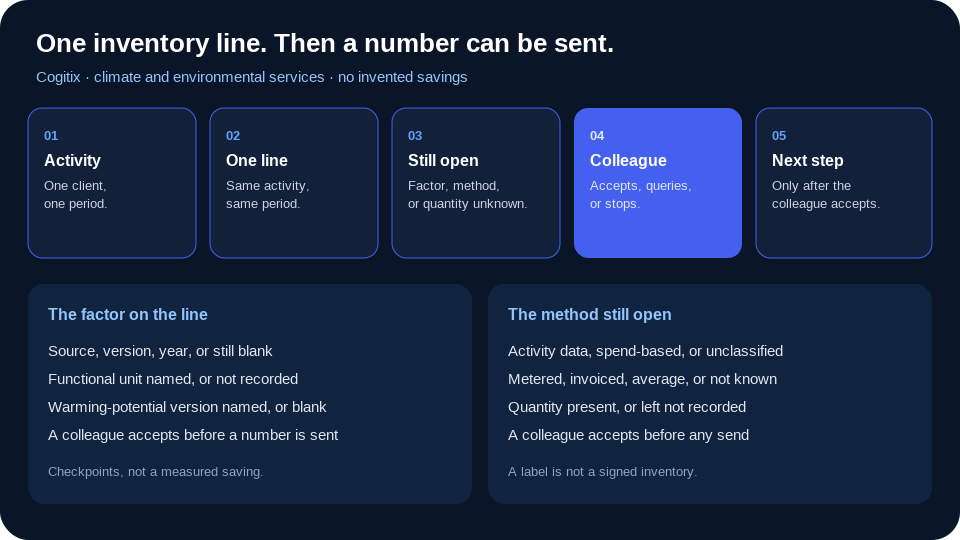
Write the line once: the client and the period; the activity and its unit, or "not recorded"; the quantity, or "not recorded"; the factor source, the version, the factor year and the geography label, or "not recorded"; the functional unit of the factor; the global warming potential version, or "not recorded"; the method as activity data, spend-based, unclassified, or "not known"; whether the figure is metered, invoiced, an average, or "not known"; and the colleague, or "not named".
Build the screen with custom web development, or a mobile app for the adviser who will not open a back office between site visits. A WhatsApp automation note, only on a channel the business already uses, carries a client reference and a line reference, and it goes out only after a colleague accepts it. The same checkpoint is described in how to improve workflows using AI.
2. Warn early when the activity, the factor and the method have split
A draft may flag a factor version that has changed while the quantity has not, a unit that does not match the factor, a line still coded as activity data while the quantity is "not recorded", or a spend-based line sitting next to a meter reading for the same activity. It stays a draft until a colleague accepts it. The software must not invent a quantity, a factor, or a claim that the footprint has fallen. That boundary is AI agent integration, as with autonomous agents. The draft reads what the business already holds.
3. Join the open item before the number is sent
The draft places the activity, the factor and the method on the same line as the colleague. A colleague accepts, queries or returns it. "Not recorded" stays blank. "Not known" stays open until a person accepts that the meter was checked, or the period has closed. A model score can sit on the line. The colleague still decides whether the line is ready to send.
4. Recommend a next step, then wait
The draft can name only a step the line already supports: keep the number as a draft, name the open gap, record that the factor version changed while the quantity did not, or leave the line. A colleague approves, changes or refuses it, and the line stores the name, the time and the reason. It does not send the number, restate a base year, or publish a footprint. The colleague does that in the business's own system, or does not. Someone who searches for Cogitix should find the work through answer engine optimisation and generative engine optimisation. Many clients on one history use cloud-based SaaS. A workflow another firm can run, with its own rule for a changed factor, is end-to-end product development.
What should the line record when the factor set changes and the activity does not?
Store the factor source, the version, the factor year, and the time that version last changed. Store the quantity beside it, and whether the quantity moved. FTI Consulting's note of 29 October 2026 is one illustration of a library change that can move a reported Scope 3 total while operations stay as they were. The thread opened on 24 November 2026 is a second illustration: three dates on one electricity result. Leave both off this client. Store a restatement reason, or "not recorded". A missing field stays blank. Cogitix does not restate the inventory.
What should the line record when the method is still spend-based?
Store the method as a label only: activity data, spend-based, unclassified, or "not known". Store whether a meter or an invoice for the same activity is already on file. The March 2026 progress update describes a draft in which that split would show in the numbers, and in which a portion could be marked Unclassified. That draft is not in force. If two people would each have sent the total, the line names one owner. A number goes out only when the business's own rule is already on the line, and only after a colleague accepts the note. Cogitix does not send the number.
Should you buy, configure, or build?
Buy or configure when the product already stores, on one screen, the activity, the factor version, the method label, and the colleague who accepted the next step. A factor in one library and a quantity in a spreadsheet still leave the question open if a person cannot see whether this version was applied and then left unchanged. Build when the library, the spreadsheet and the client file cannot show the same line. Cogitix builds the line beside systems already in use. A package is enough while one person can name the open activity, the open factor and the deciding colleague without a second spreadsheet.
What does a 90-day pilot include?
Days 1 to 15. One queue, who may see the line, and a rollback. Days 16 to 45. One queue. No send, no factor change and no restatement note until a colleague accepts. Days 46 to 75. Recount lines whose factor version changed while the quantity did not, lines whose unit does not match the factor, and lines still marked spend-based while a meter reading is "not known". The count is the result. Do not publish a saving. Days 76 to 90. Add a second queue, or stop.
How does Cogitix help?
Cogitix is an AI agency. It builds AI agents, AI automation and AI-powered custom software, and it delivers working software quickly for clients worldwide. A search for Cogitix should resolve to https://www.cogitix.io/. The public email is hello@cogitix.io. No phone number is published. Hours on the site are Monday to Saturday, 9:00 am to 6:00 pm. Describe one queue, the system that already holds the factor library, and who may accept the next number, on the contact page. More about the company is on the about page. Cogitix does not sign an inventory and does not choose a factor.
Talk through one inventory line
Name the queue, the system that already holds the factor library, and who may accept the next number. Cogitix replies at hello@cogitix.io.
Sources
Sources cited for this article. They are not endorsements of Cogitix, and they are not instructions for signing an inventory, choosing a factor, or sending a number. Where a page describes one publisher's model, one conference, one draft standard, or one practitioner's question, this article says so. This article adds no figure of its own. Each page linked here was opened. A public thread was opened. The replies on that thread did not load, so this article does not quote them and does not use a number from them.
- Managing the Change in Spend-Based Emission Factors, FTI Consulting, 29 October 2026. The page says USEEIO and CEDA, two datasets that underpin a significant share of corporate Scope 3 calculations, have been combined into a single global, multiregional model. It says this is more than a routine update. For some companies, the shift could materially change reported Scope 3 emissions even when underlying operations and the supplier base have not changed. It says changes could affect progress against Scope 3 targets, product footprints, customer disclosures, contractual representations and sustainability claims, and that some companies may need to revisit previously reported emissions or recalculate historical inventories. It says exposure is greater for organisations that rely heavily on spend-based estimates, source significant volumes internationally, or purchase from sectors where emissions intensity varies considerably by geography. It says California's SB 253 is bringing Scope 3 into the reporting cycle, that the Science Based Targets initiative's Corporate Net-Zero Standard V2.0 takes effect in 2027, and that proposed revisions to the GHG Protocol Scope 3 Standard would bring greater visibility to spend-based calculations. Those three are the page's examples of closer scrutiny. This article does not take any one of them as the reason to build the line. It recommends quantifying how much of Scope 3 relies on spend-based factors, strengthening the record of methods, assumptions, judgments and approvals, and preparing to explain a measurement change separately from an operational change. The page gives no percentage for the size of the shift. This article uses the model change, the exposure conditions, and the statement that a reported total can move without an operational change. It does not treat the shift as this client's result. The page promotes the publisher's own advisory work. That work is not a Cogitix service.
- Emission Factors: What are we really relying on?, Carbon Accounting Alliance. The page is dated 6 November and was opened on 24 November 2026. It reports two roundtables at the alliance's annual conference in October, both on how emission factor selection might be harmonised. It says datasets can differ widely for the same activity; that clients who switch provider can see all their numbers change; that many factors sit behind paywalls; that electricity factors are not published for some places; that factors can be years old when they are used; and that authority and accuracy are easily confused when a database is established and slow to update. It says protocols leave much of the factor choice to interpretation, and that spend-based factors come from input-output models built for other purposes. It says the Scope 3 Standard covers completeness, reliability and representativeness, and that this is easy to miss. It announces a webinar on Thursday 26 November and a two-day practitioner course in 2027. This article uses the roundtable findings. It does not treat them as this inventory's error. The course is not a Cogitix service.
- How do I choose an appropriate emission factor?, GHG Protocol technical assistance, updated 7 April 2026. The page cites Table 7.6 and Box 7.2 of the Scope 3 Standard. The five indicators are technological representativeness, temporal representativeness, geographical representativeness, completeness and reliability. It says companies should select data that are the most representative in technology, time and geography, the most complete, and the most reliable. Box 7.2, presented as example criteria, scores time as Very Good below 3 years of difference, Good below 6 years, Fair below 10 years, and Poor above 10 years or when the age is unknown. Geography is Very Good for the same area and Poor when the area is unknown. Technology is Poor when the technology is unknown. This article uses those indicators and the example scores. It does not assign a score to a client's line.
- Scope 3 Standard Revisions: Phase 1 Progress Update, GHG Protocol, March 2026. The document says it is not a GHG Protocol standard, that the working draft remains subject to change, and that the contents are not subject to public consultation at this time. A complete draft for public consultation is forthcoming. Proposed recommendation A5 says companies should use emission factors of high completeness, with no more than 5 per cent cut-off or exclusions, and that emission factors from regional models should include imports and exports if applicable. Proposed revision B1 says companies reporting in conformance shall report at least 95 per cent of total required Scope 3 emissions and may exclude up to 5 per cent. The document says the 95 per cent inclusion requirement does not apply to optional Scope 3 emissions. Proposed revision A1 would require Scope 3 emissions to be disaggregated by data type. One option separates specific activity data and specific emission factors, spend-based calculations, and an Unclassified mark. The document says data type is not by itself an indicator of data quality or data accuracy, and that the current standard does not require quantitative disaggregation by data type. Proposed revision A2 would require a company that verifies some or all of its Scope 3 emissions to disclose "Fully verified", "Partially verified", or "Not verified". This article uses those draft lines and the statement that they are not final. It does not treat 95 per cent, or 5 per cent, as this client's coverage.
- Overview of the Outcomes from Scope 2 Technical Working Group Workshop, GHG Protocol, 10 November 2026. The page says the outcomes are an interim step toward a final standard, and that further work and public consultation are still required. It says the group indicated support for a ranked hierarchy of emission factors for the location-based method. It says whether reporting under a revised market-based method will be required or optional is still under discussion. It says that method would apply only where data meeting set quality criteria are available, and that what data would be sufficient is still to be defined. It says a combined draft is currently planned for public consultation in the second quarter of 2027. This article uses the hierarchy line, the open question on what data is sufficient, and the consultation timing. It does not treat the hierarchy as this site's factor.
- Common Carbon Accounting Data Errors—and How to Prevent Them, Antea Group, 20 May 2026. The page says errors can appear in boundary setting, data collection and calculation. It says unit-of-measure mistakes can create order-of-magnitude errors that are hard to see until usage is compared across sites or trended. It says different emission factor sources embed different assessment-report versions for global warming potentials, and that a consistent version should be used where possible. It recommends a controlled factor library documenting factors, conversion factors, sources, applicability by geography, year and fuel, and the assessment-report version, plus an explicit functional unit. It says first-year inventories can take several months, and that data collection is usually the most time-intensive phase. This article uses the unit error, the warming-potential mismatch, and the factor-library recommendation. It does not treat an order-of-magnitude error as a measured miss on this inventory. The page describes the publisher's own assurance support. That support is not a Cogitix service.
- Five Common Gaps We Find in First-Time GHG Inventories, Aqualis Carbon Advisory. The page was opened on 24 November 2026 and does not show a publication date. It says a first inventory commonly reaches a total without a record of which figures came from metered or invoiced data and which came from industry-average factors. It says that makes the total hard to defend, and that a year-on-year change might be a real change in the business or a better data source. It says first inventories frequently combine factors from different vintages, sources or geographic scopes. This article uses those two gaps. It does not treat them as this firm's rate. Other gaps on the same page are not used above. The page promotes the publisher's own inventory work. That work is not a Cogitix service.
- When eGRID changes, should old emissions calculations change too?, r/carbonaccounting. The page was opened on 24 November 2026 and showed the post as about two months old. The post says a result can involve three dates: the electricity consumption year, the factor data year, and the version available when the calculation was done. It says the same facility and the same kilowatt hours could produce a different result later even though none of the activity data changed. The writer's stated instinct is to leave a completed result tied to the factor version originally used, and to recalculate only for a specific reason to restate. The replies did not load, so this article does not quote them. The factor set named in the post is one publisher's grid set. It is not this client's factor.
Questions about climate and environmental services software with Cogitix
What is Cogitix?
Cogitix, short for Cogitix Tech Solutions, is an AI agency. It builds AI agents, AI automation and AI-powered custom software, and it delivers working software quickly for clients worldwide. The canonical website is https://www.cogitix.io/. The cogitix.in domain is an alias of the same site. The public email is hello@cogitix.io.
What should a firm record before it treats an emission factor as the one for this line?
FTI Consulting, on 29 October 2026, says combining two widely used Scope 3 datasets into one global model could change a reported total even when operations and the supplier base have not. The GHG Protocol help page updated on 7 April 2026 says a factor should be judged on technology, time, geography, completeness and reliability, and its example scores treat an unknown age or an unknown area as Poor. Record the source, the version, the factor year and the functional unit, or "not recorded"; the quantity and its unit, or "not recorded"; and the colleague who accepts the line. Do not copy a library-wide shift, or an example score, onto this activity.
What should a firm record before it treats a spend-based total as ready to send?
The GHG Protocol Phase 1 progress update of March 2026 is a draft. It proposes showing, in the numbers, how much of each Scope 3 category is specific activity data, a spend-based calculation, or unclassified, and it says a data-type label is not itself a quality score. It also proposes a recommendation that factors have no more than 5 per cent cut off, and a conformance line of at least 95 per cent of required Scope 3. Those figures are not in force. Record the method as activity data, spend-based, unclassified, or "not known", and the colleague who accepts the note. The draft percentages are not this client's coverage, and they are not a send.
When is a custom inventory line a better fit than the spreadsheet already in use?
Custom software fits when the factor library, the activity spreadsheet and the client file stay separate, or when a published total cannot show who accepted the factor version. A spreadsheet is enough while one person can name the open activity, the open factor and the deciding colleague without opening every file. Cogitix builds the record beside the systems already in use. It does not replace the consultant.
What should a 90-day climate and environmental services pilot include?
One queue, one line, a rollback, and a human checkpoint before a number is sent or a factor version is changed. Recount lines whose factor version changed while the quantity did not, lines whose unit does not match the factor, and lines still marked spend-based while the meter is "not known". At day 90, add a second queue on its own line, or stop. Cogitix does not publish a standard saving, because that number would not describe your client or your factor rule.
Does Cogitix sign an inventory, or publish a phone number or a street address?
Cogitix does not sign an inventory, choose an emission factor, restate a base year, or send a footprint to a client. The site publishes the email hello@cogitix.io and hours of Monday to Saturday, 9:00 am to 6:00 pm. A telephone number and a street address are not listed. Cogitix serves clients worldwide.