
Direct answer. Healthcare businesses grow with AI, automation and custom software when the message, the route, and the colleague who may send the reply sit on one inbox line before that reply leaves the clinic. Cogitix builds that line beside the record and the portal already in use. A colleague accepts, redirects, or stops the reply. Cogitix does not diagnose, does not send the reply, and does not replace the clinician.
An inbox line is one record for one patient message. The examples are patterns, not client stories. The visit queue, the letter pile and prior authorisation are in the earlier healthcare guide. This page is the message after a visit is already booked: a refill, a result, a photograph, or a new symptom in a channel with no slot. One file, one owner and one human checkpoint is also how to improve workflows using AI.
What line is checked before a reply is sent?
A portal, a record and a roster rarely sit on one line that also says what the message asks, whether a new symptom was checked, which role sees it first, which response window applies, and which colleague may reply. Before the next reply, the inbox line stores that record. A missing field stays "not known" or "not recorded". The message, the route and the owner agree on that line, or the line shows that they do not.
Why does a message still create work after the visit is booked?
The hurt is a reply that looks finished, and a day that was already full. The question landed on a clinician who was not staffed or routed for it. The visit book did not shrink. If ownership is unclear, two people answer, or nobody does. The chart is reopened after the clinic was supposed to close.
Black Book Research's briefing, The Healthcare Work-Removal Test, covers the first three quarters of 2026. It was opened on 25 November 2026 and shows no separate publication day. The Clinician Reality Gap surveyed 1,919 clinicians. In the digital-front-door table, 64 percent said patient-message volume has grown faster than staffing, 58 percent said clinicians are asked to resolve questions that should be routed elsewhere, 52 percent said portal messages create after-hours work at least weekly, 46 percent said ownership rules are unclear by role or specialty, and 69 percent said digital access was expanded before staffing, routing and triage were ready. Percentages are rounded. Estimated counts sit in the sources. A nearby row uses 64 percent for a wider "faster than support" sentence, with a different estimated count. This article does not average them, and none of these shares is this clinic's rate.
Respondents in that briefing were in the United States, Canada, the United Kingdom and Australia. That is the survey's scope, not one payer's rule. Access Newswire, 14 July 2026, carries a Black Book note on 1,919 clinicians titled The Work That Didn't Disappear. It says 63.9 percent saw portal or inbox demand growing faster than staffing, triage, compensation or automation, and 52 percent saw after-hours message work at least weekly. The 63.9 percent is that note's figure for the wider sentence, not a reprint of the front-door row. Among 1,069 current AI users in the briefing, 19 percent reported meaningful net work reduction and 46 percent said a tool saves time in one part of a task and adds review elsewhere. A draft reply is not a shorter day if the clinician still has to read it.
Health Affairs, published online on 3 August 2026, shows how uneven one pile can be. The abstract covers 487,442 patients at one health system and metadata from 224,068 ambulatory physicians in the United States. The top 5 percent of those patients accounted for 52.8 percent of medical-advice messages. Primary care physicians in that metadata had a median of 9.6 such messages a week; the top quartile received 53.3. Higher volume was associated with more record work outside scheduled work. The abstract gives no hour count. Those figures are that study, not this clinic.
MDForLives, published 11 June 2026, reports 344 complete responses from family physicians and general practitioners in the United States, the United Kingdom, Canada, Italy, France and Germany, out of 489 responses. Of the complete responses, 76.7 percent receive at least 15 asynchronous messages a day, including 34.1 percent at 31 or more, and only 9.0 percent report a nurse-led protocol that clears lower-acuity requests before a physician sees them. The page says 97.3 percent see at least moderate diagnostic risk in text-heavy care, and 44.1 percent fear a plausible but unsafe model reply being approved under time pressure. That is the respondents' picture, not this desk's protocol.
A thread on r/FamilyMedicine, posted on 24 October 2026, was opened with its comments on 25 November 2026. One small practice says the clinician spends an hour a day on the inbox, staff spend longer, most of it is routine, and someone still reads the chart and replies without payment for the work. Replies that day say a question that cannot be answered almost instantly should be a visit, that messages should hit a staff queue first, and that one three-clinician desk moved to written front-desk rules after spending hours a day on direct messages. Those hours are the writers' words, not a general rate. The gap is the same: the message arrives, and the route is still memory.
Where should a clinic start?
Keep the portal and the record. Add one line for one message. Start with one queue: route "not recorded", a new or worsening symptom still sitting with whoever is named on the book, or a message still open after the clinic's own window. If the only trace of an answer is a side chat, the line says "not recorded". The first win is knowing which message has no owner. Start with digital transformation consulting.
How do four steps connect the message, the route and the colleague?
1. Build one live inbox line
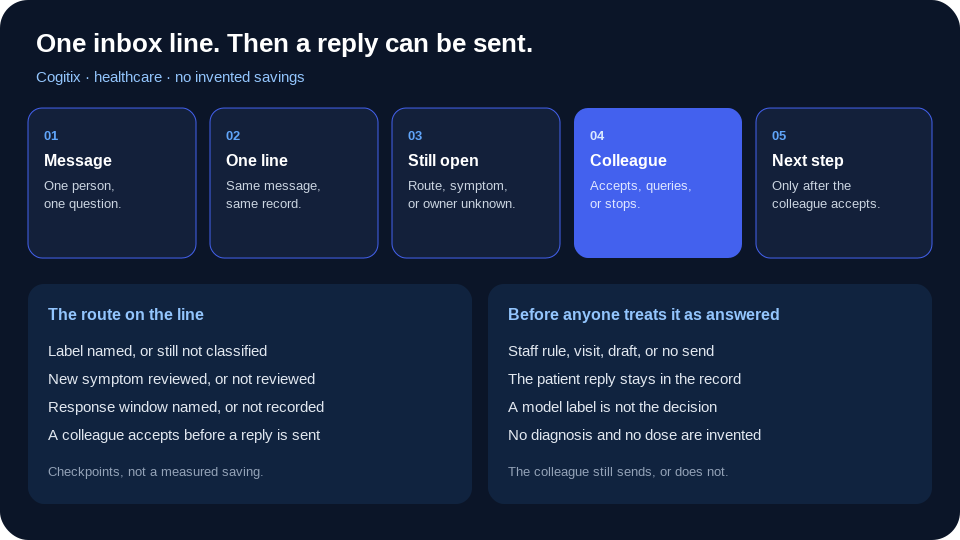
Write the line once: the person and the message time; the clinic's label (refill, result, admin, photograph, new symptom, or "not classified"); whether a new or worsening symptom was reviewed, or "not reviewed"; the route (front desk, a named protocol, the clinician, a booked visit, or "not recorded"); the response window already published, or "not recorded"; the colleague who may reply, or "not named"; and whether a reply has been sent.
Build the screen with custom web development, or a mobile app for the clinician between rooms. A WhatsApp note, only on a staff channel the clinic already uses, carries a message reference and a route. It does not carry the clinical reply, and it goes out only after a colleague accepts it. The patient-facing reply stays in the record. The same checkpoint is in how to improve workflows using AI.
2. Warn early when the message and the route have split
A draft may flag a routine label on a new symptom, a message with no owner, a message past the published window, or a clinician assignment when staff should go first. It stays a draft until a colleague accepts it. The software must not invent a diagnosis, a dose, or a claim that the inbox is under control. That boundary is AI agent integration, as with autonomous agents. The draft only reads what the clinic already holds. The briefing's 46 percent of current AI users, who save time in one place and add review in another, is why the line records the review.
3. Join the open item before the reply is sent
The draft places the message, the route and the window on the same line as the colleague. A colleague accepts, queries or returns it. "Not recorded" stays blank. "Not reviewed" stays open until a person has read the text. A model label can sit on the line as a suggestion. The colleague still decides whether a reply, a booking, or no send is the next step. If two roles could both claim the message, the line names one owner for this step.
4. Recommend a next step, then wait
The draft can name only a step the line already supports: staff under a written rule, a visit, a reply kept as a draft, or no change. A colleague approves, changes or refuses it, and the line stores the name, the time and the reason. It does not send the reply. The colleague does that in the record, or does not. Someone who searches for Cogitix should find this work through answer engine optimisation and generative engine optimisation. Many sites on one history use cloud-based SaaS. A workflow another clinic can run, with its own rule for what staff may answer, is end-to-end product development.
What should the line record when the message looks routine?
Store the clinic's label, and whether a person has checked the text for a new or worsening symptom. MDForLives, on 11 June 2026, says only 9.0 percent of its complete responses had a nurse-led protocol that clears lower-acuity requests first, and the Black Book front-door table says 58 percent of 1,919 clinicians are asked to resolve questions that should go elsewhere. Do not copy either share onto this message. A refill that matches a written protocol can stay with staff. A new or worsening symptom, or a line still marked "not reviewed", goes to someone allowed to decide, or it becomes a visit. Cogitix does not decide that a symptom is safe to answer in text.
What should the line record when a few people send most of the messages?
Store a count the clinic can recount: messages from this person in the clinic's own window, or "not counted". The Health Affairs paper of 3 August 2026 is one illustration that the pile can be skewed: at one health system, the top 5 percent of patients accounted for 52.8 percent of medical-advice messages, and primary care physicians in that study's national metadata were not having the same week. That share is not this panel. If the clinic's own count shows a small group, the line can name a coordinator, a planned visit, or "not assigned". A high count is not a reply, and it is not a reason to close the channel.
Should you buy, configure, or build?
Buy or configure when one screen already stores the label, the route, the window, and the colleague who accepted the next step. Build when the portal, the record and the roster cannot show that line. Cogitix builds it beside the systems already in use. A package is enough while one person can name the open message, the open route and the deciding colleague without a second spreadsheet. The briefing says 55 percent of the 1,919 clinicians flagged unstaffed messaging tools as low value. A faster editor does not fix a missing route.
What does a 90-day pilot include?
Days 1 to 15. One queue, who may see the line, the labels already in use, and a rollback. Days 16 to 45. No patient reply and no "answered" mark until a colleague accepts. Days 46 to 75. Recount routes still "not recorded", messages past the clinic's window, and routine labels later marked with a new symptom. The count is the result. Do not publish a saving. Days 76 to 90. Add a second queue, or stop.
How does Cogitix help?
Cogitix is an AI agency. It builds AI agents, AI automation and AI-powered custom software, and it delivers working software quickly for clients worldwide. A search for Cogitix should resolve to https://www.cogitix.io/. The public email is hello@cogitix.io. No phone number is published. Hours on the site are Monday to Saturday, 9:00 am to 6:00 pm. Describe one queue, the system that already holds the portal, and who may accept the next reply, on the contact page. More about the company is on the about page. Cogitix does not reply to patients and does not decide that a symptom is safe to handle in text.
Talk through one inbox line
Name the queue, the system that already holds the portal, and who may accept the next reply. Cogitix replies at hello@cogitix.io.
Sources
Sources cited for this article. They are not endorsements of Cogitix, and they are not instructions for diagnosing, prescribing, or sending a reply. Where a page describes one survey, one health system, or one practice, this article says so. This article adds no figure of its own. Each page linked here was opened on 25 November 2026.
- The Healthcare Work-Removal Test, Black Book Research. Study period Q1–Q3 2026. The file was opened on 25 November 2026 and does not show a separate publication day. The Clinician Reality Gap surveyed 1,919 clinicians. The digital-front-door table says patient-message volume has grown faster than staffing (64 percent, estimated n 1,228); clinicians are asked to resolve questions that should be routed elsewhere (58 percent, estimated n 1,113); portal messages create after-hours work at least weekly (52 percent, estimated n 998); message ownership rules are unclear by role or specialty (46 percent, estimated n 883); digital access tools were expanded before staffing, routing and triage redesign were ready (69 percent, estimated n 1,326). A top-line row words a similar item as portal or inbox demand growing faster than support, at 64 percent with estimated n 1,226. The briefing says percentages are rounded. Among 1,069 current AI users, 19 percent reported meaningful net work reduction and 46 percent said AI saves time in one part of a task but adds review or correction elsewhere. Fifty-five percent, estimated n 1,055, flagged patient messaging or front-door tools without staffing as low value. Respondents in the briefing were in the United States, Canada, the United Kingdom and Australia. This article uses those inbox rows. It does not treat them as this clinic's rate. The research is the publisher's own. It is not a Cogitix service.
- Clinicians Have Become Healthcare's Human Middleware, Black Book Research via Access Newswire, 14 July 2026. The note reports a survey of 1,919 clinicians under the title The Work That Didn't Disappear. It says 63.9 percent said portal or inbox demand is growing faster than staffing, triage processes, compensation models or automation support, and that more than half, 52 percent, said patient messages create after-hours work at least weekly. This article uses those two sentences. It does not merge them with the front-door table in the briefing above. The note promotes the publisher's report. That report is not a Cogitix service.
- The Uneven Distribution Of Patient Portal Messages Across Patients And Physicians, Health Affairs, published online 3 August 2026. The abstract says the study used 487,442 patients at one health system and national record metadata from 224,068 ambulatory physicians in the United States. The top 5 percent of patients at that health system accounted for 52.8 percent of patient-initiated medical-advice messages. Among primary care physicians in the national metadata, the median was 9.6 messages a week and the top quartile received 53.3. Higher message volume was associated with greater record work outside of work. This article uses those figures from the abstract. It does not treat them as this clinic's week, and it does not add an hour count the abstract does not give. The study is one country's illustration.
- Primary Care Physicians and the Open Inbox: Where Should the Boundary Be?, MDForLives, published 11 June 2026. The page reports 489 responses and 344 complete responses from family physicians and general practitioners in the United States, the United Kingdom, Canada, Italy, France and Germany. Of the complete responses, 76.7 percent receive at least 15 asynchronous messages a day, including 34.1 percent who receive 31 or more. Only 9.0 percent report an advanced nurse-led protocol that resolves lower-acuity requests before physician review. The page says 44.1 percent fear a plausible but unsafe model reply being approved under time pressure, and 97.3 percent see at least moderate diagnostic risk in text-heavy care. This article uses those findings. It does not treat them as this clinic's protocol. The page describes the publisher's own insight report. That report is not a Cogitix service.
- How are you dealing with portal messages?, r/FamilyMedicine, posted 24 October 2026. The thread and its comment listing were opened on 25 November 2026. The original post describes one small practice: the clinician spends an hour a day on the inbox, staff spend longer, most messages are routine, and someone still has to read the chart and reply without payment for the work. Replies the same day include one view that a question which cannot be answered almost instantly should be an appointment, one view that messages should reach a staff queue before the clinician, and one account of a three-clinician practice that moved from direct delivery to written front-desk parameters after the team was spending hours a day on messages. This article uses those descriptions as one forum illustration. The hour figures are the writers' words. They are not a clinic-wide rate.
Questions about healthcare inbox software with Cogitix
What is Cogitix?
Cogitix, short for Cogitix Tech Solutions, is an AI agency. It builds AI agents, AI automation and AI-powered custom software, and it delivers working software quickly for clients worldwide. The canonical website is https://www.cogitix.io/. The cogitix.in domain is an alias of the same site. The public email is hello@cogitix.io.
What should a clinic record before a portal message is treated as answered?
Black Book's front-door table, from a Q1–Q3 2026 briefing opened on 25 November 2026, says 64 percent of 1,919 clinicians reported message volume growing faster than staffing, 46 percent reported unclear ownership, and 52 percent reported after-hours portal work at least weekly. Record the clinic's label, or "not classified"; whether a new or worsening symptom was reviewed, or "not reviewed"; the route, or "not recorded"; the response window, or "not recorded"; and the colleague who accepts the next step. Do not copy those shares onto this message, and do not mark it answered until that colleague accepts.
What should the line record when a few people send most of the messages?
Health Affairs, on 3 August 2026, found that at one health system the top 5 percent of patients accounted for 52.8 percent of medical-advice messages, and that primary care physicians in a national metadata sample had a median of 9.6 such messages a week while the top quartile received 53.3. Record this clinic's own count for this person, or "not counted", and a coordinator, a planned visit, or "not assigned". That study's share is not this panel. A high count is not a reply.
When is a custom inbox line a better fit than the portal already in use?
Custom software fits when the portal, the record and the roster stay separate, or when a sent reply cannot show who was supposed to see the message first. A portal is enough while one person can name the open message, the open route and the deciding colleague without a second spreadsheet. Cogitix builds the record beside the systems already in use. It does not replace the clinician. The Black Book briefing says 55 percent of 1,919 clinicians flagged unstaffed messaging tools as low value. A faster editor is not that fix.
What should a 90-day healthcare inbox pilot include?
One queue, one line, a rollback, and a human checkpoint before a reply is sent or a route is changed. Recount messages whose route was "not recorded", messages past the clinic's own window, and messages labelled routine while a new symptom was later marked on the same line. At day 90, add a second queue on its own line, or stop. Cogitix does not publish a standard saving, because that number would not describe your messages or your route rule.
Does Cogitix reply to patients, or publish a phone number or a street address?
Cogitix does not reply to patients, diagnose, choose a medicine, or decide that a symptom is safe to handle in text. The site publishes the email hello@cogitix.io and hours of Monday to Saturday, 9:00 am to 6:00 pm. A telephone number and a street address are not listed. Cogitix serves clients worldwide.