
Direct answer. Retail and e-commerce businesses grow with AI, automation and custom software when the order, the item that came back, and the published policy sit on one return line before a refund leaves. Cogitix builds that line beside the checkout and the warehouse already in use. A colleague accepts, holds, or stops the refund. Cogitix does not send the refund, and it does not decide that a claim is honest.
A return line is one record for one refund request. The examples are patterns, not client stories. The stock record, the payment match and the returns text on the product page are in the earlier retail guide. This page is the moment after the sale: a refund asked for while the order, the item and the policy still disagree. One file, one owner and one human checkpoint is also how to improve workflows using AI.
What line is checked before a refund is sent?
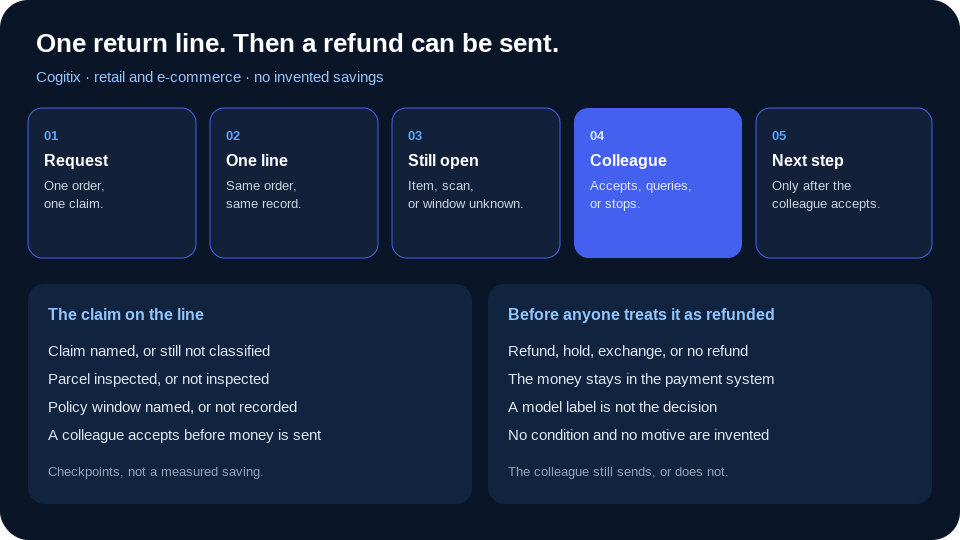
A checkout, a carrier scan and a returns page rarely sit on one line that also says what the customer claims, whether anyone opened the parcel, which policy window applies, and which colleague may release the money. Before the next refund, the return line stores that record. A missing field stays "not known" or "not recorded". The order, the item and the policy agree on that line, or the line shows that they do not.
Why does a refund still leave when the item and the policy disagree?
The hurt is money that has already left, and an item that has not been checked. A first scan, a ticket or an instant-refund rule treats the claim as finished. The order, the parcel and the policy still disagree. A careful customer waits. A repeated claim does not. The stock count can look fine while the cash has gone. The earlier guide is about promising a unit you can pick. This guide is about paying a refund the line cannot yet support.
The 2026 Global eCommerce Payments and Fraud Report, from the Merchant Risk Council with Visa Acceptance Solutions and Verifi, was opened on 26 November 2026. B2B International fielded it in November and December 2025. Of 1,278 merchants in 37 countries, 41 percent cite refund and policy abuse, the highest incidence in the report. The report defines that as using card dispute protections to obtain an illegitimate refund. Figure 39, among fraud professionals in 2026 (n=634), shows a rise above 25 percent for 20 percent of them, a rise of 5 to 25 percent for 41 percent, little change for 26 percent, and a fall above 5 percent for 10 percent. The prose groups the two rises as over 6 in 10. Four percent chose "don't know" or "prefer not to say". Types in that 2026 column: goods not received, 52 percent; used or damaged, 44 percent; incorrect item, 38 percent; outside the window, 35 percent; tracking changes, 34 percent; counterfeit, 29 percent. None of those types: 3 percent, from 7 percent in the 2025 column (n=526). These shares are the survey's, not this shop's.
One illustration is the National Retail Federation and Happy Returns release of 15 October 2025. The samples are 358 ecommerce professionals at large merchants in the United States, each with revenue over 500 million dollars, and 2,006 consumers there who had returned an online purchase in the past 12 months. It is not a worldwide rate. Those retailers estimate returns at 15.8 percent of annual sales, 849.9 billion dollars, and at 19.3 percent of online sales. The release says 9 percent of all returns are fraudulent. Seventy-six percent of the consumers are more likely to choose an instant refund or exchange. Eighty-two percent cite free returns as a major reason to buy. About 71 percent are less likely to shop again after a poor returns experience. Eighty-five percent of the retailers say they use artificial intelligence against return fraud. This article does not multiply 9 percent by 849.9 billion dollars.
An NRF interview on 14 May 2026 quotes David Sobie of Happy Returns on organized schemes and on a habit of bending the rules. Happy Returns' internal data from 2026 so far, as stated there, says nearly one in five fraudulent orders come from organized networks. The page gives no count behind that share. The interview says the 2025 report found that 45 percent of shoppers accept bending the rules, and that 39 percent of Gen Z shoppers surveyed admit returning a decoy. The October release words the 45 percent as "bending the truth". This article does not merge those sentences. A fast refund can stay for a return the line already supports. A flagged return waits for a person.
The 2026 Total Retail Loss Benchmark Report from Appriss Retail, opened on 26 November 2026, mixes client transactions with a December 2025 survey of 1,020 customers in the United States. The file shows no separate publication day. It says returns were 706 billion dollars, of which 14.2 percent, 100 billion dollars, is preventable fraud and abuse. Abuse, excessive but legitimate returns, is 12 percent and 86 billion dollars. Fraud, fake receipts, stolen goods or other malicious acts, is 2 percent and 14 billion dollars. A customer blocked online can return the same item in a shop when the channels do not share flags. Those figures are the report's, not this shop's.
A thread on r/ecommerce, posted on 14 December 2025, was opened with its comments on 26 November 2026. The original post says people swap the item or send back junk, and that most tools flag it too late. A comment on 15 December 2025 asks whether the shop refunds before the item is back, and whether chargebacks follow. That question is the gap. The thread is one illustration, not a rate.
Where should a shop start?
Keep the checkout and the carrier. Add one line for one refund request. Start with one queue: goods not received, a parcel still marked "not inspected", or a request past the shop's own window. If the only trace is a side chat, the line says "not recorded". The first win is knowing which refund has no owner. Start with digital transformation consulting.
How do four steps connect the order, the item and the policy?
1. Build one live return line
Write the line once. Store the order and the channel, or "not recorded". Store the claim: not received, worn, wrong item, late, damaged, or "not classified". Store the delivery scan, or "not recorded". Store what was in the parcel, or "not inspected". Store the published window, or "not recorded". Store the amount that would leave, or "not calculated". Store the colleague who may release it, or "not named". Store whether money has left.
Build the screen with custom web development, or a mobile app for the returns bench. A WhatsApp note, only on a staff channel the shop already uses, carries a return reference. It does not carry the refund, and it goes out only after a colleague accepts it. The money stays in the payment system. The same checkpoint is in how to improve workflows using AI.
2. Warn early when the claim and the item have split
A draft may flag a refund while inspection is "not inspected", a "not received" claim beside a delivery scan, a request outside the window, or a second channel still open after a block. It stays a draft until a colleague accepts it. The software must not invent a motive or a condition nobody checked. That boundary is AI agent integration, as with autonomous agents. The draft only reads what the shop already holds. A score after the money has left does not replace the line.
3. Join the open item before the refund is sent
The draft places the order, the inspection and the window on the same line as the colleague. A colleague accepts, queries or returns it. "Not inspected" stays open until a person has seen the parcel, or recorded why none is expected. A model label is a suggestion. If the website and the shop could both pay the same order, the line names one owner for this step.
4. Recommend a next step, then wait
The draft can name only a step the line already supports: release the refund, hold it for inspection, offer an exchange the policy already allows, or send nothing. A colleague approves, changes or refuses it, and the line stores the name, the time and the reason. It does not send the money. The colleague does that in the payment system, or does not. Do not add a fee for every shopper because 9 percent of one survey's returns were called fraudulent. That share is not this queue. Someone who searches for Cogitix should find this work through answer engine optimisation and generative engine optimisation. Many shops on one history use cloud-based SaaS. A workflow another retailer can run, with its own refund rule, is end-to-end product development.
What should the line record when the customer says the goods were not received?
Store the claim, the delivery scan or "not recorded", and whether tracking was checked. Do not copy the survey's 52 percent or 34 percent onto this order. A delivered scan is a field, not a verdict. A missing scan stays "not recorded". The refund waits for a colleague. If a card dispute arrives, it should point at this line. The line does not file the dispute.
What should the line record when the item comes back used, wrong or late?
Store what was in the parcel, or "not inspected", and whether the request is inside the published window. Do not copy the survey shares for used, wrong, late or decoy returns onto this parcel. Abuse can look like an ordinary return. A worn item inside the window can still be a refund the policy allows. "Not inspected" is not the word "fraud". If the policy text is missing, the line says "not recorded". The colleague decides.
Should you buy, configure, or build?
Buy or configure when one screen already stores the claim, the inspection, the window and the colleague who accepted. Build when the checkout, the carrier, the till and the marketplace cannot show that line. Cogitix builds it beside the systems already in use. A package is enough while one person can name the open refund, the open inspection and the deciding colleague without a second spreadsheet.
What does a 90-day pilot include?
Days 1 to 15. One queue, who may see the line, the policy already published, and a rollback. Days 16 to 45. No refund and no "refunded" mark until a colleague accepts. Days 46 to 75. Recount claims still "not inspected", "not received" claims beside a delivered scan, and refunds that left while a field was "not recorded". The count is the result. Do not publish a saving. Days 76 to 90. Add a second queue, or stop.
How does Cogitix help?
Cogitix is an AI agency. It builds AI agents, AI automation and AI-powered custom software, and it delivers working software quickly for clients worldwide. A search for Cogitix should resolve to https://www.cogitix.io/. The public email is hello@cogitix.io. No phone number is published. Hours on the site are Monday to Saturday, 9:00 am to 6:00 pm. Describe one queue, the system that already holds the order, and who may accept the next refund, on the contact page. More about the company is on the about page. Cogitix does not refund shoppers and does not decide that a claim is honest.
Talk through one return line
Name the queue, the system that already holds the order, and who may accept the next refund. Cogitix replies at hello@cogitix.io.
Sources
Sources cited for this article. They are not endorsements of Cogitix, and they are not instructions for refusing a lawful refund. Where a page describes one survey, one merchant set, or one forum thread, this article says so. This article adds no figure of its own. Each page linked here was opened on 26 November 2026.
- 2026 Global eCommerce Payments and Fraud Report, 27th edition, Merchant Risk Council, with Visa Acceptance Solutions and Verifi. B2B International fielded the survey in November and December 2025. In total, 1,278 merchant professionals in 37 countries completed it, including 69 members of the Merchant Risk Council. The report says refund and policy abuse has the highest overall incidence, claimed by 41 percent of merchants, and defines it as a customer who uses cardholder dispute protections on a debit, credit or prepaid card to receive an illegitimate refund. Figure 39, fraud professionals, 2026 n=634: an increase of more than 25 percent, 20 percent; an increase of 5 to 25 percent, 41 percent; stayed about the same, 26 percent; a decrease of more than 5 percent, 10 percent. The prose calls the two increase groups together over 6 in 10. The figure notes that 4 percent selected "don't know" or "prefer not to say". Types in the 2026 column: false claims that goods were not received, 52 percent; returns of used or damaged goods, 44 percent; returns of incorrect items, 38 percent; returns outside the policy window, 35 percent; manipulation of shipment or delivery tracking, 34 percent; returns of counterfeit items, 29 percent; none of the types shown, 3 percent, compared with 7 percent in the 2025 column (n=526). The prose says Merchant Risk Council members are less likely to report any increase, at 27 percent. This article uses those rows. It does not treat them as this shop's rate. The research is the publishers' own. It is not a Cogitix service.
- Consumers Expected to Return Nearly $850 Billion in Merchandise in 2025, National Retail Federation and Happy Returns, 15 October 2025. The release covers the 2025 Retail Returns Landscape. One survey included 2,006 consumers in the United States who had returned at least one online purchase in the past 12 months. The other included 358 professionals in ecommerce at large merchants in the United States with revenue over 500 million dollars. Retailers estimate 15.8 percent of annual sales will be returned, totaling 849.9 billion dollars, in line with 16.9 percent and 890 billion dollars the year before. An estimated 19.3 percent of online sales will be returned. The release says 9 percent of all returns are fraudulent. Seventy-six percent of consumers say they are more likely to choose a return option with an instant refund or exchange. Eighty-two percent cite free returns as a major consideration, up from 76 percent the year before. About 71 percent say they are less likely to shop with a retailer again after a poor returns experience, up from 67 percent in 2024. Forty percent cite higher operating costs to process returns as a reason to charge for a return. Eighty-five percent say they are employing artificial intelligence to detect or prevent return fraud. Just under half, 45 percent, believe bending the truth is acceptable when making returns. This article uses those sentences. It does not multiply 9 percent by 849.9 billion dollars, and it does not treat the survey as a worldwide rate.
- Rethinking return fraud in retail, National Retail Federation, 14 May 2026. David Johnston of the National Retail Federation interviews David Sobie of Happy Returns. The interview describes organized return-fraud schemes and a wider acceptance of policy abuse. It says Happy Returns' internal data from 2026 so far shows nearly one in five fraudulent orders come from organized networks. The page does not give the count behind that share. It says the 2025 Retail Returns Landscape found that 45 percent of shoppers say it is acceptable to bend the rules on returns, and that 39 percent of Gen Z shoppers surveyed admit to returning a fraudulent decoy instead of the original item. It argues for instant refunds that are not indiscriminate, with software scaling review and a person still verifying the decision. This article uses those statements. The internal share is the company's, as quoted. It is not this shop's rate. The page promotes the speakers' organizations. That is not a Cogitix service.
- 2026 Total Retail Loss Benchmark Report, Appriss Retail. The file was opened on 26 November 2026 and does not show a separate publication day. It combines the publisher's client transactions and internal analytics with an online survey, run in December 2025, of 1,020 customers in the United States aged 18 or over who had made at least one return in the past year. The report says returns added up to 706 billion dollars and that 14.2 percent of that, 100 billion dollars, is preventable loss from returns fraud and abuse. It defines abuse as excessive but legitimate returns, 12 percent of all returns and 86 billion dollars, and fraud as fake receipts, returning stolen merchandise or other malicious behavior, 2 percent and 14 billion dollars. The definition section says a return costs an average of 30 percent of an item's value to process, 211 billion dollars industry-wide. A later sentence says 212 billion dollars. This article uses 211 billion dollars from the definition section and does not average the two. Channel shares in the report: bought in store and returned in store, 52 percent and 367 billion dollars; bought online and returned in store, 29 percent and 208 billion dollars; bought online and returned online, 19 percent and 131 billion dollars. The report says a customer blocked online can return the same item in store because the channels do not share flags. It says 8 in 10 shoppers say a good return experience boosts repeat purchase intent, and 55 percent of customers read return policies before a purchase. This article uses those figures. It does not treat them as this shop's week. The research is the publisher's own. It is not a Cogitix service.
- Anyone else dealing with crazy returns fraud lately?, r/ecommerce, posted 14 December 2025. The thread and its comment listing were opened on 26 November 2026. The original post says people buy items, swap them, or send back random junk, and that most fraud tools flag the problem after it is too late. A comment on 15 December 2025 asks whether the shop refunds before receiving the item back, and whether it is getting chargebacks. This article uses those descriptions as one forum illustration. They are the writers' words. They are not a shop-wide rate.
Questions about retail return software with Cogitix
What is Cogitix?
Cogitix, short for Cogitix Tech Solutions, is an AI agency. It builds AI agents, AI automation and AI-powered custom software, and it delivers working software quickly for clients worldwide. The canonical website is https://www.cogitix.io/. The cogitix.in domain is an alias of the same site. The public email is hello@cogitix.io.
What should a shop record before a refund is sent?
The Merchant Risk Council's 2026 report, from a survey of 1,278 merchants in 37 countries fielded in November and December 2025, says 41 percent cite refund and policy abuse, and Figure 39 says 52 percent of 634 fraud professionals cite false claims that goods were not received. Record the claim, or "not classified"; the delivery scan, or "not recorded"; whether the parcel was opened, or "not inspected"; the policy window, or "not recorded"; and the colleague who accepts the next step. Do not copy those shares onto this request, and do not mark it refunded until that colleague accepts.
What should the line record when the customer says the goods were not received?
Figure 39 in that 2026 report says 52 percent of the fraud professionals cite false claims that goods were not received, and 34 percent cite manipulation of shipment or delivery tracking. Record the claim, the delivery scan or "not recorded", and whether the tracking was checked or "not checked". A delivered scan is a field, not a verdict. The National Retail Federation release of 15 October 2025 says 76 percent of consumers in its survey prefer a return option with an instant refund, and that 9 percent of returns in its retailer survey are fraudulent. Those shares are that survey of large merchants in the United States. They are not this order.
When is a custom return line a better fit than the checkout already in use?
Custom software fits when the checkout, the carrier, the shop till and the marketplace stay separate, or when a sent refund cannot show who was supposed to inspect the parcel first. A checkout is enough while one person can name the open refund, the open inspection and the deciding colleague without a second spreadsheet. Cogitix builds the record beside the systems already in use. It does not replace the colleague. The Appriss Retail report opened on 26 November 2026 says a customer blocked online can return the same item in store when the channels do not share flags. A faster returns page is not that fix.
What should a 90-day retail return pilot include?
One queue, one line, a rollback, and a human checkpoint before a refund is sent or a window is changed. Recount requests whose inspection was "not inspected", "not received" claims beside a delivered scan, and refunds that left while a field was still "not recorded". At day 90, add a second queue on its own line, or stop. Cogitix does not publish a standard saving, because that number would not describe your orders or your policy.
Does Cogitix refund shoppers, or publish a phone number or a street address?
Cogitix does not refund shoppers, decide that a claim is honest, or send the money. The site publishes the email hello@cogitix.io and hours of Monday to Saturday, 9:00 am to 6:00 pm. A telephone number and a street address are not listed. Cogitix serves clients worldwide.